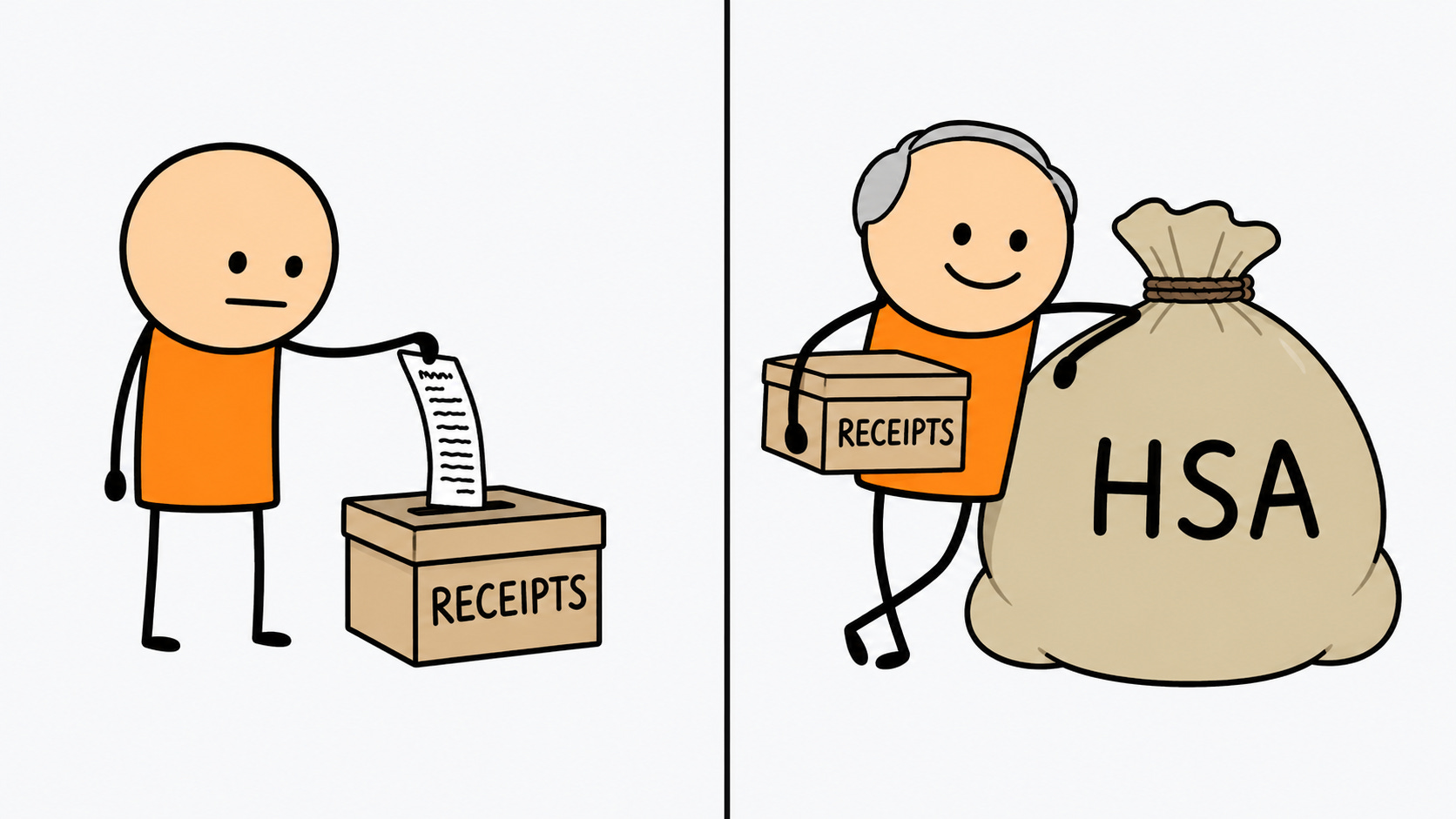
The default HSA workflow assumes a synchronous transaction. The medical bill arrives, the account holder uses the HSA debit card, the transaction posts to the account, and the matter closes. Most HSA platforms are designed around this rhythm. The card, the deposit slip, the running balance, and the year-end statement all reinforce the idea that the HSA is where current medical expenses get paid from.
The IRS rules do not require any of that.
The system actually permits a fundamentally different approach. The account holder can pay medical expenses out of pocket today, let the HSA balance keep growing, and reimburse those expenses from the HSA years or decades later. The reimbursement timing is up to the account holder. The custodian platform doesn’t say much about it, because there isn’t a fee structure or product to sell around patience.
That gap between what the system permits and what the platform promotes is where most of the long-term HSA growth opportunity lives.
The reimbursement rule is found in IRS Publication 969. A qualified medical expense can be reimbursed from the HSA at any point in the future, with three conditions.
The expense must have been incurred after the HSA was established. An expense paid before the HSA existed cannot be reimbursed tax-free from that HSA. The exact establishment date can depend on the account and custodian mechanics, which is why the account-opening date matters.
The expense must not have been reimbursed from another source. Insurance, FSA, employer reimbursement, or any other payment of the same expense disqualifies it from HSA reimbursement.
The account holder must retain documentation. That means the receipt or EOB showing the expense was incurred, plus proof that no other source paid for it. The IRS imposes no deadline on this documentation requirement. If the account holder reimburses thirty years after the expense, the documentation must still be available thirty years later.
The reporting happens on Form 8889 in the year of the reimbursement. The account holder reports the total HSA distribution for the year and identifies how much was used for qualified medical expenses. The IRS does not see the actual receipts unless the return is audited. The receipts are the account holder’s burden to maintain.
What happens if the account holder never reimburses. The contributions still received their tax deduction at the time of contribution. The balance grows tax-free for as long as it remains in the account. The flexibility to reimburse is a privilege the account holder may choose to use or not use.
What happens if the account holder withdraws without a qualified expense to back it up. Before age 65, the distribution is subject to ordinary income tax plus a twenty percent additional tax. After age 65, the distribution is subject to ordinary income tax only.
The reimbursement deadline question is the most common misconception. There is no calendar-year deadline. There is no tax-filing deadline. There is no IRS-imposed correction window. The reimbursement timing is genuinely open-ended in life.
The HSA loses some flexibility at death. A spouse who inherits the HSA gets to treat it as their own HSA and preserves the account's tax status, including the ability to use any previously-saved receipts. A non-spouse beneficiary generally has the HSA stop being an HSA at death, and the fair market value becomes taxable income in the year of death. That taxable amount can be reduced by qualified medical expenses of the deceased account holder that the beneficiary pays within one year after death. Receipts the deceased already paid out of pocket cannot be used by the beneficiary to offset the tax. The shoebox of previously-paid receipts effectively dies with the account holder for any non-spouse beneficiary
Consider a worker who incurs roughly four thousand dollars in medical expenses each year from age thirty-five through age sixty-five. The worker has an HSA opened at age thirty and pays each medical expense out of pocket from a checking account, saving every receipt and EOB.
Over thirty years, the cumulative out-of-pocket medical spend is approximately one hundred twenty thousand dollars. The worker has paper or digital documentation for all of it, none of which has been reimbursed by the HSA.
Meanwhile, the HSA receives contributions and the balance is invested. The growing balance is never touched. In a simplified illustration using steady contributions, no withdrawals, no fees, and assumed growth, the HSA balance grows to roughly five hundred fifty thousand dollars by age sixty-five. At that point, the worker has a documented one hundred twenty thousand dollars of qualified medical expense reimbursement capacity sitting against the HSA balance.
The worker can now withdraw one hundred twenty thousand dollars from the HSA, tax-free, and apply it against the documented receipts. The remaining four hundred thirty thousand dollars stays in the HSA, continuing to grow tax-free, available for future qualified medical expenses or available with ordinary income tax treatment for any other purpose.
The reimbursement happened thirty years after some of the expenses occurred. The IRS rules permit this entirely. The only requirement was that the receipts were saved.
The reimbursement timing strategy is rarely promoted because it requires three things most people don’t enjoy doing. It requires paying medical expenses with after-tax dollars when the HSA card sits in the wallet. It requires keeping receipts and EOBs for years, possibly decades. It requires waiting for the math to work.
What matters is that the strategy exists and that the rules support it. The IRS does not impose a reimbursement deadline. The HSA balance is genuinely free to grow as long as the account holder is willing to pay current medical expenses from another source and maintain documentation.
The friction is real. Receipts get lost, EOBs go missing, and most people give up the strategy within a year or two. The account holders who do maintain the discipline tend to find that the HSA becomes the most efficient retirement account they own, because every dollar of qualified medical expense documentation stored is a dollar of future tax-free withdrawal capacity.
The reimbursement timing rule is a feature of the system. The fact that custodian platforms don’t surface it reflects what custodians sell, which is transactional convenience.
I write one of these every day, one retirement rule, explained in plain language and verified against the source. The daily email is free: subscribe here.
Full archive, worksheets, and search live at RetirementNewsRundown.com.
Disclaimer
This article is for educational and informational purposes only. It is not tax, legal, or financial advice and does not create an advisor–client relationship. Always consult appropriate professionals regarding your specific situation.