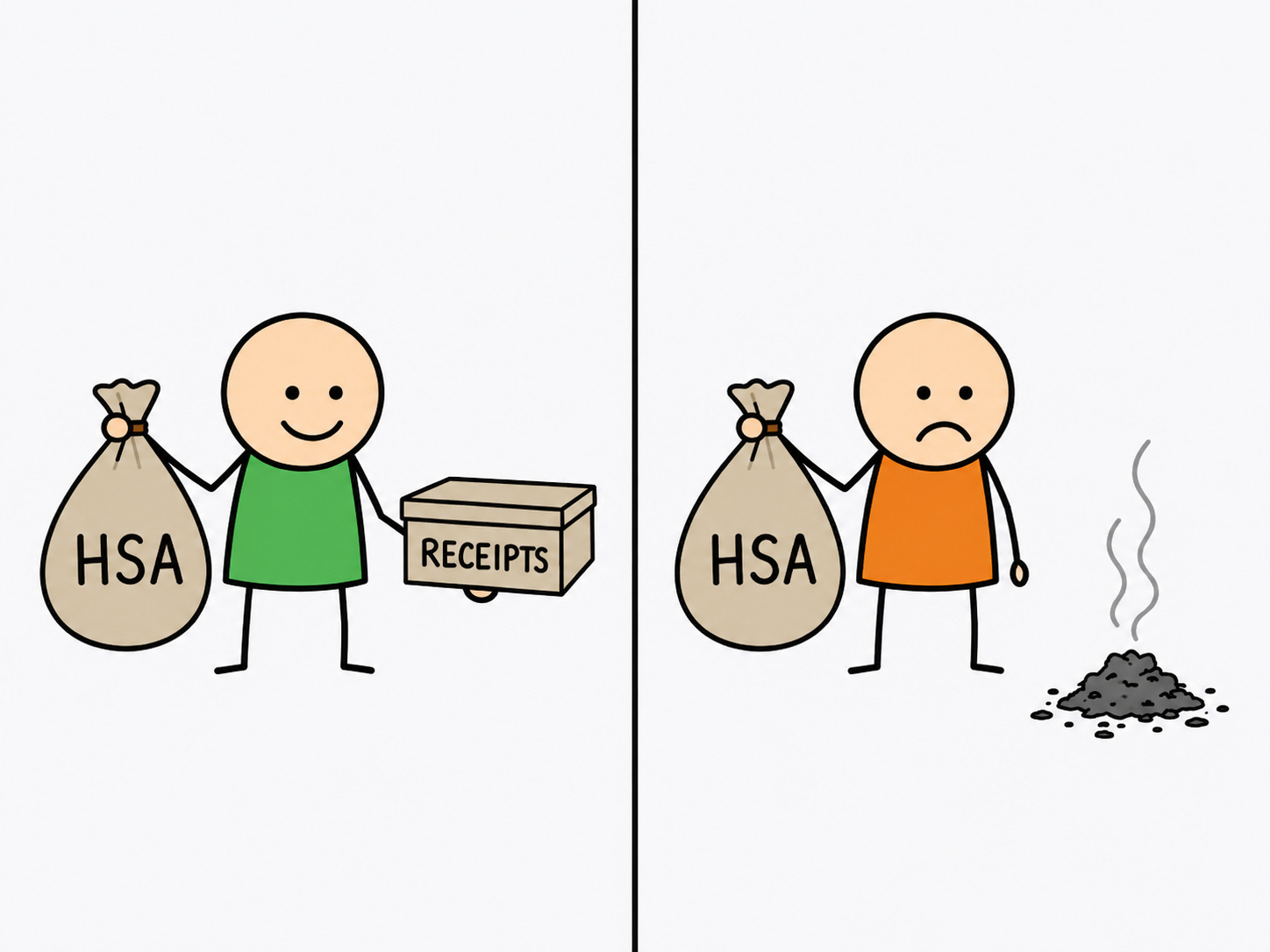
The HSA system positions itself as a long-term retirement asset. Contributors are told to invest the balance, save the receipts, let the account grow, and reimburse decades later. The math of the strategy works for the account holder during their lifetime. The strategy continuation is most favorable for a surviving spouse who inherits the account. The math falls apart for any other beneficiary.
The fine print sits in the inheritance rules, which determine what happens to the HSA balance and the accumulated shoebox of saved receipts when the account holder dies. The rules treat spouses entirely differently from any other beneficiary, and the difference between those two outcomes can be the entire tax benefit of the account.
Most contributors building a long-term HSA strategy never read the inheritance rules until estate planning forces the issue. By then, the strategy has often been running for decades, and any restructuring requires recovering tax benefits that may already be unrecoverable.
The HSA inheritance rules are explained in IRS Publication 969. The treatment depends entirely on who inherits.
For a spouse beneficiary, the HSA is treated as the surviving spouse’s own HSA. The account retains HSA status, which is the most favorable beneficiary outcome. A surviving spouse may be able to continue using the account under the normal HSA reimbursement rules, including for qualified medical expenses tied to the couple’s documented medical history, but unreimbursed lifetime receipts should be reviewed before assuming every old receipt remains usable.
For a non-spouse beneficiary, the HSA stops being an HSA on the date of death. The fair market value becomes taxable income to the beneficiary in the year of death. The taxable amount can be reduced only by qualified medical expenses of the deceased account holder that the beneficiary pays within one year after death. The deceased account holder’s accumulated bank of already-paid, unreimbursed receipts does not transfer.
For an estate as beneficiary, the HSA balance is included in the deceased’s final income tax return as ordinary income. This is a different mechanic than the non-spouse beneficiary rule and generally produces a worse outcome because there is no one-year offset opportunity. If no beneficiary is designated on the account, the default treatment is usually the estate.
What happens if the account holder dies before reimbursing the shoebox. The accumulated receipts lose their reimbursement value at the moment of death for non-spouse beneficiaries. The spouse beneficiary inherits HSA status and may continue using the account under normal HSA rules. For any other heir, the receipts cannot be used to offset the inheritance tax.
What happens if the account holder reimburses the shoebox before death. The tax-free withdrawal happens during the account holder’s lifetime, and the cash sits in another account or gets spent. The HSA balance reduces by the amount withdrawn, which reduces the inheritance tax exposure for the non-spouse beneficiary.
This is the basis for the deathbed drawdown strategy. When an account holder with significant HSA assets and a non-spouse beneficiary is approaching end of life, the strategy reimburses the full accumulated receipt total before death, converting tax-free withdrawal capacity into cash before the beneficiary loses that capacity.
The deadlines worth keeping straight. There is no calendar-year deadline for HSA reimbursement during the account holder’s lifetime. There is no tax-filing deadline for the deceased’s lifetime reimbursements. The one-year window after death for the non-spouse beneficiary is calculated from the date of death, not from a tax filing date. That window cannot be extended.
Consider two scenarios involving the same account holder, a worker who has run the HSA shoebox strategy for thirty years and accumulated one hundred twenty thousand dollars of documented qualified medical expense receipts, with an HSA balance grown to five hundred fifty thousand dollars.
In the first scenario, the account holder dies at age sixty-four with a surviving spouse. The spouse inherits the HSA as their own. The five hundred fifty thousand dollars retains HSA status, and the spouse can continue using the account under normal HSA reimbursement rules.
In the second scenario, the account holder is single and dies at age sixty-four. The named beneficiary is an adult child. The HSA stops being an HSA on the date of death. The five hundred fifty thousand dollars becomes ordinary income to the child in the year of death. The one hundred twenty thousand dollars of accumulated shoebox capacity cannot be used by the child to offset the inheritance. If the child has no qualified medical expenses of the deceased to pay within one year of death, the full balance is taxable.
The difference between the two scenarios is roughly one hundred to two hundred thousand dollars in tax depending on the heir’s bracket. The same financial life produced completely different outcomes based solely on who inherited.
The HSA shoebox strategy is most favorable for married couples with a surviving spouse, because spousal inheritance preserves HSA status. For single account holders without a spouse beneficiary, the inheritance outcome is materially less efficient, and the gap is meaningful enough to factor into estate planning.
What matters is awareness of the inheritance treatment before the strategy has been running for decades. A single account holder with a long HSA shoebox accumulating receipts should know that the receipts have no inheritance value beyond their own lifetime. A married couple has a different math, with the surviving spouse inheriting the account under HSA rules.
The estate planning options exist. Naming a charitable beneficiary avoids the income tax hit. The deathbed drawdown converts shoebox capacity into cash before death. Beneficiary designations can be revisited as life circumstances change.
The shoebox strategy works during the account holder’s lifetime. For couples, spousal inheritance extends the favorable HSA status to the surviving spouse. For single account holders, the strategy has a sunset date that the rules impose on the account holder.
I write one of these every day, one retirement rule, explained in plain language and verified against the source. The daily email is free: subscribe here.
Full archive, worksheets, and search live at RetirementNewsRundown.com.
Disclaimer
This article is for educational and informational purposes only. It is not tax, legal, or financial advice and does not create an advisor–client relationship. Always consult appropriate professionals regarding your specific situation.