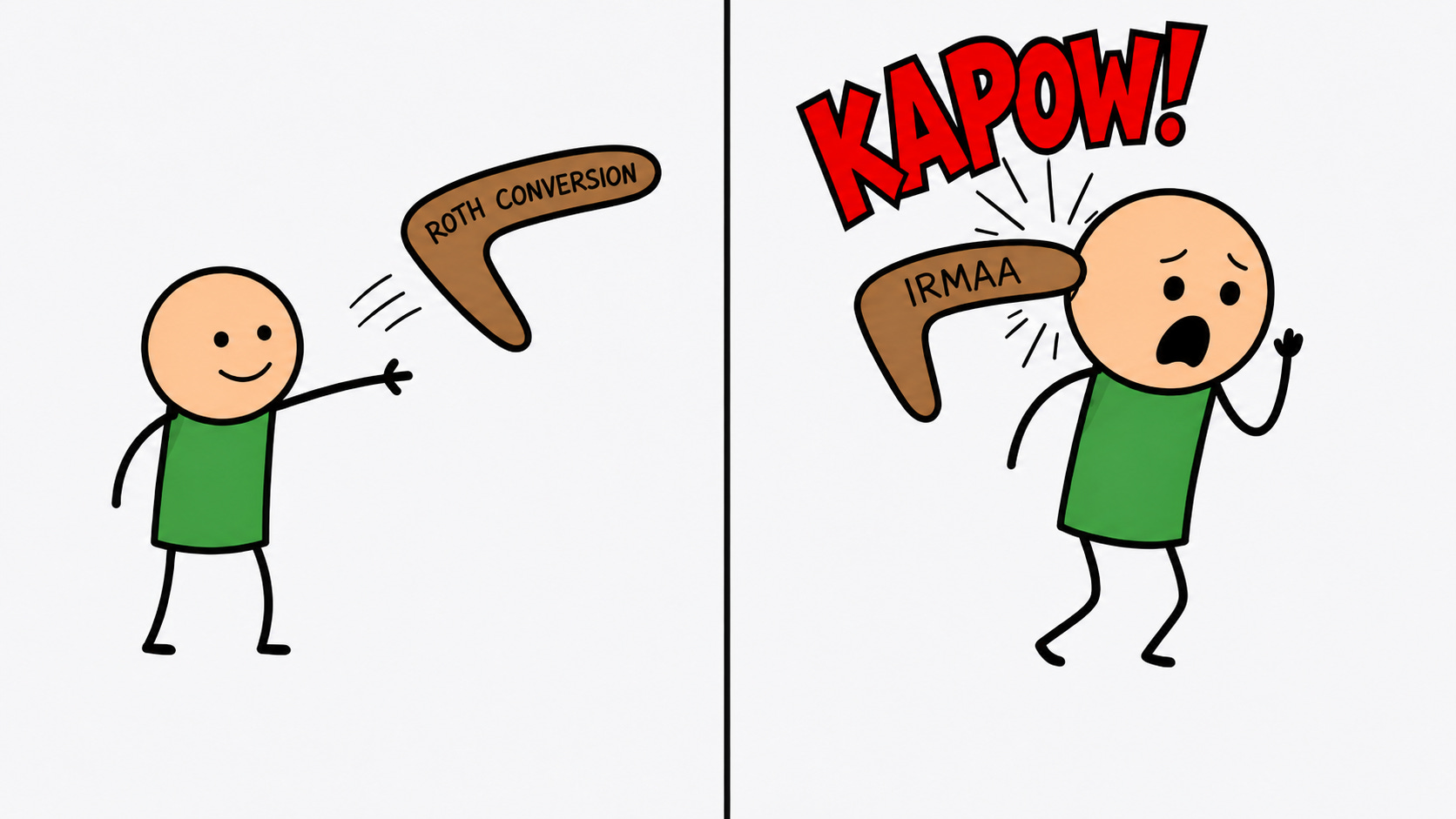
Medicare Part B and Part D premiums are means-tested. The Social Security Administration looks at the Medicare beneficiary’s income from two years prior and assigns a premium based on tiered income brackets. Beneficiaries with higher incomes pay more for the same coverage, often substantially more, and the increase shows up automatically without any opportunity to negotiate at enrollment.
The mechanism is called IRMAA, the Income-Related Monthly Adjustment Amount. It surprises new Medicare enrollees who assumed the standard premium they read about in the enrollment materials was what they would pay. It surprises retirees who did a Roth conversion two years before going on Medicare and discover the surcharge tied to that conversion year. It surprises everyone who learns that municipal bond interest, which is exempt from federal income tax, counts in full for IRMAA purposes.
The IRMAA system is designed to look invisible until it shows up on a Social Security statement. Then it becomes the most visible piece of the Medicare premium structure.
IRMAA applies to Medicare Part B and Part D premiums. It is a surcharge added to the standard premium based on the beneficiary’s Modified Adjusted Gross Income, calculated by SSA using the tax return filed two years prior to the premium year.
MAGI for IRMAA purposes is Adjusted Gross Income plus tax-exempt interest. That tax-exempt interest line catches people because municipal bond income, which produces zero federal income tax, still counts in full for the IRMAA calculation. The total of AGI plus tax-exempt interest is what gets measured against the IRMAA tier thresholds.
The two-year lookback is the most consequential mechanic. The premium for the current Medicare year is based on the tax return for the year that ended two calendar years earlier. A beneficiary turning sixty-five this year pays a premium based on a tax return filed for income earned two years before. A Roth conversion done in a given year shows up in IRMAA two years later. The decisions that affect today’s premium happened two years ago.
The tier structure is built as cliff thresholds, not phase-ins. The beneficiary either is or is not above a threshold. Cross the threshold by a single dollar and the IRMAA surcharge jumps to the next tier for the entire year, applied monthly to both the Part B and Part D premiums. The brackets are adjusted annually for inflation, though the exact dollar boundaries change each year.
Part B IRMAA is billed through Social Security, either deducted from benefits or billed directly. Beneficiaries pay Part D IRMAA to Medicare. The Part D plan premium continues to be paid to the plan provider. The two invoices arrive separately, which is why beneficiaries sometimes miss the Part D IRMAA charge.
For a married couple where both spouses are enrolled in Medicare, the IRMAA calculation applies separately to each spouse based on the joint return income. The result is that both spouses pay IRMAA, and the household total is doubled compared to a single beneficiary at the same income level.
What happens if income changes after the lookback year. The current Medicare year’s premium remains based on the two-year-prior return. Ordinary income changes after the lookback year do not automatically retroactively adjust the current year’s premium. A qualifying life-changing event may allow the beneficiary to request a new determination using Form SSA-44 or a standard appeal path. Income changes will affect the premium two years from now, when SSA looks at the return for the current year.
What happens if the beneficiary believes the IRMAA assignment is wrong. Two paths exist. The first is the life-changing event appeal using Form SSA-44, which applies when a qualifying event has reduced income since the lookback year. The second is a standard appeal of the SSA determination. Both paths exist outside the regular tax filing cycle and can be initiated at any time after the IRMAA notice arrives.
Consider a married couple, both age sixty-five and both newly enrolled in Medicare. Two years before their Medicare enrollment year, the couple sold a small business and recognized a one-time capital gain that pushed their joint MAGI well into the upper IRMAA tiers.
That two-year-old tax return is what SSA uses to set their current year’s Medicare premiums. Both spouses are assigned the higher IRMAA tier. Both pay an additional monthly surcharge on Part B and an additional monthly surcharge on Part D, for twelve months.
Across both spouses and both program parts, the IRMAA impact for that single year could exceed ten thousand dollars compared to the standard premium, even though their current year income may have returned to a normal retirement-level cash flow.
In a later premium year, SSA generally pulls the next available tax return. If that return reflects the post-business-sale income level, the IRMAA tier can reset based on the new income. The cliff structure means that even returning just below a tier threshold drops the IRMAA assignment to the lower bracket. The one-time event affected one year of premiums. The recalculation is automatic.
The IRMAA system rewards planning that accounts for the two-year lookback and punishes financial decisions made without that lookback in mind. The brackets are knowable, the lookback is predictable, and the appeal paths exist for genuinely changed circumstances.
What matters is awareness that a high-income year carries a delayed Medicare cost. A Roth conversion done in the year before Medicare enrollment can produce surcharges in the enrollment year and the year after. A business sale, a deferred compensation payout, an inherited IRA distribution, or any other one-time income event that pushes MAGI above a tier threshold creates the same delayed bill. The income event happens once. The IRMAA surcharge applies to one specific year of premiums, two years later.
The municipal bond interest detail is worth absorbing. Beneficiaries who hold significant municipal bond positions often discover that the IRMAA calculation captures the full interest income, even though no federal income tax was owed on it. The tax-free status of municipal interest does not extend to the IRMAA MAGI calculation.
The system is rule-based and predictable. The brackets are published annually. The two-year lookback is mechanical. The appeals path exists. The surprise of a first IRMAA notice usually says more about retirement planning than about the IRS.
I write one of these every day, one retirement rule, explained in plain language and verified against the source. The daily email is free: subscribe here.
Full archive, worksheets, and search live at RetirementNewsRundown.com.
Disclaimer
This article is for educational and informational purposes only. It is not tax, legal, or financial advice and does not create an advisor–client relationship. Always consult appropriate professionals regarding your specific situation.