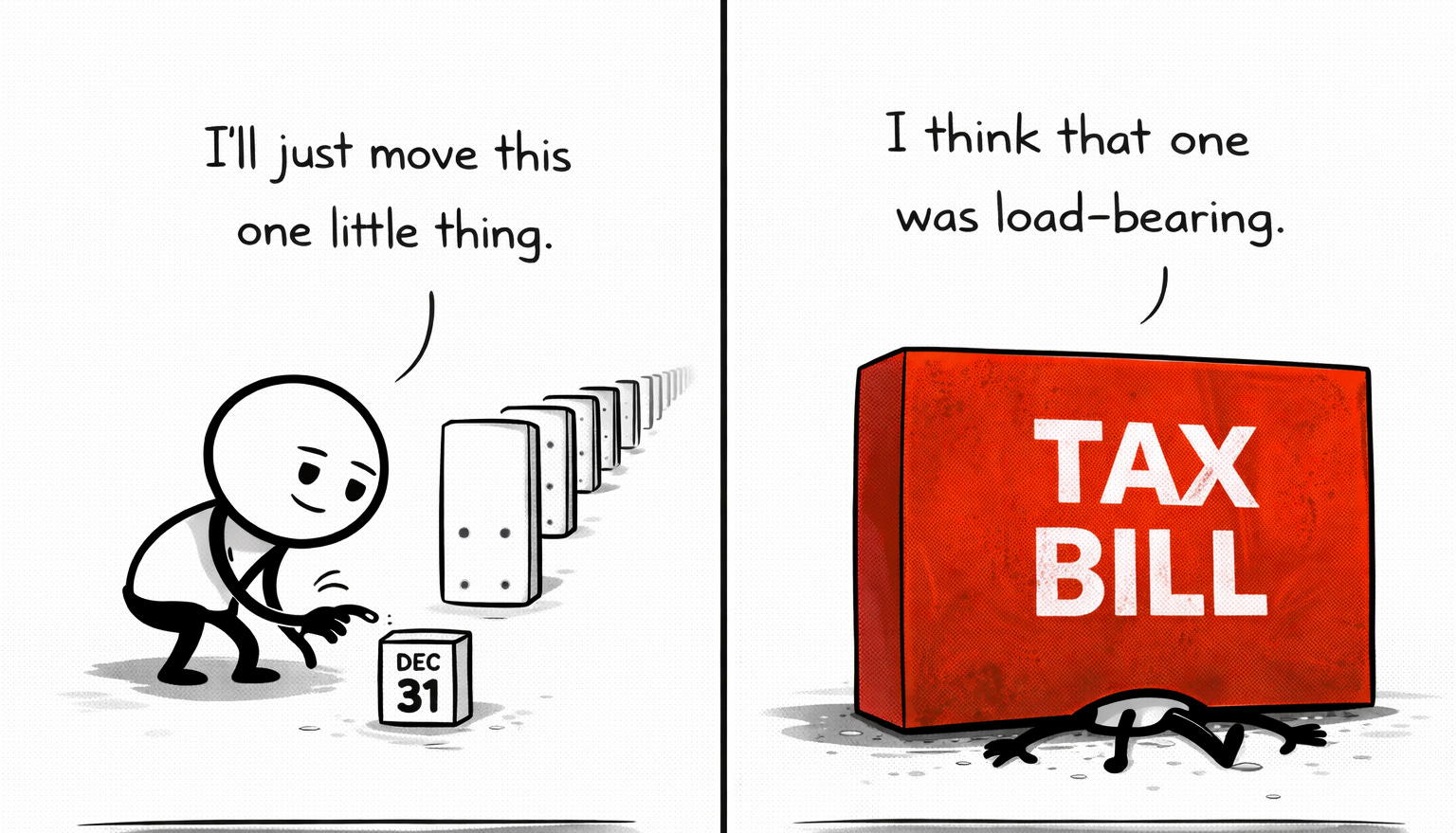
People love to point to the moment everything “went wrong.”
It’s the Roth conversion that triggered the tax bill. The rollover that somehow became taxable. The missed distribution that turned into a penalty. In hindsight, it always looks like a single bad move, one click or one delay that blew everything up.
That framing is comforting. If one move caused the problem, then avoiding that move next time must be the solution.
It’s also usually incorrect.
Retirement outcomes are almost never determined by a single action. They are determined by how multiple actions interact over time, especially when the system waits until the end to judge the result.
The retirement system does not score transactions as they happen. It scores them in context.
Calendar year deadlines are where that context becomes fixed. December 31 is when eligibility, balances, and classifications are frozen for review. Until then, many actions exist in a kind of limbo where nothing appears final.
Tax filing deadlines come later. They allow reporting and some corrections, but they do not reopen the year. Filing tells the system what happened. It does not change what happened.
Correction windows sit in between. Some issues created by timing or sequencing can be fixed after the year ends without lasting penalties. Once those windows close, the outcome is locked.
If something is done later instead, the system does not isolate that action. It evaluates how it interacts with everything else that happened during the measurement period.
That is why outcomes feel bigger than the move that gets blamed.
Roth conversions are a perfect example.
People often treat a conversion as a standalone decision. Assets move. Taxes may be withheld. The transaction posts cleanly. It feels self contained.
The tax outcome is not determined on conversion day.
It is determined at year end, based on what IRA balances remained on December 31. Traditional, SEP, and SIMPLE IRAs are all part of that snapshot.
If other IRA balances remained at year end, the conversion becomes taxable based on that total. If those balances were moved out before December 31, even if they were substantial earlier in the year, the pro rata rule does not apply.
If cleanup happens later instead, after the year closes, the conversion outcome does not change. The system already captured the full picture.
The conversion was not the problem. The timing of the surrounding moves was.
Roth IRA contributions tell a similar story.
A contribution made early in the year looks harmless. Eligibility seems likely. The account accepts the deposit. Nothing signals trouble.
Income eligibility is not confirmed until the calendar year closes. That means the contribution remains provisional until December 31.
If income ends up within limits, the contribution stands. If income ends up too high, the contribution becomes excess retroactively.
If the excess is corrected by the tax filing deadline or extension, the issue can often be resolved cleanly. If it is done later instead, after the correction window closes, penalties accrue for each year the excess remains.
The outcome was not about the contribution itself. It was about the interaction between income, timing, and correction.
Rollovers often get blamed unfairly.
A distribution taken with rollover intent feels like one move. The money leaves. The plan is to redeposit it. Life intervenes.
The system starts the clock when the distribution occurs, not when the plan is formed.
If the funds land in another eligible retirement account within the rollover window, the transaction qualifies. If they do not, the entire distribution is reclassified as taxable.
If the deposit happens later instead, even slightly later, the classification does not soften. Taxes and potential penalties apply based on the original distribution date.
The problem was not the rollover. It was the sequence and timing of steps around it.
Required minimum distributions are another place where outcomes look sudden but are not.
An RMD applies to a specific calendar year. There is no enforcement during the year. Accounts function normally whether the distribution happens or not.
At the end of the year, the system checks whether the required amount left the account.
If it did not, the RMD is officially missed. Taking it in January does not convert it into an acceptable late distribution. It becomes a missed RMD followed by a corrective one.
If the correction process is handled properly, penalties may be reduced or waived. If it is done later instead or ignored, penalties apply based on the year that already closed.
The penalty was not caused by one forgotten withdrawal. It was caused by time passing without the required sequence being completed.
This is why focusing on individual moves often leads people astray.
The retirement system cares less about what you did and more about when you did it relative to everything else. Actions that are harmless in isolation can become expensive when paired with the wrong timing or when left unfinished.
Calendar year deadlines determine when the system takes its snapshot. Tax filing deadlines determine how that snapshot is reported. Correction windows determine whether missteps in the sequence can be repaired.
If something is done later instead, it does not get evaluated alone. It gets evaluated as part of the full timeline.
Understanding this removes a lot of unnecessary anxiety. It explains why outcomes feel disproportionate to the move that gets blamed. It explains why fixing one thing does not always fix the result.
Most retirement surprises are not caused by a single bad decision. They are caused by incomplete sequences and missed timing around otherwise reasonable actions.
Once you see outcomes as the result of patterns instead of moments, the system starts to make sense.
And when the system makes sense, it becomes much easier to understand where you stand.
I write one of these every day, one retirement rule, explained in plain language and verified against the source. The daily email is free: subscribe here.
Disclaimer
This article is for educational and informational purposes only. It is not tax, legal, or financial advice and does not create an advisor–client relationship. Always consult appropriate professionals regarding your specific situation.