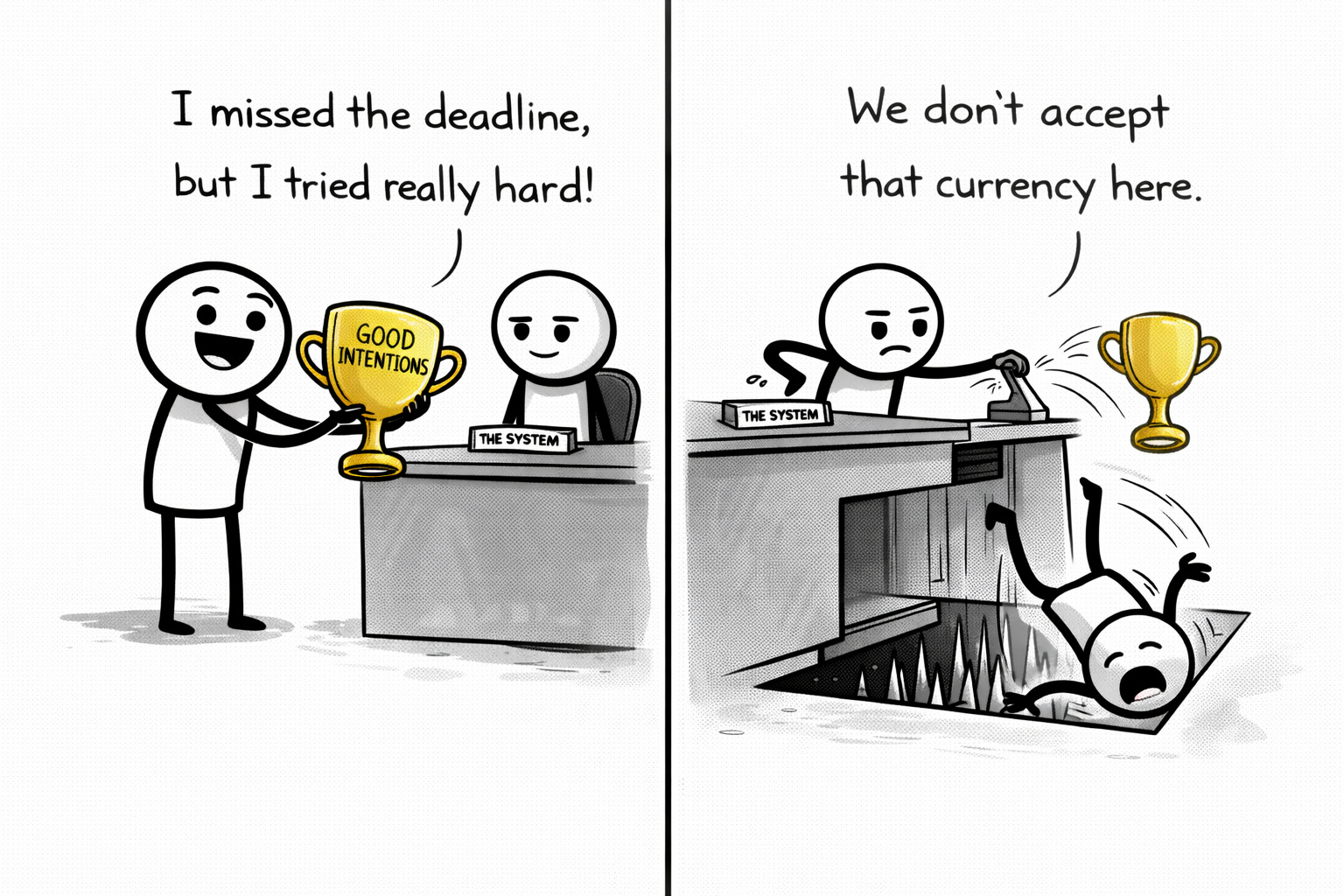
Most retirement frustration starts with the same thought.
“I did the responsible thing.”
People contribute when they can. They wait when things feel uncertain. They avoid rushing decisions. They try not to overcomplicate things. From a human perspective, these are all reasonable instincts.
From the system’s perspective, they are irrelevant.
The retirement system does not reward good intentions, patience, or effort. It rewards timing, sequence, and completion. When outcomes feel unfair, it is usually because the system applied its rules exactly as written, not as imagined.
The system is built to evaluate behavior at specific checkpoints, not to judge whether someone was being careful.
Calendar year deadlines are the most powerful of those checkpoints. December 31 is when eligibility is locked in, balances are frozen for review, and certain opportunities either qualify or disappear. Until that date passes, many actions feel open ended.
Tax filing deadlines come later. They exist to report and sometimes correct what already happened. Filing does not change eligibility or outcomes that were locked in when the calendar year closed.
Correction windows exist for specific issues. They allow certain mistakes to be fixed after the year ends without permanent penalties. Once those windows close, the system stops negotiating.
If something is done later instead, the system does not reassess intent. It applies the rule that matches the timing.
That is what it rewards.
Roth IRA contributions are one of the clearest examples.
Someone contributes early in the year because it feels proactive. Income is uncertain, but waiting feels unnecessary. The account accepts the contribution. Nothing appears wrong.
Income eligibility is not confirmed until the calendar year ends. That means the contribution exists in a provisional state until December 31.
If income ends up within limits, the contribution stands. If income ends up too high, the contribution becomes excess retroactively.
If the excess is corrected by the tax filing deadline or extension, the issue can often be resolved cleanly. If it is done later instead, after the correction window closes, penalties accrue for each year the excess remains.
The system rewards knowing when eligibility is measured, not when the money moved.
Roth conversions reward sequence even more bluntly.
A conversion can happen at any point during the year. The transaction posts cleanly. Taxes may even be withheld. It feels decisive.
The tax result is not decided on conversion day.
It is decided at year end, based on what traditional, SEP, and SIMPLE IRA balances remained on December 31.
If other IRA balances remained on that date, the conversion becomes taxable based on that year end total. If those balances were moved out before December 31, even if they were large earlier in the year, the pro rata rule does not apply.
If cleanup happens later instead, after the year closes, the conversion outcome does not change. The system already took its snapshot.
The system rewards finishing the sequence before the checkpoint, not effort during the year.
Required minimum distributions reward completion, not intention.
An RMD applies to a specific calendar year. There is no enforcement during the year. Accounts operate normally whether the distribution happens or not.
At the end of the year, the system checks whether the required amount left the account.
If it did, the requirement is satisfied. If it did not, the RMD is officially missed.
Taking the distribution in January does not convert it into a late but acceptable RMD. It becomes a missed RMD followed by a corrective distribution.
If the correction process is handled properly, penalties may be reduced or waived. If it is done later instead or ignored, penalties apply based on the year that already closed.
The system rewards completion by December 31, not plans to act.
Rollovers reward precision, not convenience.
A distribution taken with rollover intent is allowed to leave the account without friction. The system does not pause the transaction to confirm future behavior. It records the distribution date and starts the clock.
If the funds land in another eligible retirement account within the rollover window, the transaction qualifies. If they do not, the entire distribution is reclassified as taxable.
If the deposit happens later instead, even by a small margin, the classification does not soften. Taxes and potential penalties apply based on the original distribution date.
The system rewards hitting the window, not meaning to.
This is why the system often feels unfair.
People assume fairness means recognizing effort, caution, or good faith. The system defines fairness as applying the same timing rules to everyone, regardless of circumstance.
It does not care whether a delay was reasonable. It cares whether a deadline passed.
Calendar year deadlines determine when facts are locked in. Tax filing deadlines determine how those facts are reported. Correction windows determine whether mistakes can be undone without permanent cost.
If something is done later instead, the system does not weigh how close you were. It applies the rule for being late.
Understanding this removes a lot of unnecessary frustration. It reframes outcomes as mechanical rather than punitive.
The system is not trying to teach lessons. It is not trying to be harsh. It is trying to be consistent.
Once you see what it rewards, outcomes stop feeling random. They start feeling predictable.
And predictability, even when it feels strict, is far easier to live with than surprise.
I write one of these every day, one retirement rule, explained in plain language and verified against the source. The daily email is free: subscribe here.
Disclaimer
This article is for educational and informational purposes only. It is not tax, legal, or financial advice and does not create an advisor–client relationship. Always consult appropriate professionals regarding your specific situation.