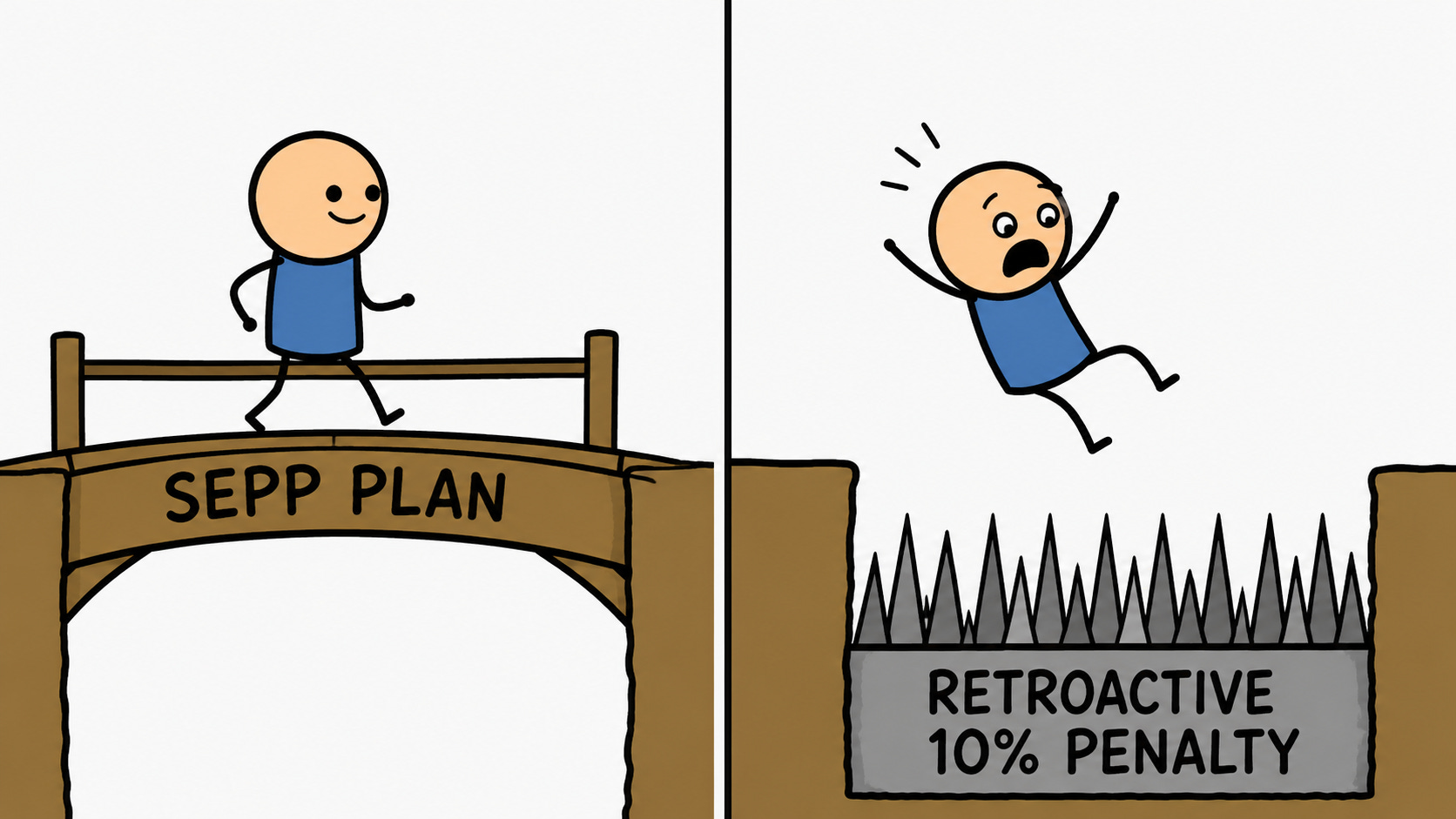
A worker considering early retirement before age fifty-nine and a half discovers that traditional IRA and 401k accounts have a wall built into them. Distributions taken before fifty-nine and a half are subject to a ten percent additional tax on top of the ordinary income tax already owed on the distribution. The penalty applies even when the account holder genuinely needs the money to live on. The system treats pre-fifty-nine-and-a-half withdrawals as premature regardless of the account holder’s actual retirement status.
Section 72(t) of the Internal Revenue Code carves out a specific exception. A series of substantially equal periodic payments, calculated using one of three IRS-approved methods and continued for a fixed period, escapes the ten percent penalty entirely. The strategy is called SEPP, and it was designed for exactly this situation. Early retirees who need IRA income, or employer-plan income after separation from service, before the standard penalty-free withdrawal age.
The plan looks straightforward on paper. Calculate a withdrawal amount, take it annually, stop worrying about the penalty. The reality is more complex, and the consequences of breaking the SEPP schedule are severe.
The SEPP exception applies to distributions from IRAs and from employer retirement plans where the account holder has separated from service. The account holder selects one of three IRS-approved calculation methods, calculates the annual SEPP amount based on the account balance and a life expectancy factor, and begins taking the distribution. The amount can be paid in one annual distribution or split across the year.
The three approved calculation methods. The required minimum distribution method uses an account balance divided by a life expectancy factor and recalculates annually. The fixed amortization method uses an amortization schedule with a chosen interest rate. The fixed annuitization method uses an annuity factor based on mortality tables and a chosen interest rate. The amortization and annuitization methods produce larger annual withdrawals than the RMD method, and both fix the dollar amount at inception. The RMD method recalculates annually based on the current account balance, so the dollar amount changes each year.
The interest rate used in amortization and annuitization calculations cannot exceed the greater of five percent or one hundred twenty percent of the federal mid-term applicable rate for either of the two months preceding the start of the SEPP. This rule was updated under IRS Notice 2022-6. The five percent floor allows for meaningful SEPP withdrawal amounts even when interest rates are low.
The SEPP must continue for the longer of five years from the first distribution or until the account holder reaches age fifty-nine and a half. A SEPP started at age forty-five must continue until age fifty-nine and a half, roughly fourteen years. A SEPP started at age fifty-eight must continue for five years, ending at age sixty-three.
What happens if the SEPP is modified before the required period ends. The ten percent early withdrawal penalty applies retroactively to every prior SEPP distribution, plus interest from the date each distribution was taken. A worker who took five years of SEPP distributions and modified the schedule in year six faces ten percent of the cumulative withdrawn amount, plus interest, in the modification year. The IRS calls this “busting” the SEPP, and it converts what looked like a clever strategy into the worst possible tax outcome.
Death and disability are the major statutory exceptions to the modification tax. Disability means the formal IRC disability standard, not simply being unable or unwilling to keep taking payments.
A one-time modification is permitted. The account holder may switch from the fixed amortization method or the fixed annuitization method to the required minimum distribution method without busting the SEPP. The switch can only happen once. This option allows account holders who started with a larger fixed payment to reduce the annual withdrawal if account performance declines. The reverse switch, from RMD method to a fixed method, is not permitted.
What is treated as a modification. Changing the SEPP account balance through additions, transfers, rollovers, extra withdrawals, or partial rollouts can be treated as a modification. Account-level rules require treating the SEPP account as locked for the duration of the schedule.
The deadlines worth keeping straight. The five-year clock runs from the first SEPP distribution, not from a calendar year boundary. The fifty-nine-and-a-half date is calculated from the account holder’s birthday. The longer-of-the-two rule applies to both deadlines. There is no correction window for a busted SEPP. The retroactive penalty plus interest applies once the modification occurs.
Consider a worker, age forty-eight, with an eight hundred thousand dollar traditional IRA. The worker retired early and needed roughly thirty thousand dollars annually from the IRA to cover expenses until other income sources became available. The worker chose the fixed amortization method, used an interest rate within the allowable range, and calculated an annual SEPP of approximately thirty-two thousand dollars.
The SEPP began and ran for six years. At age fifty-four, the worker received a one-time inheritance that eliminated the need for further IRA withdrawals. The worker stopped taking the SEPP distribution. That action was a modification before the required period ended.
The required period for this SEPP was the longer of five years or until age fifty-nine and a half. The fifty-nine-and-a-half date was the binding requirement. By stopping at age fifty-four, the worker modified the schedule before reaching the required end. The ten percent penalty applied to all six years of SEPP distributions, totaling roughly nineteen thousand dollars, plus interest from each distribution date.
A different approach would have been to switch from the fixed amortization method to the RMD method using the one-time election. That switch would have reduced the annual withdrawal to whatever the RMD calculation produced, without busting the SEPP. The worker could have taken the smaller RMD-method distribution for the remaining years, satisfying the SEPP requirement without needing the cash.
The SEPP exception is a real planning tool for early retirement, and it is the primary path to penalty-free IRA distributions before fifty-nine and a half for someone who has not separated from service after age fifty-five from an employer plan. The calculation methods are published, the interest rate framework is defined, and the duration is fixed at inception.
What matters is awareness that the SEPP is a multi-year commitment, not an annual choice. The account holder is locked into the schedule for the longer of five years or until fifty-nine and a half, and modifications outside the one-time RMD-method election trigger retroactive penalties. The strategy works when the account holder needs the SEPP income for the duration of the schedule and is not relying on flexibility to change course later.
The interest rate environment matters less than it once did because of the five percent floor. The choice between calculation methods determines the annual withdrawal size and the flexibility to switch later. Starting with a fixed method preserves the right to switch to the RMD method later. Starting with the RMD method forfeits the option to switch to a fixed method.
The penalty for breaking a SEPP is severe enough that the strategy should be confirmed against the actual cash flow need before starting. The IRS does not view the SEPP as a flexible income strategy. The IRS views it as a formal exception to the early withdrawal penalty, granted on the condition that the schedule runs to completion.
I write one of these every day, one retirement rule, explained in plain language and verified against the source. The daily email is free: subscribe here.
Full archive, worksheets, and search live at RetirementNewsRundown.com.
Disclaimer
This article is for educational and informational purposes only. It is not tax, legal, or financial advice and does not create an advisor–client relationship. Always consult appropriate professionals regarding your specific situation.