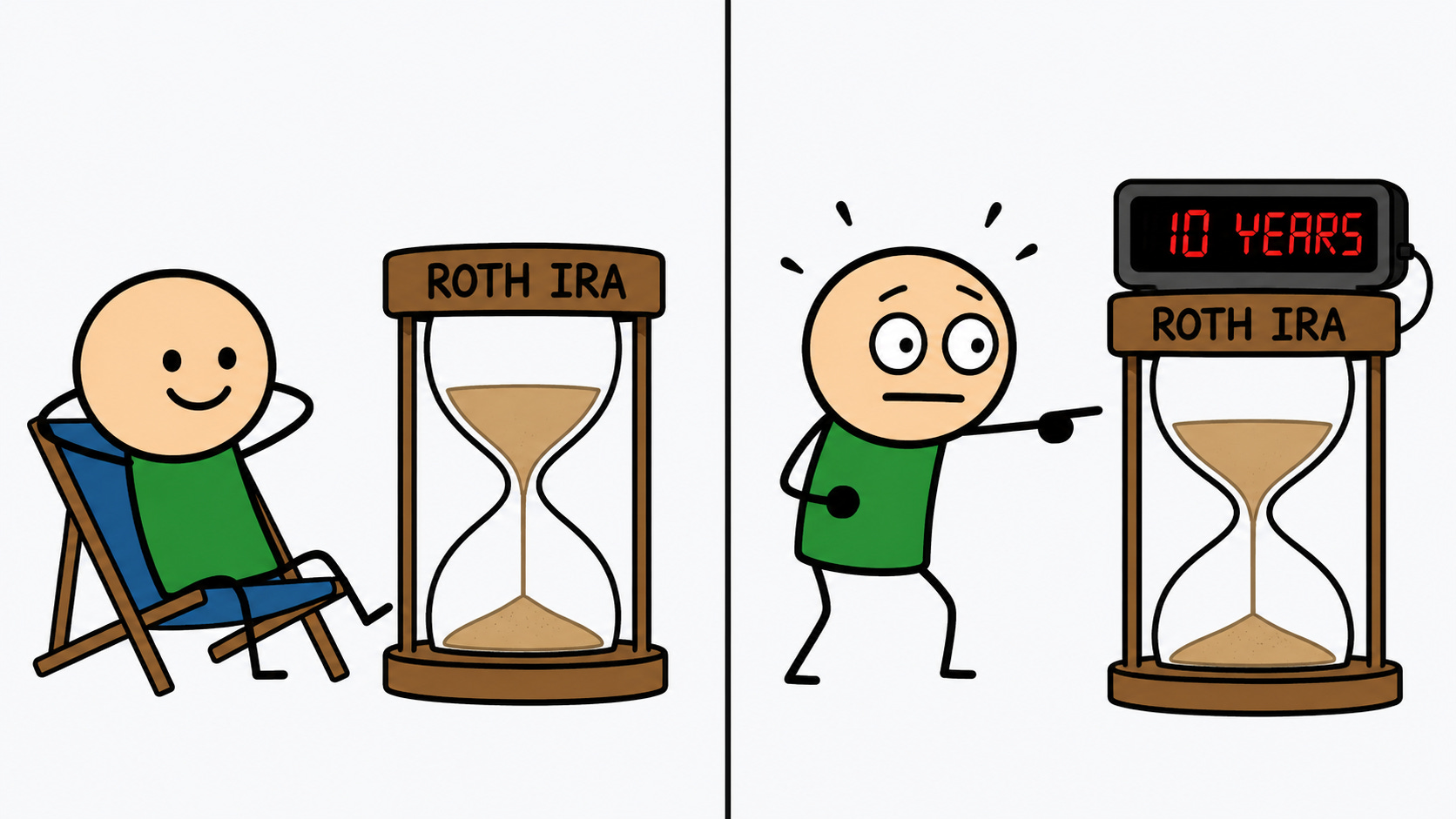
A common assumption is that inherited Roth IRAs are exempt from the SECURE Act’s ten-year rule because Roth distributions are already tax-free. The assumption is wrong. The ten-year rule applies to inherited Roth IRAs for deaths after the SECURE Act effective date, with the same eligible-designated-beneficiary carve-outs as traditional IRAs. The tax-free character of the distributions does not exempt the account from the distribution timing rule.
The confusion is understandable. The original Roth owner pays no lifetime required minimum distributions, the account grows tax-free, and qualified distributions to the original owner are tax-free. The expectation is that an inherited Roth would simply continue under the same tax-free treatment indefinitely. The SECURE Act changed the inheritance side of that picture.
The mechanic that catches non-spouse beneficiaries is the deadline itself. A Roth IRA inherited by an adult child is on a ten-year clock, even though the distributions taken to satisfy that clock are typically tax-free.
The ten-year rule applies to most non-spouse beneficiaries of Roth IRAs where the original owner died after the SECURE Act effective date. The full account balance must be distributed by the end of the calendar year containing the tenth anniversary of the original owner’s death.
The ten-year rule for inherited Roth’s has one important mechanical difference from the ten-year rule for inherited traditional IRAs. Because the original Roth owner had no required beginning date during their lifetime, the beneficiary is treated as inheriting from someone who died before their required beginning date. Current IRS guidance confirms that no annual RMDs are required during years one through nine. The beneficiary can take distributions on any schedule they choose, including a single distribution in year ten, as long as the account is fully emptied by the deadline.
Eligible designated beneficiaries get a different treatment. EDBs include the surviving spouse, a minor child of the decedent, a disabled individual, a chronically ill individual, and any other beneficiary who is not more than ten years younger than the decedent. Eligible designated beneficiaries may qualify for life-expectancy treatment instead of the standard immediate ten-year cleanout rule, though minor children of the decedent shift into a ten-year rule once they reach majority.
A surviving spouse has the strongest options. The spouse can generally treat the inherited Roth IRA as their own Roth IRA, preserving the no-lifetime-RMD treatment, or remain a beneficiary and use beneficiary rules. The choice depends on planning preferences and timing.
A minor child of the decedent gets the stretch using single life expectancy until they reach the age of majority, at which point the ten-year rule kicks in for the remaining balance.
For non-EDB beneficiaries, distributions during the ten-year period are tax-free assuming the original owner’s five-year holding period was satisfied. The original owner’s five-year clock carries over to the beneficiary. If the original owner had held the Roth for five or more years before death, all beneficiary distributions are qualified and tax-free. If less than five years, earnings may be taxable until the five-year mark is reached, calculated from the original owner’s account opening date.
What happens if the ten-year deadline is missed. The undistributed balance may be subject to the excise tax on missed required distributions, which is twenty-five percent of the missed amount under SECURE 2.0. The excise tax can be reduced to ten percent if corrected within the correction window, and waiver relief may be available for reasonable cause.
The deadlines worth keeping straight. The ten-year deadline is a calendar-year deadline, not a tax-filing deadline. The deadline is the last day of the calendar year containing the tenth anniversary of the death. The correction window for a missed final distribution generally runs through the end of the second taxable year following the year the distribution was due. The original owner’s five-year holding period clock continues running after death and is not reset by the inheritance.
Consider a retiree who died at age seventy-two with a four hundred thousand dollar Roth IRA. The Roth had been open for fifteen years, so the five-year holding period was clearly satisfied. The beneficiary was the deceased’s adult child, age forty-five, a non-EDB.
The ten-year rule applies. The child has until the end of the calendar year containing the tenth anniversary of the death to fully distribute the Roth. Because the original owner died before their required beginning date for distribution purposes, no annual RMDs are required during years one through nine. The child can take a single distribution at the end of year ten, take small distributions throughout the ten years, or any pattern in between. All distributions are tax-free because the five-year holding period was satisfied before the death.
The child chooses to leave the account untouched for nine years, letting it grow tax-free. In year ten, the child distributes the full balance, by then grown to roughly seven hundred thousand dollars after a decade of tax-free compounding. The full distribution is tax-free.
A different scenario uses the same facts, but the child forgets to take the year-ten distribution. The undistributed balance is subject to the twenty-five percent excise tax on the missed amount. If the child catches the error and takes the distribution within the correction window, the excise tax drops to ten percent. Even with the excise tax, the distribution itself remains tax-free because the underlying Roth qualification rules still apply.
The ten-year rule reaches inherited Roth IRAs the same way it reaches inherited traditional IRAs for non-EDB beneficiaries. The tax-free character of the distributions does not exempt the account from the timing rule. The two pieces of the puzzle are independent. Distribution timing is governed by SECURE Act and SECURE 2.0 rules. Tax treatment is governed by the Roth qualification rules.
For a non-EDB beneficiary of a Roth where the original owner satisfied the five-year holding period, the planning question is usually whether to leave the account untouched until year ten and take the full distribution then, capturing the maximum tax-free growth, or to take partial distributions earlier for other planning reasons. The only thing missing the year-ten deadline produces is the excise tax, not the loss of tax-free treatment.
For an EDB beneficiary, the stretch is still available, and the full multi-decade tax-free growth window remains. The beneficiary takes annual RMDs based on their own single life expectancy from the year following death.
For deaths before the SECURE Act effective date, the old stretch framework generally continues to apply. The ten-year rule does not retroactively reach those inherited accounts.
What matters is awareness that the ten-year rule applies to inherited Roth IRAs, that no annual RMDs are required during the ten years for Roth-specific reasons, and that the year-ten deadline is a hard calendar-year deadline carrying a substantial excise tax for misses.
I write one of these every day, one retirement rule, explained in plain language and verified against the source. The daily email is free: subscribe here.
Full archive, worksheets, and search live at RetirementNewsRundown.com.
Disclaimer
This article is for educational and informational purposes only. It is not tax, legal, or financial advice and does not create an advisor–client relationship. Always consult appropriate professionals regarding your specific situation.