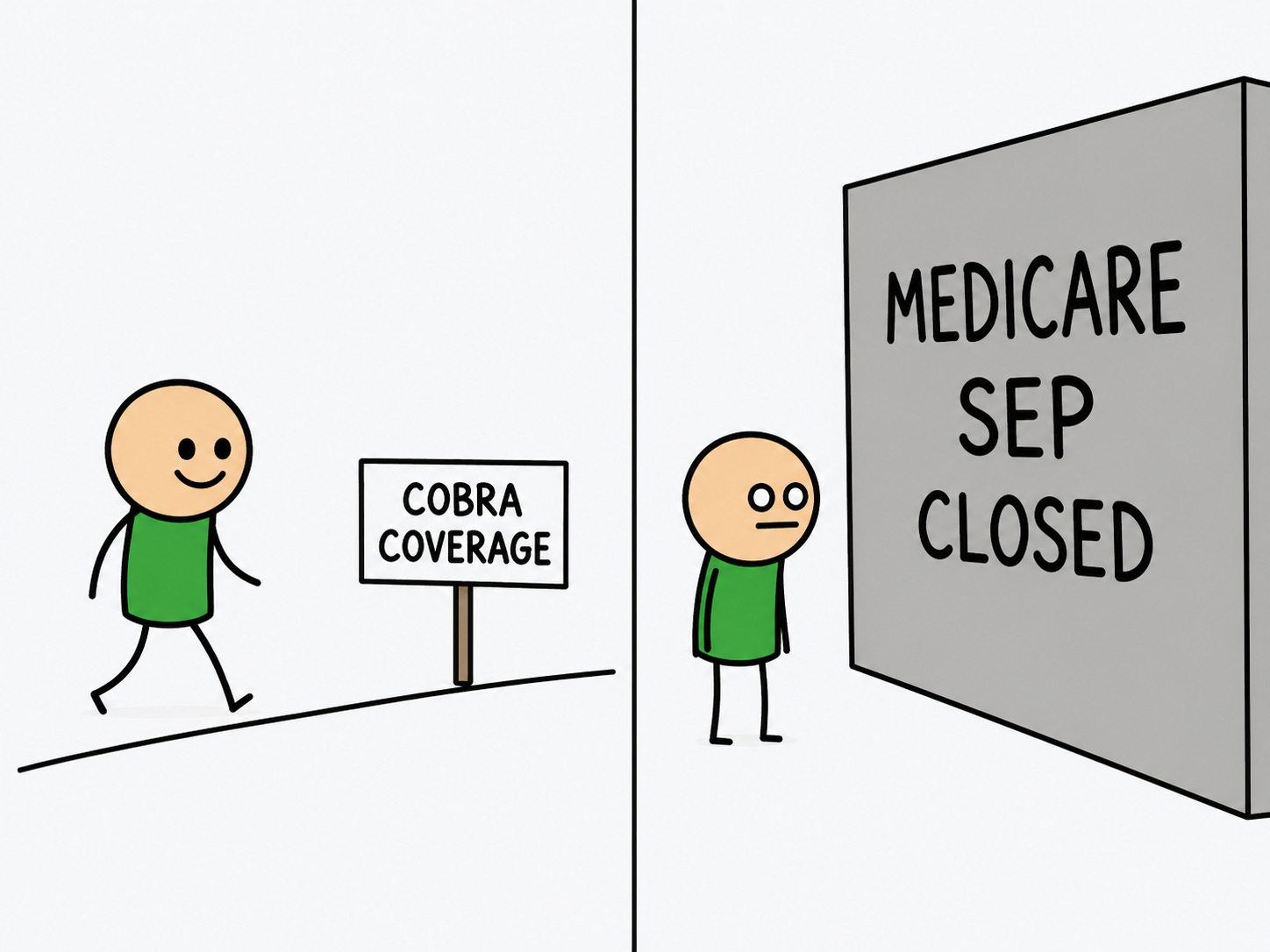
A worker past sixty-five who delayed Medicare Part B enrollment because they were covered under their employer’s health plan reaches the day employment ends. The assumption is that the transition to Medicare runs on its own timeline, that the worker can elect COBRA continuation coverage and sort out Medicare later, and that the system somehow knows employment ended. None of those assumptions are correct.
The Medicare system runs on a Special Enrollment Period that begins the month after employment ends or employer coverage ends, whichever comes first. The clock starts on a fixed date and runs for eight months. The worker is responsible for initiating enrollment, providing documentation, and completing the paperwork within that window. COBRA continuation coverage does not pause the SEP clock. The clock runs regardless of whether the worker has any other coverage during the transition.
The most expensive version of this mistake is the worker who elects COBRA, assumes the eighteen-month COBRA window protects them, and discovers near the end of COBRA that the Medicare SEP closed months earlier. The next available enrollment window is the General Enrollment Period the following January, the Part B late-enrollment penalty calculation starts running, and the coverage gap is uninsured for Medicare purposes.
The Part B Special Enrollment Period applies to workers who delayed Medicare Part B enrollment because they were covered under an employer group health plan based on current employment, either their own or a spouse’s. The SEP runs for eight months and begins the month after the qualifying coverage ends or the employment ends, whichever happens first.
Enrollment during the SEP requires two CMS forms. Form CMS-40B is the application for Medicare Part B. Form CMS-L564 is the request for employment information, completed by the employer or the employer’s HR or benefits administrator. The L564 documents that the worker had qualifying employer coverage during the period after age sixty-five eligibility began, and it identifies the date employment or coverage ended.
The two forms are submitted together to the Social Security Administration. SSA processes the enrollment and assigns a Part B coverage start date based on when in the SEP window the enrollment was completed. Enrollment in the first month of the SEP produces coverage starting the first day of the following month. Later SEP enrollments generally produce coverage starting the first day of the month after enrollment, unless the worker qualifies for and requests a permitted delayed start date.
COBRA continuation coverage does not extend or pause the SEP. The SEP clock starts when active-employment coverage ends, not when COBRA ends. A worker who retires at the end of a calendar month, elects COBRA the following month, and rides COBRA for eighteen months has actually used ten of those eighteen months after their Medicare SEP closed. Months nine through eighteen of that COBRA period are running parallel to a closed Medicare enrollment window.
The same logic applies to retiree health benefits. Retiree health coverage is not based on current employment, so it does not qualify as creditable coverage for SEP purposes. A retiree who transitions directly from active employment to a retiree health plan has the SEP clock running from the active-employment end date, not from the retiree coverage end date.
What happens if SEP enrollment is done later. The SEP window has a firm eight-month boundary. Missing the SEP means no penalty-free enrollment path remains, and the worker must wait for the next General Enrollment Period, which runs January 1 through March 31. The Part B late-enrollment penalty is based on full twelve-month periods when the person could have had Part B but did not have it and was not protected by qualifying current-employment coverage or a valid SEP. The resulting percentage attaches to the Part B premium permanently.
The deadlines worth keeping straight. The SEP is an eight-month calendar window starting the month after qualifying coverage or employment ends. The SEP is not a tax-filing deadline and does not align with any calendar year boundary. The GEP is the January through March window each calendar year. There is no ordinary correction window for simply realizing later that COBRA did not protect the SEP. The penalty attaches based on the unprotected months, regardless of why the SEP was missed.
Consider a worker, age sixty-seven, employed full-time at a company with five hundred employees and covered under the employer plan. The worker had delayed Part B enrollment using the active-employment creditable coverage exception. The worker retired at the end of June.
The SEP began July 1. The worker had eight months, through the end of February of the following year, to complete Part B enrollment without penalty. The worker elected COBRA continuation coverage starting July 1, paid the COBRA premium monthly, and assumed the eighteen-month COBRA window provided the transition runway. The worker did not file CMS-40B or request CMS-L564 from the former employer.
In May of the following year, eleven months into COBRA, the worker contacted Medicare to begin enrollment. The SEP had closed at the end of February of that year, three months earlier. The worker was directed to the GEP, which would not open until January of the following calendar year. Enrollment in January produced a Part B coverage start date in February.
The Part B late-enrollment penalty calculation captured the months between the end of active-employment coverage and the GEP enrollment, excluding the months protected by employer coverage during active employment. The penalty attached to the months after active-employment coverage ended, totaling more than twelve months by the time of GEP enrollment. The resulting Part B surcharge applied to every monthly premium for the rest of the worker’s life.
A different version of the same scenario uses CMS-40B and CMS-L564 in July, within the first month of the SEP. The forms were filed, processing was completed within a few weeks, and Part B coverage began August 1. No late-enrollment penalty applied. COBRA was secondary to Medicare from the start, and the worker could choose to drop COBRA or continue it for the prescription drug coverage during the transition.
The SEP exists because Medicare understands that workers past sixty-five often have legitimate reasons to delay Part B enrollment. The active-employment exception is the formal recognition of that reality. The SEP is the structured path back into Medicare when that employment ends.
What matters is awareness that COBRA does not extend the SEP clock. The clock starts when active-employment coverage ends, regardless of what other coverage the worker elects afterward. The two CMS forms are the formal enrollment mechanism, and they are submitted together to SSA. The employer’s HR or benefits team completes the L564 portion, which is why the form is initiated by the worker but signed by the employer.
The SEP window is eight months, which sounds long. Most missed SEPs trace back to a worker who assumed COBRA paused the clock, assumed retiree coverage qualified for the active-employment exception, or assumed Medicare would somehow initiate the enrollment automatically. None of those assumptions hold.
The system is rule-based. The eight months are published. The forms are public. The penalty is permanent. The CMS-40B and CMS-L564 combination is the entire mechanism, and most workers can complete the filing without professional help if they start the process within the first two months of the SEP. The trap is the wait, not the paperwork.
I write one of these every day, one retirement rule, explained in plain language and verified against the source. The daily email is free: subscribe here.
Full archive, worksheets, and search live at RetirementNewsRundown.com.
Disclaimer
This article is for educational and informational purposes only. It is not tax, legal, or financial advice and does not create an advisor–client relationship. Always consult appropriate professionals regarding your specific situation.