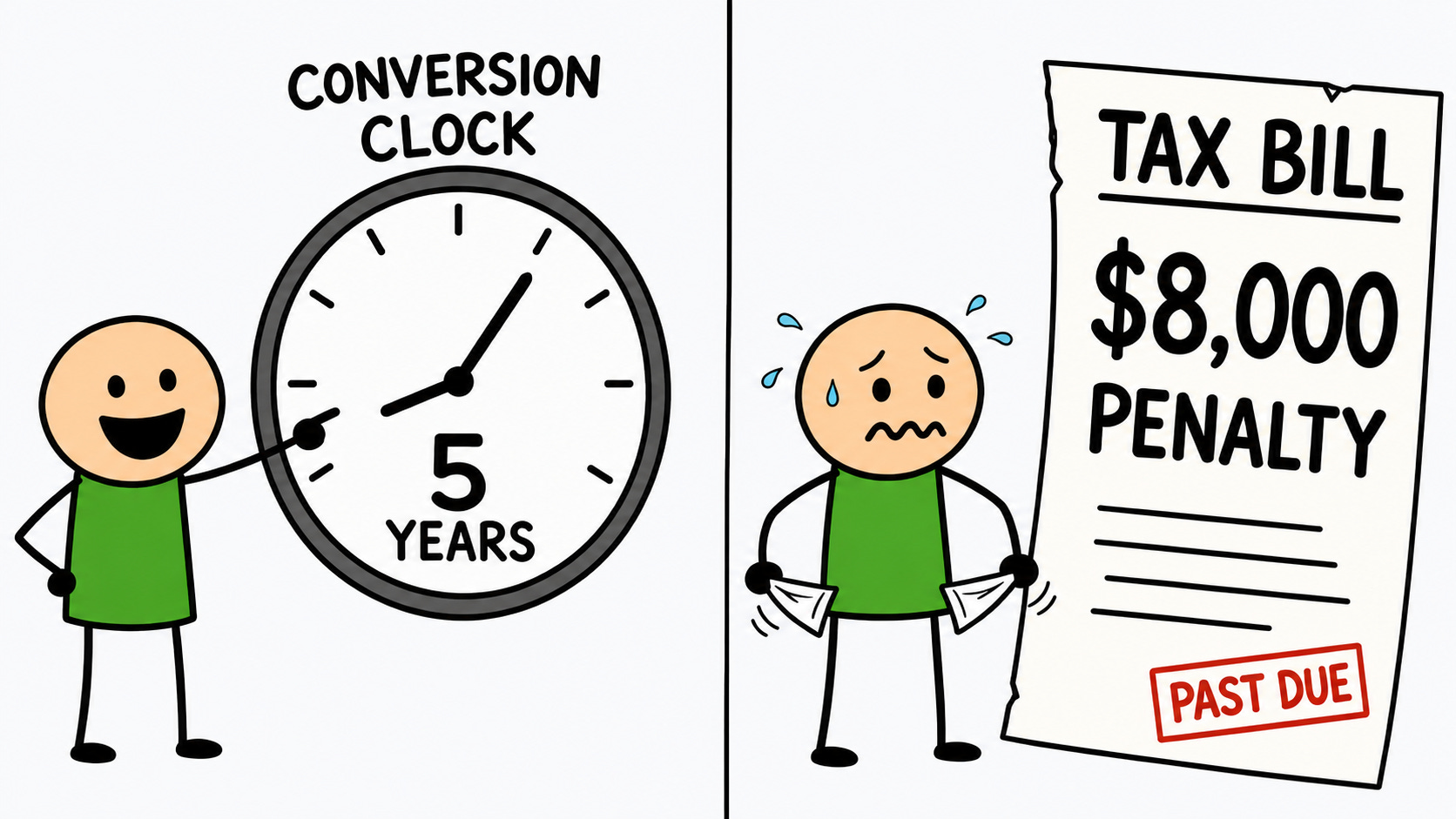
The conversion gets done in a calendar year, the tax bill comes that same year, the money lands in a Roth IRA, and the natural assumption is that the Roth IRA now behaves like any other Roth IRA. Withdraw the converted amount whenever. Pay no tax because the conversion was already taxed. End of story.
That assumption is where the trouble starts.
Each Roth conversion comes with its own five-year holding period, and that period is separate from any other Roth IRA timing rule. The clock exists for one specific reason. Without it, anyone under age 59.5 could move pre-tax dollars to a Roth, immediately withdraw the converted amount, and avoid the 10% additional tax that would have applied to a direct early withdrawal. The five-year conversion clock closes that loophole.
The rule says that if the converted amount is withdrawn within five years of the conversion and the account owner is under age 59.5 at the time of the withdrawal, the 10% early withdrawal tax applies to the amount withdrawn that was taxable at the time of conversion. The conversion itself was already taxed as ordinary income in the year of conversion. The 10% early withdrawal tax is on top of that.
The five-year period starts on January 1 of the year the conversion is made, regardless of when in that year the conversion actually happened. A conversion done in December starts the clock on January 1 of that same year, which is why year-end conversions are often described as having an eleven-month head start. A conversion done in January starts the clock the same way, on January 1 of that year.
The period ends on January 1 after five tax years have passed. A conversion in any month of one year satisfies the holding period on January 1 of the sixth tax year. Calendar year, not anniversary date.
The clock is per conversion. A conversion done in one year has its own clock. A conversion done the next year has a separate clock. A conversion done three years later has a third clock. Each one starts and ends independently. Withdrawing converted dollars before the relevant clock has expired triggers the 10% early withdrawal tax on the taxable portion of that specific conversion.
Roth IRA ordering rules determine which dollars are treated as coming out first, so the conversion clock matters when the distribution reaches converted dollars. Regular contributions come out first. Conversion and rollover contributions come out next, on a first-in, first-out basis. Earnings come out last. The clock attaches to the converted dollars themselves, and the ordering rules determine whether a given distribution has reached those dollars yet.
If the account owner reaches age 59.5 before the five-year period expires, the 10% early withdrawal tax no longer applies regardless of how long the converted amount has been in the account. The age 59.5 milestone overrides the conversion clock for the early withdrawal penalty. Other early withdrawal exceptions can also matter, but the conversion clock is the specific rule that catches people who are simply pulling converted dollars early without another exception.
What happens if the withdrawal is delayed until after the five-year period expires? Nothing extra. The converted dollars come out without the 10% early withdrawal tax, and because the conversion was already taxed at the time it happened, the withdrawal is not taxable a second time. The practical consequence of waiting is that the converted principal clears the penalty clock, while any earnings still follow the separate Roth qualified-distribution rules.
The five-year conversion clock is separate from the five-year contribution clock that determines whether earnings on Roth IRA contributions can be withdrawn tax-free. That is a different rule, and the two clocks can run at the same time without affecting each other.
A 52-year-old converts $80,000 from a traditional IRA to a Roth IRA in November. The full $80,000 is taxable as ordinary income for that year, and the tax is paid by April 15 of the following year. The conversion clock starts on January 1 of the conversion year and clears on January 1 of the sixth tax year.
In April of the second year after the conversion, the account owner is 54 and decides to withdraw the converted $80,000 to pay for a home renovation. The conversion was already taxed, so no income tax is due on the withdrawal. The five-year period has not expired, and the account owner is under 59.5. The 10% early withdrawal tax applies to the $80,000 withdrawn. The owner owes $8,000 in additional tax on a withdrawal that felt tax-free.
If the same owner had waited until January 1 after five tax years had passed, the five-year period would have closed and the 10% early withdrawal tax would not have applied, even though the owner was still under 59.5 at the time of the withdrawal.
If the same owner had instead reached age 59.5 before withdrawing the $80,000, the 10% early withdrawal tax would not have applied even if the five-year period had not yet closed. Age 59.5 is the override.
The conversion clock exists for one purpose, which is preventing the use of conversions as a workaround for the early withdrawal penalty. Once the period passes or the account owner reaches age 59.5, the clock no longer matters for that specific conversion. The dollars converted can be withdrawn without the 10% early withdrawal tax.
The mechanic catches people who run conversion ladders before age 59.5 without tracking which year each conversion happened in. The fix is recordkeeping. Every conversion has a year, every year starts its own clock, and the clock matters only if the withdrawal happens before age 59.5 and before the five-year period closes.
The five-year conversion clock is one of two five-year clocks that apply to Roth IRAs. The other is the contribution clock that determines whether earnings can be withdrawn tax-free as a qualified distribution. Both clocks can be running at the same time, and they answer different questions. The conversion clock answers whether the 10% early withdrawal tax applies to converted dollars withdrawn early. The contribution clock answers whether earnings are tax-free when withdrawn.
I write one of these every day, one retirement rule, explained in plain language and verified against the source. The daily email is free: subscribe here.
Full archive, worksheets, and search live at RetirementNewsRundown.com.
Disclaimer
This article is for educational and informational purposes only. It is not tax, legal, or financial advice and does not create an advisor-client relationship. Always consult appropriate professionals regarding your specific situation.