Medicare enrollment is built around a single seven-month window tied to the calendar month a person turns sixty-five. The window opens three months before the birthday month, includes the birthday month itself, and closes three months after. Coverage start dates depend on when within that window the enrollment is completed. Anyone who misses this Initial Enrollment Period and does not qualify for a different enrollment path faces two consequences. A coverage gap until the next enrollment window opens, and a late-enrollment penalty added to the monthly premium for the rest of the beneficiary’s life.
The system is unforgiving in a specific way. The penalty is not a one-time fee. It increases with each full twelve-month period the person was eligible but not enrolled, and the resulting percentage stays attached to the premium permanently. A person who delays enrollment by three years without qualifying coverage carries the resulting surcharge for every Medicare premium they will ever pay.
The most common misconception treats Medicare like ACA marketplace coverage, where annual open enrollment offers a recurring opportunity to sign up. Medicare has its own windows, its own deadlines, and its own penalty structure.
The Initial Enrollment Period covers seven calendar months. Three months before the birthday month. The birthday month itself. Three months after. A person born on the first day of a month has an IEP that opens one month earlier than the standard pattern. Coverage start dates depend on when in the window enrollment is completed. Enrollment before the birthday month produces coverage starting the first day of the birthday month. Enrollment in the birthday month or later produces coverage starting the first day of the month after enrollment.
The General Enrollment Period runs from January 1 through March 31 each calendar year. Anyone who missed the IEP without qualifying for an SEP must wait for the next GEP to enroll. Coverage starts the month after enrollment.
The Special Enrollment Period applies to beneficiaries who delayed enrollment because they were covered under an employer group health plan based on current employment, either their own or a spouse’s. The SEP lasts eight months and begins the month after the employment ends or the coverage ends, whichever comes first. Enrollment during the SEP avoids the late-enrollment penalty.
The Part B late-enrollment penalty adds ten percent of the standard Part B premium for each full twelve-month period the beneficiary was eligible but not enrolled. The percentage stacks. Two full years of late enrollment produces a twenty percent surcharge. The surcharge applies to the monthly Part B premium permanently.
The Part D late-enrollment penalty adds one percent of the national base beneficiary premium for each month the beneficiary was eligible but not enrolled in creditable Part D coverage. The percentage accumulates monthly rather than annually. The surcharge applies to the monthly Part D premium permanently.
Premium-free Part A applies to most beneficiaries who qualify based on work history. For beneficiaries who must buy premium Part A, a late-enrollment penalty adds ten percent to the Part A premium, applied for twice the number of years the beneficiary was eligible but not enrolled.
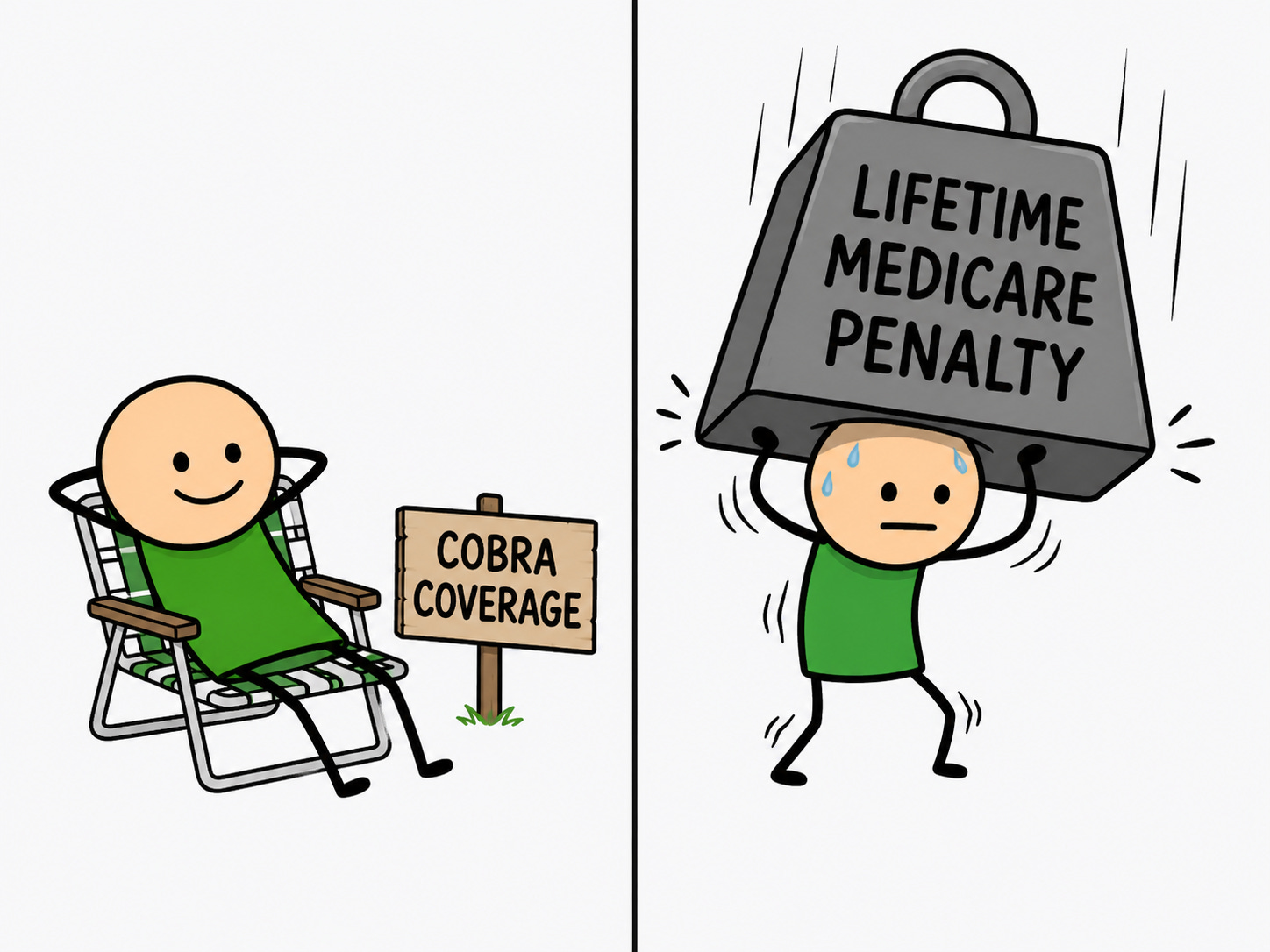
The critical creditable coverage distinction. For most people becoming eligible for Medicare at sixty-five, active employment with an employer group health plan at a company with twenty or more employees is the key standard for delaying Part B without penalty. Three categories that do not count. COBRA continuation coverage. Retiree health benefits. Individual market or marketplace coverage. A beneficiary relying on any of those three to delay Part B faces both a coverage gap and the lifetime penalty when the IEP closes.
What happens if enrollment is done later. The next available window is the GEP, which runs January 1 through March 31 of the following calendar year. Coverage starts the month after GEP enrollment. The penalty calculation runs from the end of the IEP through the GEP enrollment month, and the resulting percentage applies permanently.
The deadlines worth keeping straight. The IEP is a seven-month calendar window tied to the birthday month, not a tax deadline. The GEP is a three-month calendar window each year. The SEP is an eight-month window from the end of qualifying employer coverage. There is no ordinary correction window for simply realizing the mistake later. Once a late-enrollment penalty properly attaches, it is generally permanent.
Consider a worker, age sixty-five, employed at a company with two hundred employees and covered under the employer health plan. The worker chose to delay Part B enrollment using the active-employment creditable coverage exception. Three years later, at age sixty-eight, the worker retired and the employer coverage ended.
The SEP began the month after employment ended. The worker had eight months to enroll in Part B without penalty. Enrollment was completed in month four of the SEP window. Coverage began the first day of the month after enrollment. No late-enrollment penalty applied. The delayed enrollment was protected by the creditable coverage exception and the SEP timing.
A different worker, age sixty-five, recently retired with COBRA continuation coverage running for eighteen months. The worker assumed COBRA satisfied the creditable coverage requirement and delayed Part B enrollment. When COBRA ended, the worker discovered COBRA is not qualifying coverage for Medicare delay purposes and no SEP applied. The worker had already missed the IEP. The next available enrollment window was the GEP the following January. Coverage began the month after GEP enrollment.
The Part B late-enrollment penalty calculation captured one full twelve-month period of delayed enrollment, producing a ten percent surcharge on the standard Part B premium. That surcharge applied to every monthly Part B premium for the rest of the beneficiary’s life. The coverage gap between the end of COBRA and the GEP enrollment month was uninsured for Medicare purposes.
The enrollment windows are the actual deadline structure. The penalty is the actual consequence. The system treats Medicare enrollment as a calendar event with limited recurrence, not a recurring annual choice.
What matters is awareness that creditable coverage has a narrow definition for Medicare delay purposes. Active employment with an employer group plan at a company with twenty or more employees qualifies. COBRA does not qualify. Retiree health benefits do not qualify. Individual market coverage does not qualify. The list of what counts is shorter than most beneficiaries assume, and the consequences of getting it wrong are permanent.
The SEP exists for a reason. It is the formal mechanism for beneficiaries who legitimately had creditable coverage and need to transition into Medicare when that coverage ends. The eight-month window is generous compared to other enrollment paths, but it begins on a fixed date and cannot be extended.
The system is rule-based. The windows are published. The penalty calculation is mechanical. The penalty is generally permanent once it attaches. Most late-enrollment penalties trace back to a coverage type the beneficiary assumed was creditable but actually was not. The answer is verification of creditable coverage status before the IEP closes, not after.
I write one of these every day, one retirement rule, explained in plain language and verified against the source. The daily email is free: subscribe here.
Full archive, worksheets, and search live at RetirementNewsRundown.com.
Disclaimer
This article is for educational and informational purposes only. It is not tax, legal, or financial advice and does not create an advisor–client relationship. Always consult appropriate professionals regarding your specific situation.