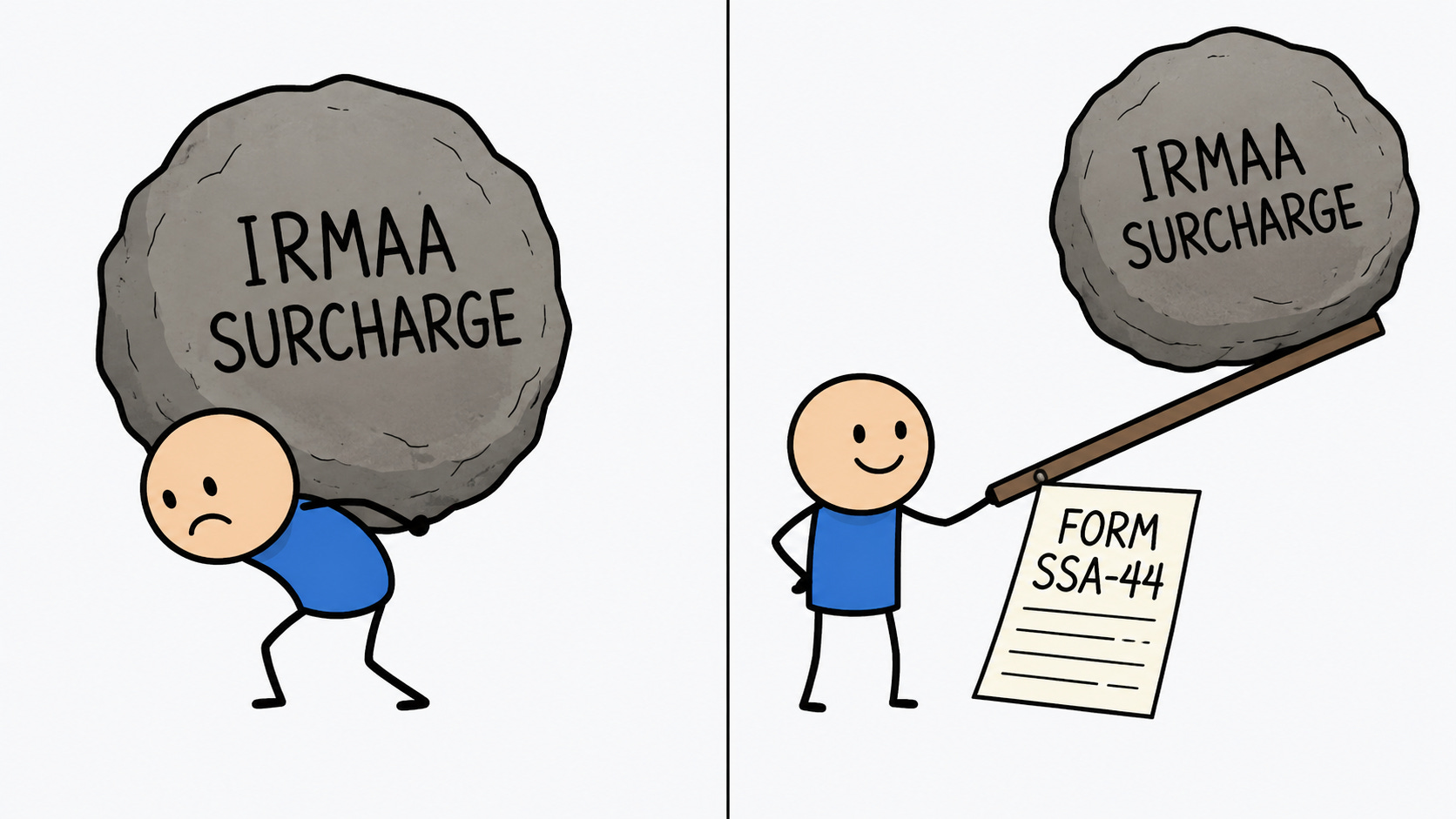
The first IRMAA premium notice often arrives in the year following a major life change. A spouse died and the joint return for the lookback year still shows two incomes. A divorce closed and the lookback year still shows joint income. A pension was lost and the lookback year still shows the full pension. The Medicare premium for the upcoming year is based on a tax return that reflects a financial life the beneficiary no longer has.
Most beneficiaries assume the only option is to wait until the two-year lookback catches up with the new income reality. That assumption skips the formal appeal path the system actually provides.
Form SSA-44 exists for exactly this situation. It is the Social Security Administration’s life-changing event request for a new IRMAA determination, and it is significantly underused.
The form allows a Medicare beneficiary to ask SSA to set the IRMAA assignment using a more recent income year rather than the two-year-prior return. The qualifying life-changing events are listed on the form itself. Marriage. Divorce or annulment. Death of a spouse. Work stoppage. Work reduction. Loss of income-producing property due to events beyond the beneficiary’s control. Loss of pension income. Employer settlement payment.
Each event requires documentation. A marriage certificate. A divorce decree. A death certificate. A signed statement from an employer confirming work stoppage or work reduction. Documentation of the property loss and the cause. Verification of pension termination from the plan administrator. A copy of the employer settlement agreement.
The form also requires the beneficiary to provide an estimated MAGI for the year they want SSA to use instead of the two-year-prior return. The replacement year can be the year before the premium year, or the premium year itself, depending on which year better reflects the post-event income. SSA may use the estimate when the documentation supports the life-changing event and the income reduction. Reconciliation happens later, when the actual tax return for the estimated year is filed and matched to the SSA record.
What happens if SSA accepts the filing. SSA issues a new initial determination using the estimated income. The premium adjusts going forward. If higher premiums have already been paid for months in the affected premium year, an accepted new determination may result in an adjustment or refund, but the practical process takes time.
What happens if SSA denies the filing. The standard appeals process applies. The first step is reconsideration, filed with SSA within sixty days of the determination letter. If reconsideration is denied, the next steps are administrative law judge review, then the SSA Appeals Council, then federal court.
What is not covered. Voluntary income recognition is not a qualifying LCE. A Roth conversion, a capital gain from an investment sale, an inherited IRA distribution, or any other choice to recognize income produces no SSA-44 appeal path. The form is built for income reductions caused by external events, not for income increases the beneficiary controlled.
What happens if the form is filed later. SSA-44 has no rigid filing window. The form can be submitted any time after the qualifying event. The premium year being affected is the calendar year identified on the form. The standard annual recalculation happens automatically when the next tax return is processed and matched to the SSA record, so a beneficiary who never files SSA-44 will eventually see the surcharge drop on its own, but only after paying it for the affected premium year.
The deadlines worth keeping straight. The life-changing event request is different from the standard reconsideration appeal, which has a sixty-day filing window from the date of the SSA determination letter. SSA-44 can be filed after the qualifying event, but it is most useful when the event and income reduction relate to the premium year being adjusted. The practical effectiveness of the form drops as months pass within that premium year because the higher surcharge has already been collected for prior months.
Consider a beneficiary, age sixty-seven, whose spouse died during the lookback year. The joint return for that lookback year captured a full year of the deceased spouse’s wages, a final-year deferred compensation payout, and the surviving spouse’s pension and Social Security income. Total joint MAGI pushed well into an upper IRMAA tier.
The first Medicare premium year after the death used the lookback year’s joint return. The surviving spouse received an IRMAA assignment based on the high-income joint year. The new income reality, with only the surviving spouse’s pension and Social Security, was substantially lower.
The surviving spouse submitted Form SSA-44 with a copy of the death certificate and a MAGI estimate for the year following the death. SSA accepted the filing and issued a new initial determination using the estimated income. The IRMAA assignment for that Medicare premium year was reduced to reflect single-filer income at the lower tier. The previously paid higher premiums for that year were eligible for adjustment or refund.
If the surviving spouse had not filed SSA-44, the higher premium would have applied for the full first year after death. The second-year premium would have used the next available return, which reflected the post-death income, and the tier would have reset on its own. The earlier-year surcharge would not have been recovered.
The SSA-44 path exists because the two-year lookback structure produces predictable mismatches between past income and current income. SSA built the form to handle cases where waiting two years would produce an unfair result on a premium that the beneficiary cannot delay paying.
The form is administrative, not judicial. It is filed with the local Social Security office, by mail, by fax, or through other accepted submission methods. There is no filing fee. There is no required attorney involvement. The processing time varies, and the path is generally shorter than a standard appeal because the form is designed to be reviewed against documented life-changing events.
What matters is awareness that the form exists and that the qualifying events cover more than most beneficiaries assume. Work reduction qualifies, not only work stoppage. Loss of income-producing property qualifies when the loss is outside the beneficiary’s control. Loss of pension income qualifies. The list of events covers most of the major financial transitions that retirement actually produces. Voluntary income recognition is the major category the form does not cover.
The surcharge for the affected premium year may be reduced or adjusted through SSA-44 when the LCE applies and SSA accepts the new determination. The form is the formal path. Filing it requires the documentation, the income estimate, and the patience to wait for SSA to process the new determination. The path is available, and significantly underused.
I write one of these every day, one retirement rule, explained in plain language and verified against the source. The daily email is free: subscribe here.
Full archive, worksheets, and search live at RetirementNewsRundown.com.
Disclaimer
This article is for educational and informational purposes only. It is not tax, legal, or financial advice and does not create an advisor–client relationship. Always consult appropriate professionals regarding your specific situation.