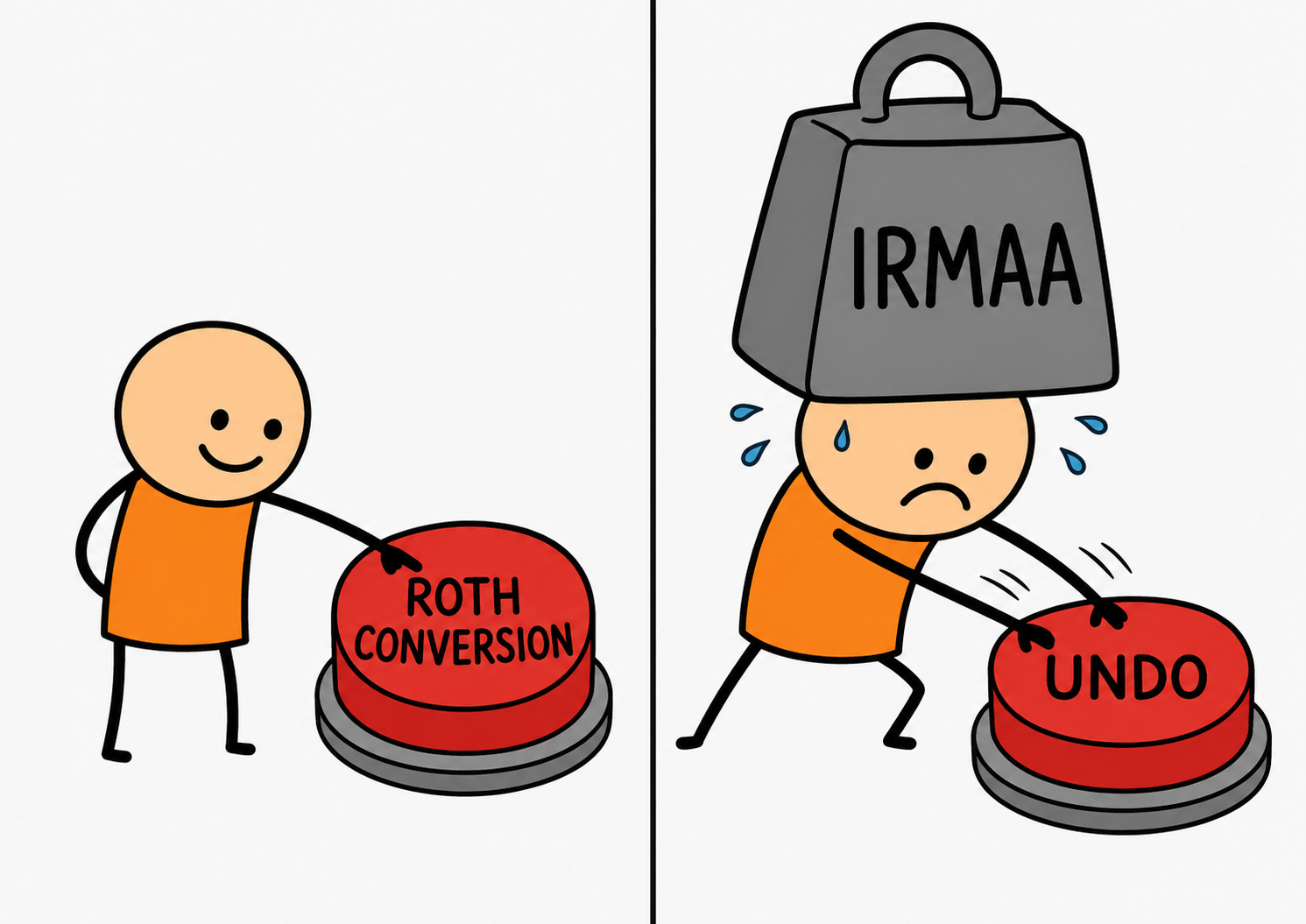
A Roth conversion adds the converted amount to ordinary income in the year of the conversion. That income flows through AGI and lands in MAGI for IRMAA purposes. Two years later, SSA pulls that tax return when setting the Medicare premium, and the conversion amount is sitting in the income figure that gets compared against the IRMAA tier thresholds.
The conversion was a tax-bracket strategy. The strategist optimized to stay inside the twenty-four percent federal bracket. The IRMAA thresholds sit at different income levels than the federal bracket boundaries, and crossing an IRMAA threshold by a single dollar triggers the full-tier surcharge.
The first Medicare premium notice arrives. The surcharge is attached. The retiree opens the notice and discovers the conversion strategy from two years ago has just produced a Medicare bill substantially higher than the standard premium.
The mechanic that produces this outcome has three moving parts. The conversion increases MAGI. The two-year lookback puts that MAGI on the table when SSA sets a Medicare premium. The cliff structure of IRMAA tiers means that crossing a threshold by any amount triggers the full surcharge for that tier.
The conversion amount is fully taxable as ordinary income in the conversion year. The amount flows into AGI. For IRMAA purposes, MAGI is AGI plus tax-exempt interest. The conversion adds to MAGI dollar for dollar.
The two-year lookback applies the same way for conversion income as it does for any other income. A conversion done in the year someone turns sixty-three lands in the MAGI calculation for the Medicare premium year when that person turns sixty-five. A conversion done at sixty-five lands at sixty-seven. The lag is mechanical and does not depend on the source of the income.
The cliff structure means there is no smooth penalty for going slightly above a tier threshold. A retiree who converts an amount that pushes MAGI one dollar above a threshold pays the full tier surcharge on both Part B and Part D for the affected Medicare year. For a married couple where both spouses are enrolled in Medicare, the surcharge applies to both spouses based on the joint return income.
What happens if the conversion is done later. The IRMAA impact still arrives two years later, applied to whatever Medicare premium year matches the two-year lookback. A conversion at sixty-three hits the first Medicare premium year. A conversion at sixty-five hits the third. A conversion at seventy-five hits the year the retiree turns seventy-seven. Each conversion year produces one IRMAA-relevant premium year.
The deadlines worth keeping straight. The conversion calendar-year deadline is December 31 of the conversion year. Conversions cannot be backdated to the prior year using the April 15 extension that applies to IRA contributions. The conversion is reported on the tax return for the calendar year it occurred, due the following April. The do-over window for Roth conversions is closed. Recharacterization of Roth conversions is no longer available under federal tax law. Once a conversion is processed, the conversion cannot be undone, reversed, partially clawed back, or reclassified back to traditional.
SSA-44 does not list Roth conversion as a qualifying life-changing event. The form covers reductions in income from external events such as work stoppage, divorce, or death of a spouse. A voluntary decision to recognize income from a conversion is the opposite of an LCE and produces no appeal path under the life-changing event rules.
Consider a retiree who turned sixty-two and built a Roth conversion ladder. The plan converted approximately eighty thousand dollars from a traditional IRA to a Roth each year, for five years, with the federal tax math sized to stay inside the twenty-four percent marginal bracket.
The conversion at age sixty-two lands in the MAGI calculation for the Medicare premium year when the retiree turns sixty-four. The retiree is not yet enrolled in Medicare at sixty-four, so the conversion produces no IRMAA exposure.
The conversion at age sixty-three lands in the MAGI calculation for the first Medicare premium year, age sixty-five. If MAGI in that conversion year crosses an IRMAA tier threshold, the first Medicare year carries the surcharge for twelve months of Part B and Part D premiums.
The conversion at age sixty-four lands at age sixty-six, the second Medicare year. The conversion at age sixty-five lands at age sixty-seven. The conversion at age sixty-six lands at age sixty-eight. Each remaining conversion year in the ladder produces one IRMAA-relevant Medicare premium year.
If every conversion year in the ladder crosses an IRMAA tier threshold by even a small amount, the retiree pays four consecutive years of IRMAA surcharges on the post-Medicare side of the ladder. The total cost across four years and both Medicare program parts can run into the tens of thousands of dollars, depending on the tier crossed and whether a spouse is also on Medicare.
The conversion-IRMAA interaction is a planning problem, not a penalty. The thresholds are published, the lookback is predictable, and the conversion amounts are entirely within the retiree’s control. Modeling the IRMAA side of the equation before processing a conversion is the difference between a controlled strategy and a surprise.
What matters is the dual optimization. A conversion strategy that targets a federal tax bracket can miss the IRMAA thresholds by a wide enough margin to produce tax savings that get partially or fully eaten by IRMAA surcharges in the relevant Medicare years. The two threshold sets sit at different income levels and adjust differently each year. Optimizing for one without checking the other is where the cost shows up.
Once a Roth conversion is processed, the federal recharacterization do-over is gone. Custodian error corrections are a different issue, but the old strategy of converting now and recharacterizing later is no longer available.
The pre-Medicare conversion years carry no IRMAA exposure from those specific conversions, since the two-year lookback lands before Medicare enrollment. Conversions done in or after the year someone turns sixty-three produce IRMAA-relevant Medicare premium years on a one-to-one basis. The planning question is whether the long-term tax savings from converting outweigh the IRMAA cost. That math requires modeling both sides.
I write one of these every day, one retirement rule, explained in plain language and verified against the source. The daily email is free: subscribe here.
Full archive, worksheets, and search live at RetirementNewsRundown.com.
Disclaimer
This article is for educational and informational purposes only. It is not tax, legal, or financial advice and does not create an advisor–client relationship. Always consult appropriate professionals regarding your specific situation.