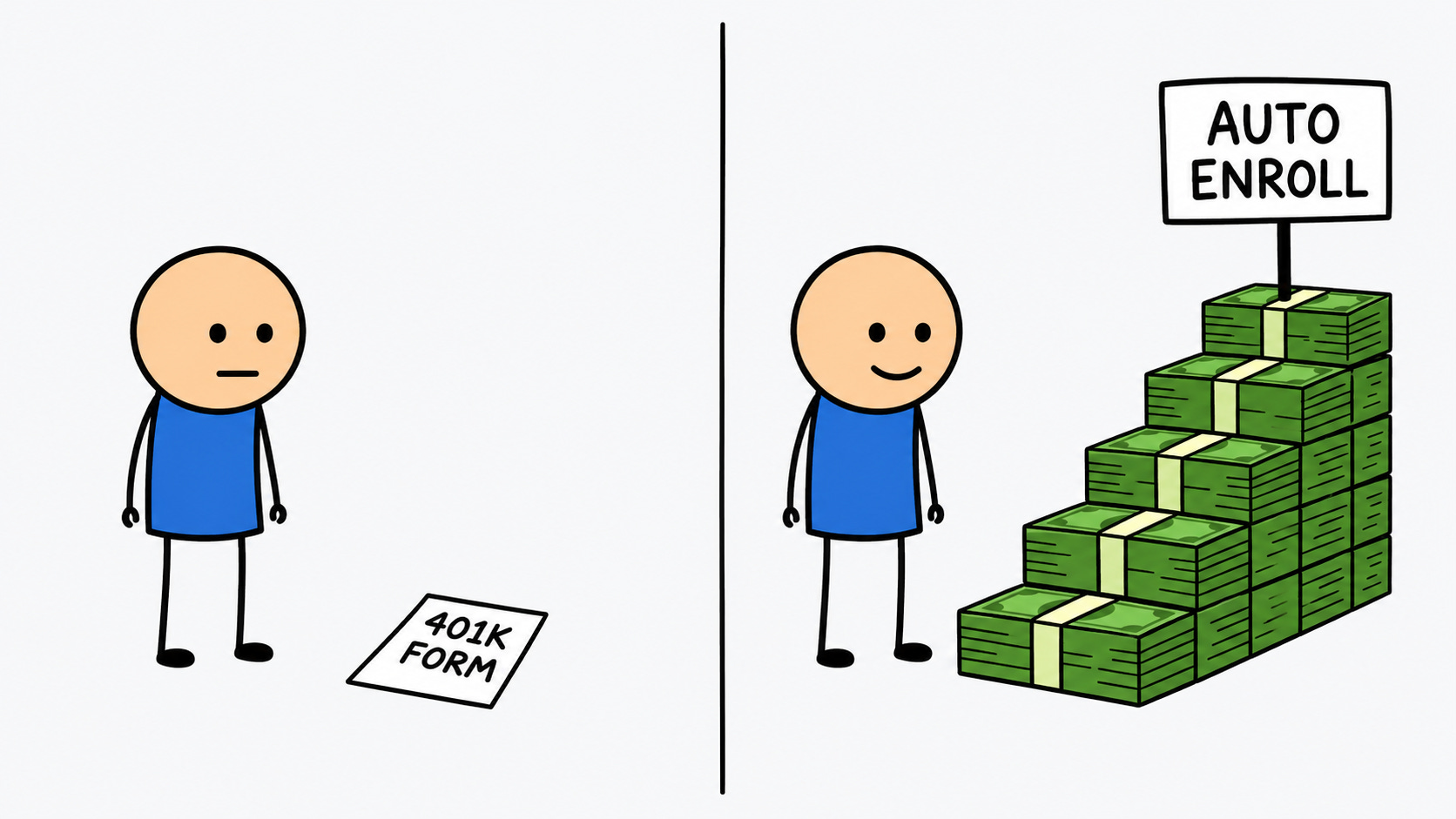
A 401k plan can sit on a new employee’s enrollment form for months. The plan is in place. The employer is willing to match. The deferral percentage just needs the employee to fill in a number and sign. Most employees mean to. Many never get around to it. The default, in plans without auto-enrollment, is to defer nothing, miss the match, and miss the early contributions that compound over a career.
SECURE 2.0 took that default and flipped it for most new plans. Plans established after the law’s enactment generally have to enroll new employees automatically, at a starting percentage of pay, and increase that percentage each year. The employee can still opt out. The default just changed.
SECURE 2.0 added an automatic enrollment requirement for 401k and 403b plans established at or after the law’s enactment. The rule does not apply to plans that already existed when the law was passed, and it does not apply to several categories of employers that fall under specific exceptions. For newly established plans that do not fall into an exception, automatic enrollment is no longer optional.
The required design generally has to operate like an Eligible Automatic Contribution Arrangement, or EACA, with additional SECURE 2.0 requirements. The initial deferral rate at enrollment must be at least three percent of compensation, and no more than ten percent. From there, the deferral rate must increase by one percentage point per year, until it reaches at least ten percent, and no more than fifteen percent. An employee can opt out, lower the rate, or change investments at any time.
A participant who is automatically enrolled has a ninety-day permissible withdrawal window. During that window, the participant can withdraw the contributions that have been auto-deferred, along with any earnings, without the ten percent early distribution penalty that would otherwise apply. After the ninety days, the contributions are subject to the standard rules.
Default investments are also addressed. Contributions auto-deferred under the arrangement must go into a qualified default investment alternative, or QDIA, unless the participant directs the money somewhere else. Target-date funds are common, but they are not the only possible QDIA.
Several categories of plans are exempt. Small businesses with ten or fewer employees are not subject to the requirement. Businesses in existence for less than three years are not subject to it. Church plans, governmental plans, and SIMPLE 401k plans are not subject to it. And as noted, plans that existed before the law’s enactment are grandfathered, regardless of how long the business has been around.
The timing matters. The mandate applies to plans established at or after the law’s enactment, but the actual compliance obligation runs from plan years beginning after a transition window. A plan started during the transition window after enactment had time to implement the design before the rules took effect. A plan established after the transition window runs under the requirement from its first plan year.
What happens if you do this later instead. A plan that should have implemented automatic enrollment and did not is in an operational failure. The IRS has correction procedures for these situations, and the correction generally requires a contribution from the employer to cover the missed deferral opportunity, plus matching contributions the employee would have received, plus earnings. The correction grows the longer the failure runs, since each affected participant accumulates more missed contributions for each year the rule is ignored.
A plan can also be designed to combine the EACA design with a QACA, which is the auto-enrollment safe harbor design that provides relief from nondiscrimination testing. The two designs share auto-enrollment as a feature. They serve different purposes. EACA satisfies the SECURE 2.0 mandate. QACA satisfies the safe harbor exemption from ADP and ACP testing.
A small business with twenty employees launches a new 401k plan two years after the SECURE 2.0 enactment. The plan does not fit any of the exceptions. As designed, it must include an EACA.
The plan starts new employees at a four percent deferral rate, within the three-to-ten percent initial range. Each year, the deferral rate increases by one percentage point until it reaches twelve percent, within the ten-to-fifteen percent ceiling.
A new hire is enrolled automatically. The deferral begins at four percent and goes into a target-date fund chosen as the plan’s default investment. The employee has ninety days to opt out or withdraw the auto-deferred amounts under the permissible withdrawal rule. After ninety days, the contributions stay in the plan under normal rules.
The next year, the employee’s deferral rate automatically steps up to five percent. The year after that, six percent, and so on, until it reaches twelve percent. The employee can adjust the rate up or down at any time, including dropping it back to zero.
The SECURE 2.0 auto-enrollment requirement changes how a plan looks at a new employee’s silence. Under the old default, silence meant no contribution. Under the new default for affected plans, silence means a starting contribution that grows each year. The shift was designed to address the gap between employees who would benefit from saving and employees who actually fill out the form.
What truly matters is whether the rule applies to a given plan. Plans established before the law’s enactment are grandfathered, and several categories of employers are exempt. A new plan that does not fit an exception has to incorporate automatic enrollment from the start, with the prescribed initial rate, the auto-escalation feature, the default investment, and the ninety-day permissible withdrawal window.
Plans that fit an exception today may grow out of it. A small business with ten or fewer employees can cross that threshold by hiring. A business in existence less than three years eventually passes that line as well. The exception is not permanent, and the plan design has to be ready when it falls away.
A plan that runs without auto-enrollment when it should be running with it is heading toward a correction. Knowing whether the plan needs the EACA design is most of what it takes to stay on the right side of the rule.
I write one of these every day, one retirement rule, explained in plain language and verified against the source. The daily email is free: subscribe here.
Full archive, worksheets, and search live at RetirementNewsRundown.com.
Disclaimer This article is for educational and informational purposes only. It is not tax, legal, or financial advice and does not create an advisor–client relationship. Always consult appropriate professionals regarding your specific situation.