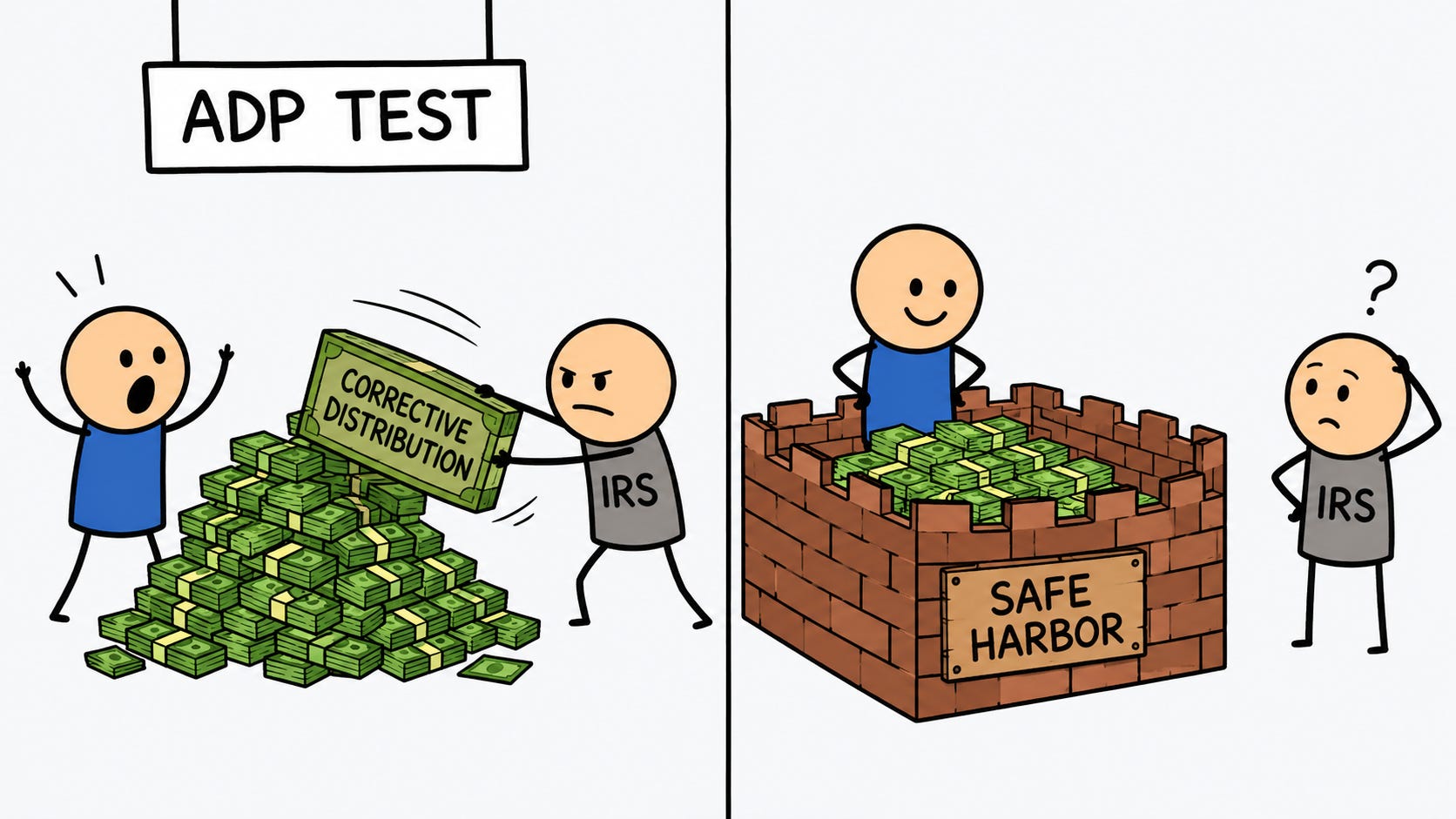
A small business owner who funds a 401k plan tends to discover the testing rules the same way, by getting a check back in March labeled corrective distribution. The plan ran its annual tests, the highly compensated participants deferred more than the rules allow relative to everyone else, and the system pushed the excess out. The owner did not break a rule. The plan structure created a math problem that the IRS solved by returning contributions.
The safe harbor 401k design exists to keep that math problem from showing up at all. By committing to a defined employer contribution that meets specific requirements, the plan earns an exemption from the annual nondiscrimination tests that would otherwise apply. The owner can defer at the limit without worrying that the rest of the workforce’s deferral rate will pull contributions back at year end.
The standard 401k nondiscrimination tests compare what highly compensated employees defer or receive in matching contributions to what other employees defer or receive. The Actual Deferral Percentage test, known as ADP, looks at salary deferrals. The Actual Contribution Percentage test, known as ACP, looks at matching contributions and after-tax employee contributions. If the HCE numbers run too high above the non-HCE numbers under the formulas, the plan has to fix the imbalance, usually through corrective distributions to the HCEs.
A safe harbor 401k is a plan design that gives the employer an exemption from those tests in exchange for making a specified contribution.
There are two main paths. The matching safe harbor requires the employer to match employee deferrals using one of the prescribed formulas. The basic version is a one hundred percent match on the first three percent of compensation, plus a fifty percent match on the next two percent. An employee who defers five percent of compensation receives a match equal to four percent of compensation. Enhanced matching formulas can be used as long as they are at least as generous as the basic.
The nonelective safe harbor requires the employer to contribute at least three percent of compensation to every eligible employee, whether the employee defers anything or not. The cost is more predictable, since it does not depend on employee deferral behavior, but it can be more expensive in plans where employees do not defer much on their own.
Safe harbor contributions are generally fully vested when made. A QACA safe harbor design, which pairs automatic enrollment with a safe harbor contribution, is allowed to use a two-year cliff vesting schedule on the safe harbor contribution.
When the plan meets the safe harbor requirements, it is treated as satisfying the ADP test. A safe harbor match that meets the additional ACP safe harbor conditions can also protect the plan from ACP testing. A plan that uses only safe harbor contributions and does not layer on other employer contributions generally avoids the top-heavy minimum contribution problem as well.
The timing rules matter. A matching safe harbor must be in place at the start of the plan year. A three percent nonelective safe harbor can be adopted as late as a short window before the end of the plan year. A four percent nonelective safe harbor can be adopted retroactively, even after the year ends, up to the end of the following plan year. Under the SECURE Act and SECURE 2.0, the annual safe harbor notice requirement was eliminated for nonelective safe harbor plans, though employees still must be able to make or change a deferral election at least once per year. Matching safe harbor plans still have notice obligations.
What happens if you do this later instead. A plan that misses the matching safe harbor timing has to wait until the next plan year. A plan that missed the three percent nonelective cutoff has the four percent retroactive route, at higher cost. A plan that runs a year without safe harbor protection runs the regular testing. If the testing fails, the plan corrects through the standard means, usually refunding contributions to HCEs and sometimes making additional contributions to non-HCEs.
A small consulting firm has an owner who wants to defer at the limit and three employees who defer modest amounts. Without safe harbor protection, the plan would likely fail the ADP test, since the owner’s deferral percentage runs well above the average deferral percentage of the three employees. The fix would be a corrective distribution to the owner in the following year, making part of the owner’s deferral taxable income.
The firm adopts a matching safe harbor at the start of the plan year. The owner defers the full annual limit. The three employees each defer between three and five percent of compensation, and each receives the matching contribution corresponding to their deferral, up to four percent of compensation for those deferring at least five percent.
At year end, no ADP test runs. The owner’s full deferral stays in the plan. The plan is also exempt from top-heavy testing for the year, since the only employer contributions are the safe harbor matching contributions.
The trade-off is the matching cost. The savings, beyond the testing exemption itself, come from the certainty that the owner’s deferral will not be partially refunded the following spring.
The safe harbor design is one of the few places in retirement plan rules where the trade is clearly stated upfront. The employer commits to a contribution that meets the prescribed formula. The plan gets an exemption from the tests that would otherwise constrain how much the highly compensated participants can defer or receive.
What truly matters is understanding when the design pays for itself. A plan where the owner wants to defer aggressively and the rest of the workforce defers modestly is a setup where the ADP test will struggle, and safe harbor turns that struggle into a known cost. A plan where everyone defers similar percentages may not need safe harbor protection.
The timing rules are the part most likely to trip up a new adoption. Matching safe harbor has to be set up before the year starts. Nonelective safe harbor has a longer runway, including a retroactive option at higher cost. A plan that misses the timing for the year just runs a year on regular testing and adopts safe harbor for the following plan year.
The exemption from testing is paid for in the contribution formula. Knowing what the formula costs and what the testing exposure looks like without it is most of what it takes to decide whether the design fits the plan.
I write one of these every day, one retirement rule, explained in plain language and verified against the source. The daily email is free: subscribe here.
Full archive, worksheets, and search live at RetirementNewsRundown.com.
Disclaimer This article is for educational and informational purposes only. It is not tax, legal, or financial advice and does not create an advisor–client relationship. Always consult appropriate professionals regarding your specific situation.