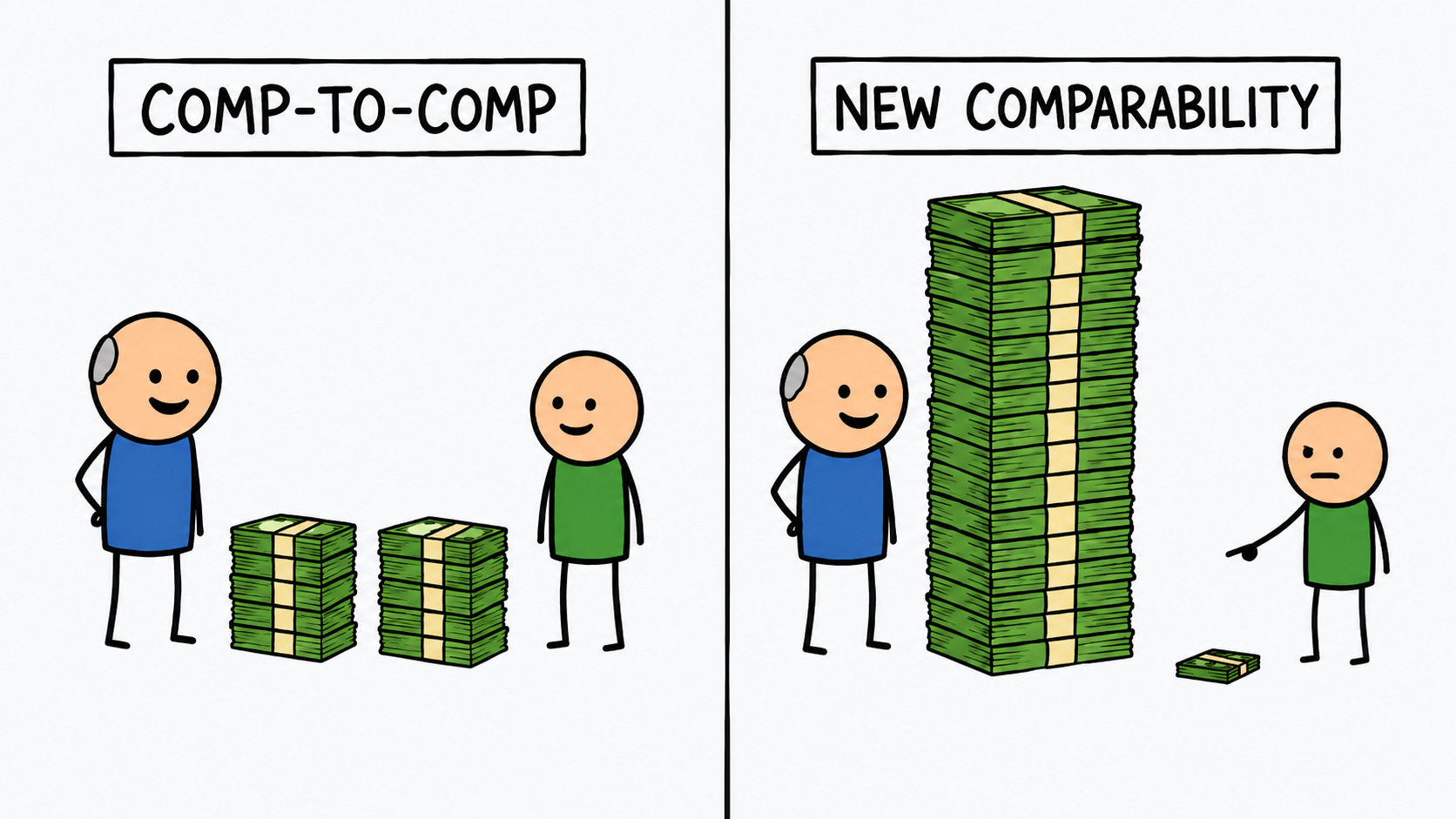
A small business owner looks at the profit-sharing section of a 401k plan and sees what looks like a single decision. How much to contribute this year. The deeper question, who gets what percentage, is the one most owners never realize they get to choose. The plan can give every participant the same percentage of compensation, or give different groups different percentages designed to favor specific people while still passing the rules.
The choice of formula matters more than it looks. It can move thousands of dollars of contribution between the owner and the rest of the workforce in the same year, on the same total contribution. The two main formulas in this conversation are comp-to-comp and new comparability, and they answer that question very differently.
Comp-to-comp is the straightforward formula. The employer decides a percentage of compensation, and every eligible participant receives that percentage applied to their own pay. If the rate is six percent, the owner gets six percent of compensation, every employee gets six percent of compensation, and the math is the same for everyone. Because the rate is uniform, the allocation formula is generally straightforward from a nondiscrimination standpoint. The plan still has to satisfy the rest of the qualified-plan rules, because naturally the IRS did not create a one-sentence escape hatch and call it a day. It is simple to administer and easy to explain.
New comparability is the alternative. The plan splits participants into groups, often as small as one person per group, and assigns a different contribution percentage to each group. The owner might be in a group that receives twenty percent of compensation while a group of younger employees receives five percent. The total contribution can be much smaller in dollars, while the owner’s share of that total can be much larger.
The catch is testing. New comparability is tested on a benefits basis rather than a contribution basis, since the percentages between groups are not uniform. The plan converts contributions into projected benefits at retirement age, using prescribed actuarial assumptions. A dollar contributed at fifty-five produces less retirement benefit than a dollar contributed at thirty-five, so an older participant can receive a higher contribution percentage and still produce a similar projected benefit. That math is how the formula tilts contribution toward older participants without failing the test.
There is a minimum the plan must meet to use the cross-tested approach. Non-highly compensated employees must receive a contribution of at least the lesser of one-third of the highest contribution rate given to any highly compensated employee, or five percent of compensation. In many owner-heavy small business designs, the five percent gateway is what people notice, because the owner’s allocation is often high enough that one-third of the owner’s rate would exceed five percent. If the owner’s rate is lower, the one-third test can produce a smaller gateway.
The overall limits still apply across both formulas. The annual addition limit caps total contributions per participant. The deduction limit caps the employer’s total profit-sharing deduction at twenty five percent of aggregate eligible compensation. New comparability operates within those ceilings, distributing the room under them differently across participants.
The deadline for funding a profit-sharing contribution is the employer’s tax filing deadline for the year, including extensions, which gives an employer until the October extended deadline in most cases to make the contribution and take the deduction. Whichever formula the plan uses, the formula has to be in the plan document. A discretionary annual allocation within that formula framework is normal. Picking a formula at funding time that the plan document does not authorize is not allowed.
What happens if you do this later instead. A formula that does not pass testing is an operational failure. A formula that does not pass testing is an operational failure. The IRS correction procedures generally require a reasonable correction method that puts the plan back where it should have been, often by making additional contributions to non-highly compensated employees, adjusting allocations, using a permitted retroactive amendment, or some combination of paperwork and money. As usual, the paperwork is annoying and the money is the part everyone remembers. Letting the failure run for multiple years adds layers of correction, since each year is its own testing event.
A small medical practice has one owner-physician in her mid-fifties and three administrative employees in their early to mid-thirties. The owner wants to contribute around forty thousand dollars to the plan and would prefer to keep employee contributions modest.
Under a comp-to-comp formula, all four participants would receive the same percentage of compensation. If the rate is set high enough to give the owner forty thousand dollars, every employee receives that same percentage applied to their own salary, and the total contribution across the practice is much higher.
Under a new comparability formula, the owner sits in her own group with a higher percentage, and each employee sits in a group with the five percent gateway minimum. The plan converts these into projected benefits at retirement age. Because the owner is closer to retirement, her higher percentage produces a similar projected benefit to the employees’ lower percentage, and the plan passes testing on the benefits basis.
The owner ends up with her forty thousand dollar contribution, the employees each get five percent of compensation, and the total contribution across the practice is significantly less than it would have been under comp-to-comp.
The two formulas exist for different small business situations. Comp-to-comp fits when the participant population is roughly the same age and the goal is to give everyone the same proportional share. New comparability fits when the population spans different ages and the goal is to concentrate contributions toward older owners, without losing the plan’s qualified status.
What truly matters is understanding what each formula does. Comp-to-comp passes testing because everyone gets the same percentage. New comparability passes testing on a benefits basis, with the five percent gateway as the floor for non-highly compensated employees. Both formulas live inside the overall annual addition and deduction limits.
A plan that picks comp-to-comp when new comparability would have worked better is leaving a design lever unused. A plan that picks new comparability without understanding the gateway and the testing leaves itself open to a correction that costs more than the savings the formula created. The risk is in picking a formula without understanding how it allocates contributions and how the testing actually works.
I write one of these every day, one retirement rule, explained in plain language and verified against the source. The daily email is free: subscribe here.
Full archive, worksheets, and search live at RetirementNewsRundown.com.
Disclaimer This article is for educational and informational purposes only. It is not tax, legal, or financial advice and does not create an advisor–client relationship. Always consult appropriate professionals regarding your specific situation.