A small business owner looks at the 401k plan with reasonable confidence. The plan is in place, employees are eligible, contributions are flowing the right direction. Nothing about the structure looks like a problem.
The IRS does not score plans on whether they look fine. One of the rules it looks at is the balance of plan assets across the workforce, specifically the share held by the owner and a small group of key people compared to everyone else. When that share crosses sixty percent, the plan crosses into top-heavy status, and an additional contribution requirement attaches to the year. The contribution flow stayed the same. The status of the plan changed because of who held the money.
A top-heavy plan is a defined contribution plan in which, on the determination date, the total account balances of key employees exceed sixty percent of the total account balances of all participants. The determination date is generally the last day of the prior plan year. For a brand-new plan, the determination date is the last day of the first plan year itself.
Key employees are defined narrowly. The category covers anyone who owns more than five percent of the employer, anyone who owns more than one percent of the employer and earns more than one hundred fifty thousand dollars in compensation, and certain officers earning above an indexed compensation threshold. Family attribution applies, so ownership held by a spouse, child, parent, or grandparent can be added to determine the five percent ownership status. Most non-owner rank-and-file employees fall outside the key employee category by definition.
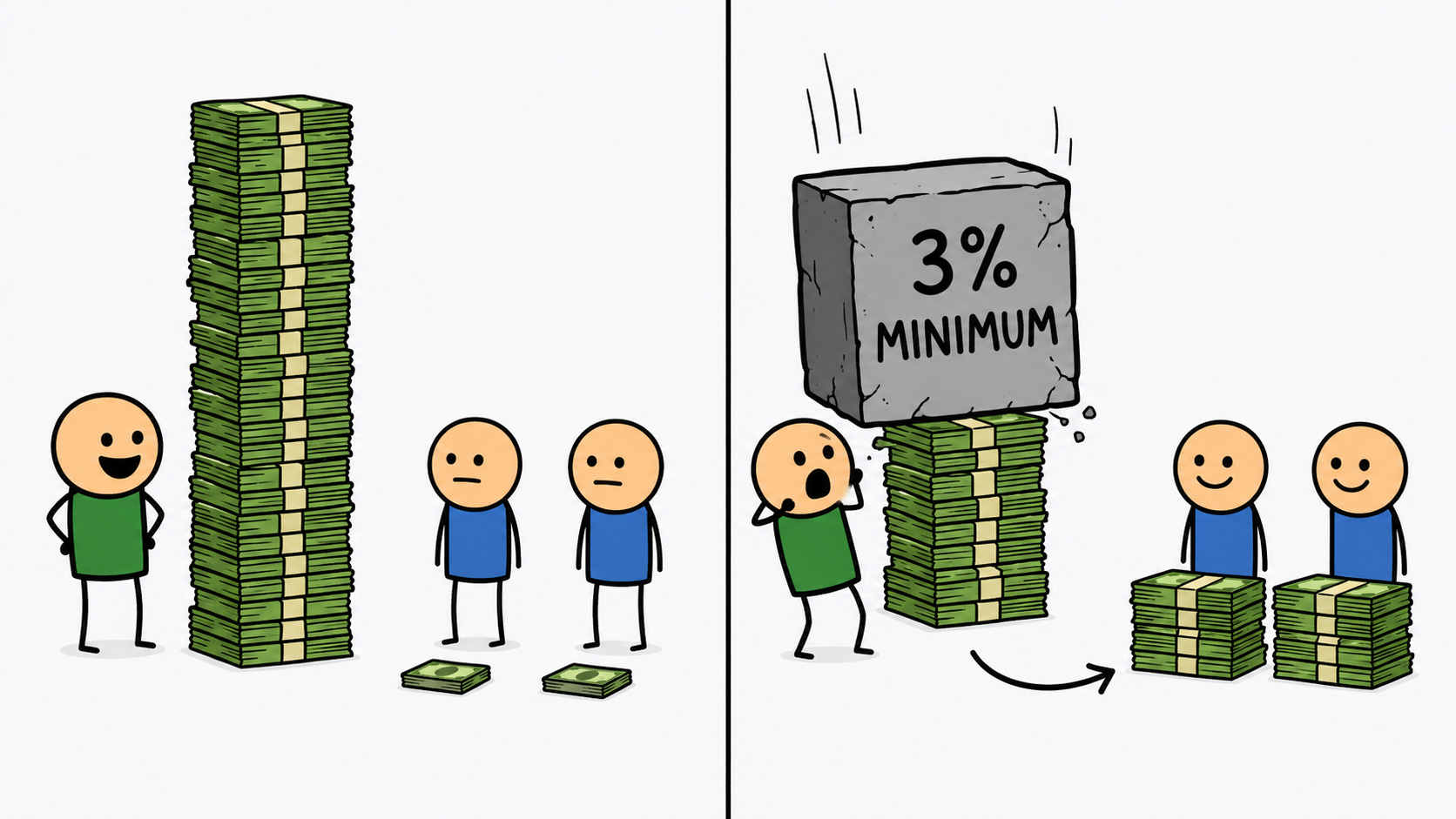
When the sixty percent threshold is crossed, the plan generally owes a minimum contribution to each non-key employee who is eligible to participate and still employed on the last day of the plan year. The minimum is generally three percent of compensation, or the highest contribution percentage made for any key employee that year, whichever is lower. This is a floor, paid by the employer. Employee deferrals by non-key employees do not count toward satisfying their required minimum. Employer contributions like matches and nonelective contributions can count. On the key-employee side, deferrals matter because the highest contribution percentage for a key employee is what can push the required minimum up to the three percent ceiling.
There is a major exception. A safe harbor 401k plan that consists only of elective deferrals and required safe harbor contributions generally avoids the top-heavy minimum contribution problem. That protection can disappear when the plan layers profit-sharing, after-tax contributions, or other non-safe-harbor contributions on top. Many small business plans are designed around this exception specifically.
Plans within a controlled group or affiliated service group can be aggregated for top-heavy testing, so the determination runs across the combined plan population rather than each plan in isolation. The vesting rules also tighten, requiring a schedule no less generous than three-year cliff or six-year graded vesting, though those schedules are now common defaults.
What happens if you do this later instead. Top-heavy testing is annual, and the minimum contribution applies to the year the plan was top-heavy. The contribution is tied to the plan year that was top-heavy. For deduction purposes, employers often think in terms of the tax-filing deadline, including extensions, but a missed top-heavy minimum is still an operational failure that has to be corrected for the affected year. Missing the minimum is an operational failure correctable through the IRS correction procedures, which require depositing the missed contribution plus earnings through the date of the correction. Letting the failure run for multiple years can lead to plan disqualification, which the correction procedures exist to prevent.
A small business owner runs a 401k plan for the business. The owner has been deferring at the limit for fifteen years, and the employer has been making profit-sharing contributions across the workforce each year. The owner’s account has grown to a substantial balance.
The other participants are five employees who have been with the business for three to five years each. Their accounts are modest compared to the owner’s.
On the determination date, the owner’s account, plus accounts of any other key employees, comes to more than sixty percent of the plan’s total balance. The plan is top-heavy for the current plan year. The employer must provide a minimum contribution of three percent of compensation to each non-key employee who is a participant on the last day of the year, unless the highest contribution percentage for the owner is lower than three percent that year, in which case the lower figure controls.
The contribution must be deposited within the timing rules for that plan year, generally by the employer’s tax filing deadline including extensions. The employer’s regular profit-sharing contribution to non-key employees can count toward satisfying the minimum.
The top-heavy rules exist to handle a structural imbalance, not to punish small business owners who have built up their plan accounts. A plan dominated by owners and key people stops looking like a workforce retirement plan, and the minimum contribution re-centers it. Many small business plans run top-heavy for years before anyone explains what is happening, and the contribution flow looks identical on the surface.
What truly matters is recognizing when the plan is at risk of crossing the threshold. The risk goes up when an owner has been in the plan for a long time and the workforce around them is newer, when the owner contributes at the limit while employees defer modestly, and when account growth has compounded for the owner over many years. Any combination of those factors moves the plan toward top-heavy.
If the plan is set up as a safe harbor 401k without layered employer contributions, the rules generally do not apply. If the plan does not use that exception, the minimum contribution is the cost of the imbalance, and it is a fixed cost that can be planned for. The correction procedures exist for years when a plan went top-heavy and the contribution did not happen, but they are more expensive than just making the contribution on time.
I write one of these every day, one retirement rule, explained in plain language and verified against the source. The daily email is free: subscribe here.
Full archive, worksheets, and search live at RetirementNewsRundown.com.
Disclaimer This article is for educational and informational purposes only. It is not tax, legal, or financial advice and does not create an advisor–client relationship. Always consult appropriate professionals regarding your specific situation.