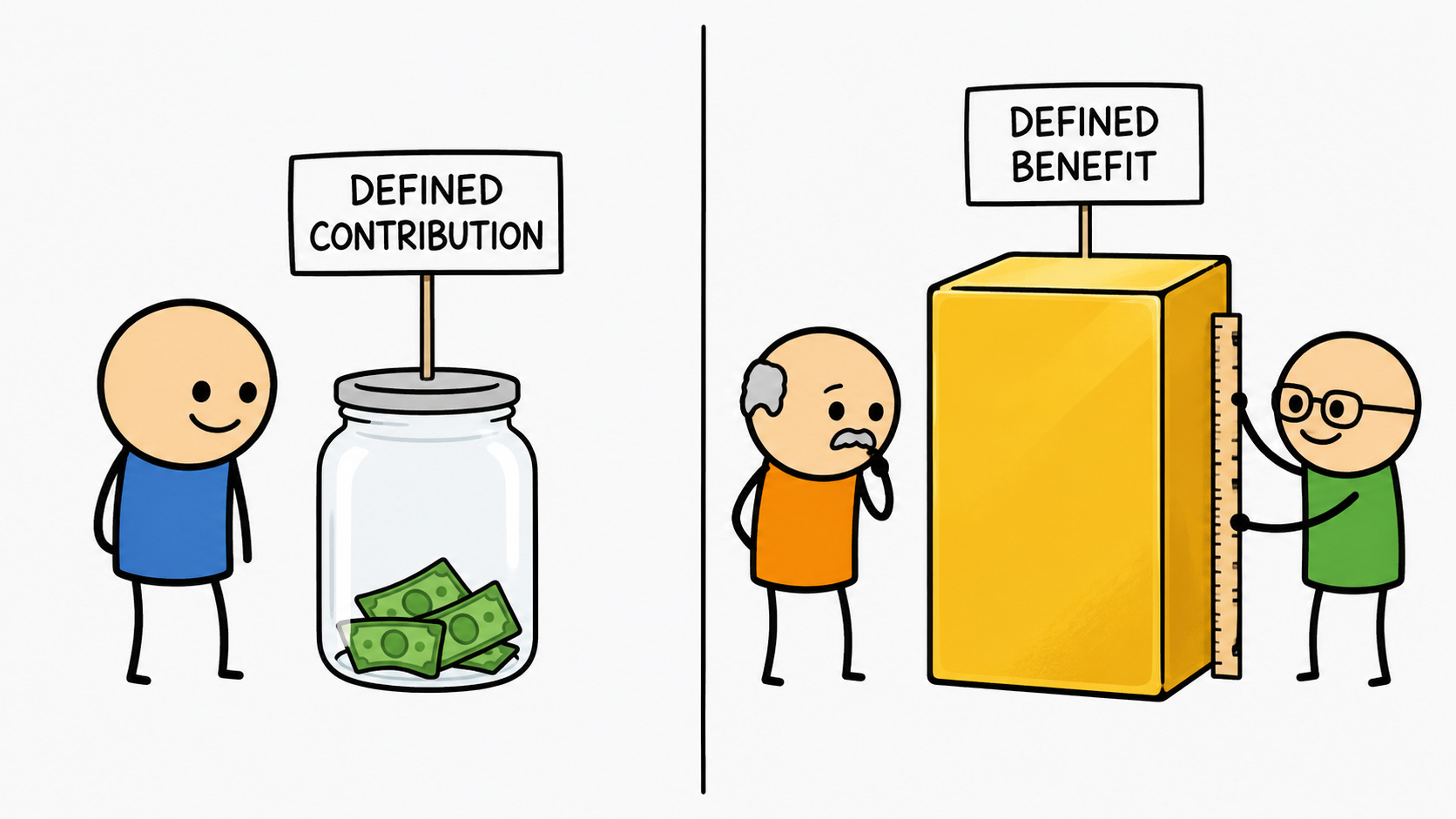
Most working Americans hear “retirement plan” and picture a 401k. That picture is accurate for the kind of plan most people have today, and it has been the dominant design for decades. What gets lost in the picture is that the modern 401k is one specific type of retirement plan, in a category called defined contribution, and there is an entire second category that operates on completely different math.
The older category is called defined benefit. It includes traditional pensions, cash balance plans, and a handful of other designs. The two categories share the goal of generating retirement income. They go about it in opposite directions, and the difference matters more than the labels suggest, both for the employee experience and the employer’s cost structure.
A defined benefit plan starts with a promise about the benefit. The plan document spells out a formula that determines what each participant will receive at retirement, usually based on years of service, final pay, and a multiplier the plan defines. The employer’s job is to make sure the plan has enough money to pay that promised benefit when each participant retires. The math runs backward from the promise. An actuary calculates what contributions the employer needs to make each year, given investment assumptions, mortality assumptions, and the participant population, so that the plan can meet its obligations.
A defined contribution plan starts with a promise about the contribution. The plan document spells out how much the employer will contribute on a participant’s behalf, and how much the participant can contribute through deferrals. Each participant has an individual account. Whatever is in the account at retirement is the benefit. There is no promised dollar figure at the end. There is just the account balance and whatever it has grown to.
That structural difference flows everywhere. In a defined benefit plan, the employer bears the investment risk. Markets up, markets down, the employer is still on the hook for the formula benefit. In a defined contribution plan, the participant bears the investment risk. Good years grow the account. Bad years shrink it. The employer’s obligation ends with the contribution.
The cost structure runs accordingly. A defined benefit plan requires an actuarial valuation each year, calculated funding minimums, and a long-term commitment to keep the plan adequately funded. A defined contribution plan requires whatever contributions the plan document promises or permits, often including employee deferrals, matching contributions, or discretionary profit-sharing. There is no actuarial calculation behind the participant’s final benefit.
The contribution limits are different shapes. A defined contribution plan has an annual addition limit that caps total contributions to any participant’s account in a year. A defined benefit plan has a maximum annual benefit limit that caps the projected benefit at retirement. That second design allows much higher annual contributions for older participants, because funding a benefit close to retirement requires larger contributions than funding the same benefit decades earlier.
Hybrid designs combine features of both. A cash balance plan is technically a defined benefit plan that presents each participant with a hypothetical account balance, which looks like a defined contribution account on a statement. The math underneath stays defined benefit, with employer funding obligations and actuarial calculations.
What happens if you do this later instead. Switching plan types is not a casual move. A defined benefit plan an employer no longer wants to fund has to be terminated, with all benefits distributed or transferred. A defined contribution plan being replaced by a defined benefit design requires a new plan document and a different funding pattern. Picking the right plan type for the situation is much easier than fixing it later.
Picture two small business owners with similar incomes. One sets up a 401k profit-sharing plan, a defined contribution design. The other sets up a cash balance plan paired with a 401k, a defined benefit and defined contribution combination.
The first owner contributes to the 401k, the business adds a profit-sharing contribution, and the total contribution for the owner is capped by the annual addition limit. The ceiling is the same shape every year, even if the employer’s actual profit-sharing contribution changes.
The second owner contributes to the 401k, and the cash balance plan calculates a much larger employer contribution based on the actuarial funding needed to deliver the projected benefit at retirement. Because the second owner is in her fifties, and assuming the plan design and workforce demographics support it, the cash balance contribution may be far larger than the annual addition limit on a stand-alone defined contribution plan would allow.
Both owners are doing the same thing on paper, putting away money for retirement. The math underneath is entirely different. One is an account. The other is a promise being funded.
The two plan categories exist because they answer different questions. Defined benefit asks how much income the retiree should have at retirement and works backward from there. Defined contribution asks how much money is being put away today and lets the future take whatever shape it ends up producing. Both are tax-favored and both have their place.
What truly matters is understanding which math is running underneath a given plan. A 401k or 403b is defined contribution, an account that belongs to the participant with a balance depending on contributions and investment results. A traditional pension or a cash balance plan is defined benefit, a formula or funding target the employer is on the hook to satisfy.
For most small businesses, the choice comes down to flexibility versus contribution capacity. Defined contribution is flexible and portable, with the same annual ceiling for everyone. Defined benefit is harder to maintain but allows much higher contributions for older participants, which can mean the difference between meaningful catch-up savings and just adding the legal maximum each year.
Knowing the category is the first step in understanding what a plan does and what it costs. A plan that looks like an account may actually be a promise. Recognizing the difference is most of what separates effective retirement plan decisions from mismatched ones.
I write one of these every day, one retirement rule, explained in plain language and verified against the source. The daily email is free: subscribe here.
Full archive, worksheets, and search live at RetirementNewsRundown.com.
Disclaimer This article is for educational and informational purposes only. It is not tax, legal, or financial advice and does not create an advisor–client relationship. Always consult appropriate professionals regarding your specific situation.