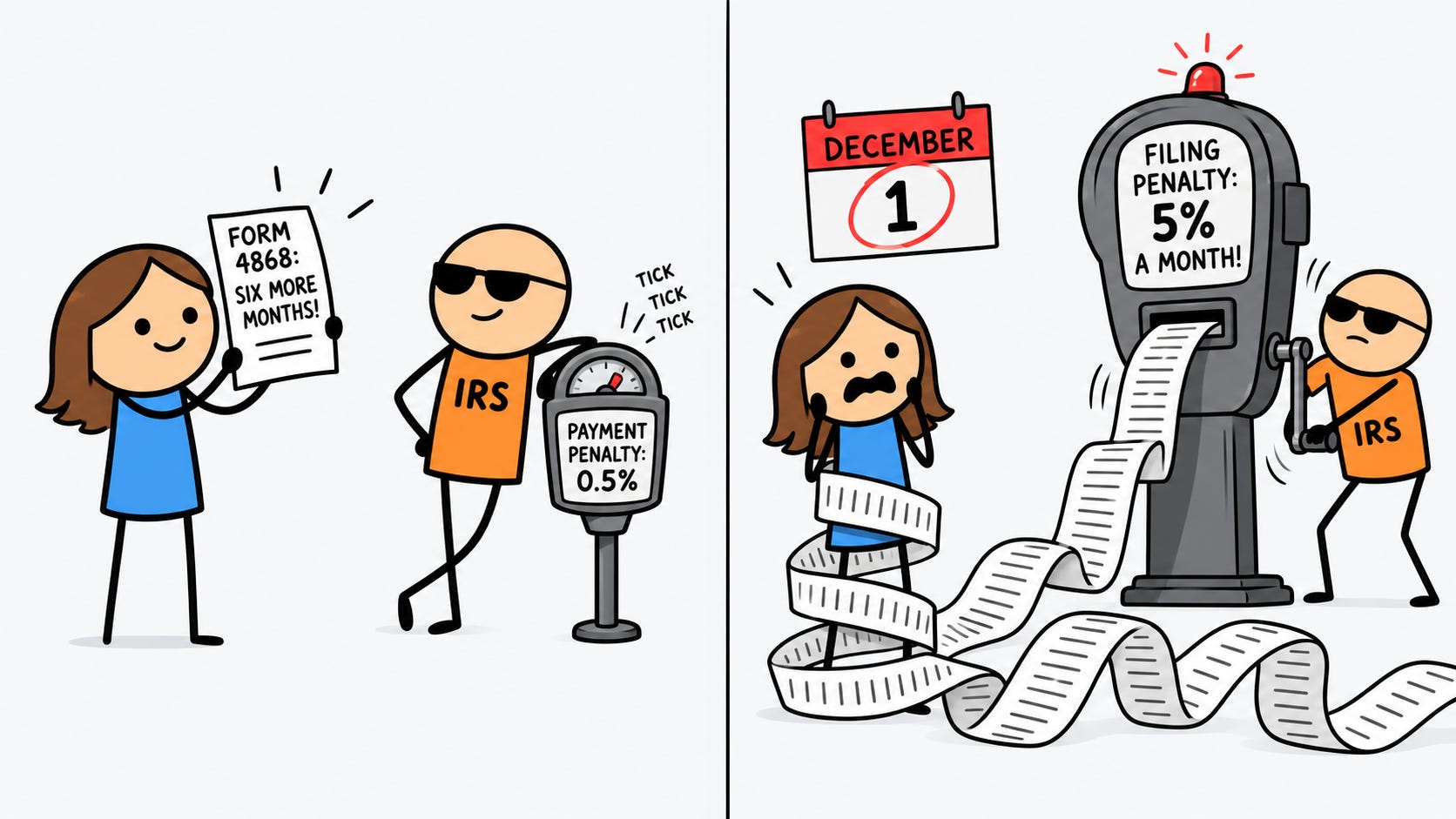
Form 4868 is the most agreeable form the IRS publishes. You file it by April 15, nobody asks why, and six more months to file your return arrive automatically with no approval letter. Retirees lean on it every year. A corrected 1099-R shows up in March, a brokerage issues a revised statement, or whoever prepares the return is waiting on one last number.
The form says it extends the time to file. A caution box on the same page says it does not extend the time to pay, and that second sentence is the expensive one. Plenty of retirees owe a balance in April, because IRA withdrawals often go out with too little withholding, and they read the extension as permission to settle up in October. The IRS reads it as a filing courtesy, and it keeps two separate penalty meters to make the point.
The first meter charges for paying late. It usually runs at one half of one percent of the unpaid tax for each month or part of a month after the original due date, which is April 15 for most calendar-year filers, and it tops out at 25%. An extension has no effect on when it starts. A balance paid on October 15 has collected six months of it, and a balance paid a week after April 15 has collected a full month, because a partial month counts as a whole one.
The second meter charges for filing late, and it runs ten times faster: usually 5% of the tax that went unpaid on the original due date for each month or part of a month the return is late, also capped at 25%. This is the one an extension actually holds off. With a valid extension, the filing penalty starts at the extended due date, October 15 for most people. Without one, it starts on April 15. The extension request itself has to go in by the original due date, so a Form 4868 mailed in late May buys nothing, and the filing penalty is figured as if it never existed.
When both meters run in the same month, the IRS reduces the filing penalty by that month’s payment penalty, so the combined charge is 5% a month. After five months of that the filing penalty hits its ceiling, and the payment penalty keeps climbing alone toward its own 25%.
A return filed more than 60 days late also hits a floor. The minimum filing penalty is a dollar amount the IRS adjusts for inflation, or 100% of the unpaid tax if that is smaller. A small balance that would have produced a polite little percentage gets rounded up to the floor once the return crosses day 60.
Both penalties are figured on tax that is due and unpaid. If withholding and estimated payments covered everything by April 15, the return shows no balance, and there is nothing for either percentage to multiply.
Interest is a third charge running underneath both penalties. It applies to any tax unpaid after the original due date, extension or no extension, and it runs until the tax is paid. The IRS charges interest on the penalties too. Interest on the tax is also the one charge a good reason cannot remove, and the Form 4868 instructions say so directly.
Both penalties can come off when the taxpayer acted in good faith and can show reasonable cause for missing the deadline. The Form 4868 instructions call for a statement attached to the return explaining the circumstances, and relief can also be requested after an IRS notice arrives by calling or writing to ask the IRS to reconsider. The extension also carries a built-in version for the payment penalty. If at least 90% of the total tax on the return was paid by the original due date, through withholding, estimated payments, or money sent with the extension, and the rest is paid with the return, the payment penalty for the extension period is treated as excused. That relief covers the extension period only. A return that shows up after the extended due date is back on the meter.
So there are two tax-filing deadlines in play. The original due date governs payment and the extension request. The extended due date governs the return itself. After the fact, a penalty can come off for reasonable cause, while the interest on the tax stays regardless.
Ruth is single and retired. Her total tax for the year comes to $20,000. Her pension withholding covered $12,000, and she took an IRA withdrawal late in the year with no withholding at all, so she has an $8,000 balance on April 15. She files Form 4868 on April 10 and sends nothing with it.
If Ruth files and pays the full $8,000 on October 15, she has met her filing deadline, and her only penalty is for paying late. Six months at one half of one percent is 3%, or $240, plus interest.
If she files and pays on December 1 instead, the payment penalty has run for eight months, counting the partial month from November 15 to December 1. That is 4%, or $320. The filing penalty starts on October 15 and covers two months, the second one partial, at 5% each reduced by the half percent overlap. That is 9%, or $720. Her return is 47 days past the extended due date, so the 60-day floor never comes into play. Six extra weeks took her from $240 to $1,040, before interest.
Had Ruth skipped the extension and filed on December 1, the filing penalty would have started on April 15 and run all the way to its cap: five months at 4.5%, or 22.5%, which is $1,800, on top of the same $320 payment penalty. That totals $2,120 for the identical return filed on the identical day.
One more version. If Ruth had mailed $6,000 with her extension, her payments by April 15 would have reached $18,000, which is 90% of her total tax. Paying the last $2,000 with a return filed by October 15 would have wiped out the payment penalty for the extension period. Interest on that $2,000 would still apply.
Most of this is gentler than it sounds. The payment penalty grows at half a percent a month, which is a slow leak. The filing penalty is the expensive one, and the extension handles it completely, provided the return actually arrives by the extended date. A return whose tax was fully paid by April 15 carries no percentage penalty at all, early or late.
The real exposure sits in two places: an extended return that misses October 15, where the meter jumps from half a percent to five, and an unextended return, where the filing penalty has been running since April. Where a return falls depends on which deadline it met, and the original due date, the extended due date, and the rest of the year’s retirement dates are collected in our retirement account deadlines guide.
I write one of these every day, one retirement rule, explained in plain language and verified against the source. The daily email is free: subscribe here.
Full archive, worksheets, and search live at RetirementNewsRundown.com.
Disclaimer
This article is for educational and informational purposes only. It is not tax, legal, or financial advice and does not create an advisor-client relationship. Always consult appropriate professionals regarding your specific situation.