Retirement accounts have no memory for the space you have used. Contribution limits run by the year and they do not bank, so a year you could not afford to contribute is a year that is simply gone, and a withdrawal in a hard year permanently shrinks what the account will ever be able to hold. That one-way quality is the reason taking money out early feels so final, separate from any penalty attached to it.
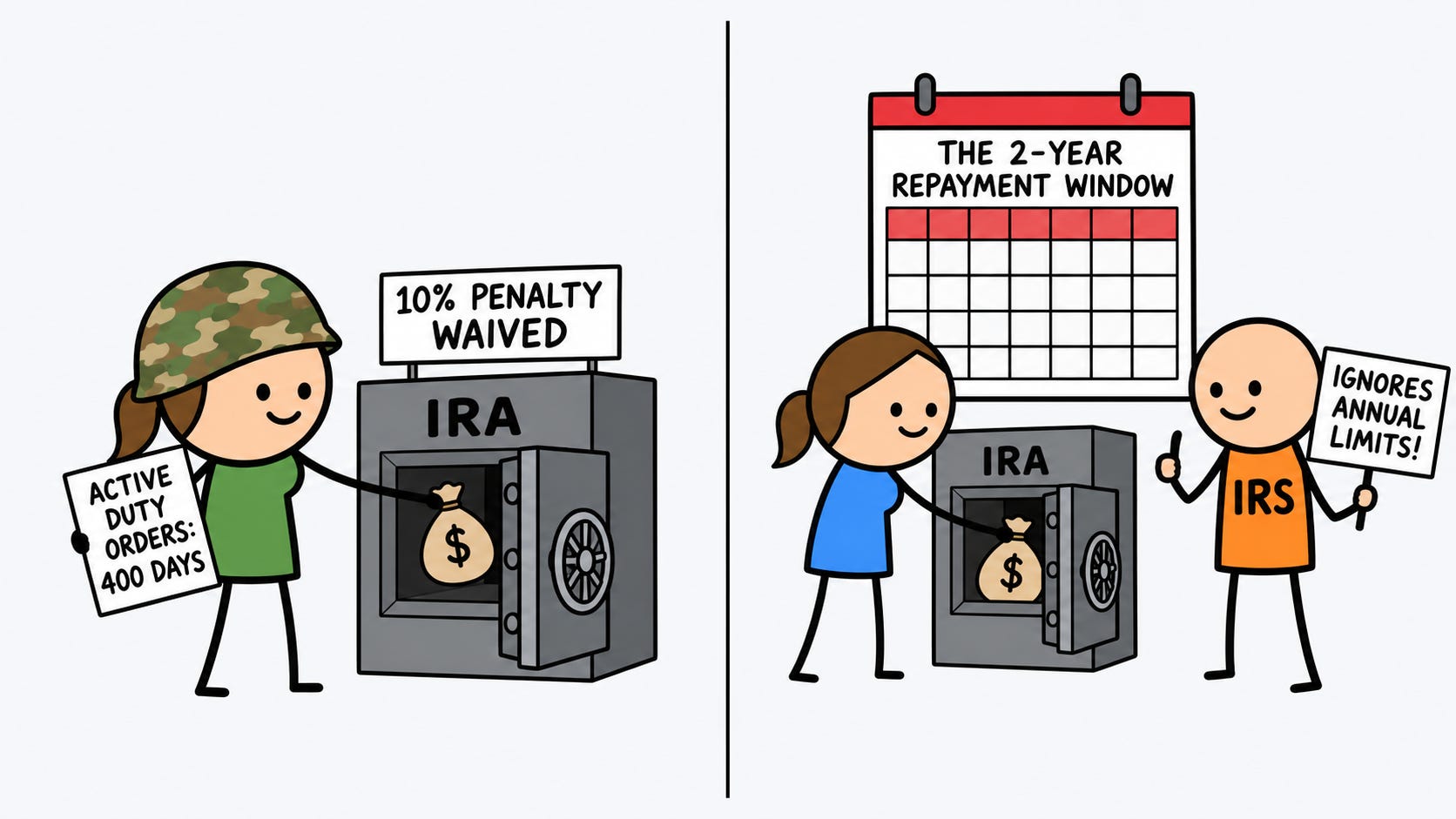
One exception suspends that. It covers reservists and National Guard members called to active duty, and alongside waiving the 10% it gives you a window measured in years to put the money back into an IRA, on top of whatever you are otherwise allowed to contribute. Several exceptions now carry a repayment right of some kind. This one runs on different plumbing from the rest, and the difference decides what you actually get back.
Four conditions have to be met, and they are narrower than people assume.
You were ordered or called to active duty as a member of a reserve component, and the publication names them: the Army and Air National Guard of the United States, the Army, Navy, Marine Corps, Air Force and Coast Guard Reserves, and the Reserve Corps of the Public Health Service.
The call has to be for a period of more than 179 days or for an indefinite period. A shorter activation does not reach it, and the duration is set by the order rather than by how long you actually end up serving.
The money has to come from the right place. An IRA qualifies. Inside a workplace plan, only amounts attributable to elective deferrals qualify, meaning your own salary reductions under a 401(k) or 403(b) arrangement or something similar. Employer match and profit sharing money in the same account does not, which surprises people who see one balance and assume it all behaves alike.
And the timing is the sharp edge. The distribution has to be made no earlier than the date of the order or call to active duty, and no later than the close of the active duty period. The window opens when the orders arrive and shuts when the duty ends. Money taken the month before the orders come through does not qualify. Neither does money taken after you are home, which is often exactly when the bills land.
Meet all four and the 10% additional tax does not apply. The exception is narrow in what it reaches. A distribution from a traditional IRA or from pretax deferrals is still ordinary income in the year taken, which for someone whose civilian pay has stopped is frequently a smaller bill than usual, though it is still a bill.
Then the repayment. You can recontribute part or all of the distribution to an IRA, and you have two years after the active duty period ends to do it. Those contributions go in as nondeductible money, reported on the basis tracking form, and you cannot take a deduction for them. In exchange, the normal dollar limits on IRA contributions do not apply to them, so you can put the deployment money back and still make your regular contribution for the same year.
This is where the plumbing matters. The publication groups five other exceptions together as early distributions whose repayments are treated as rollovers: qualified birth or adoption, terminal illness, domestic abuse, emergency personal expenses, and qualified disaster recovery. Repaying one of those reaches back and lowers your income for the distribution year, by amended return if the repayment came in a later year. The reservist repayment does not work that way. It arrives as basis, so the income tax you paid stays paid. What comes back is the shelter rather than the tax.
What happens if any of it slips. Take the distribution outside the window and it is an ordinary early distribution, with the 10% attached and no repayment right. Miss the two year repayment deadline and the distribution stays a distribution, taxed as it was, with the contribution room spent like anyone else’s. The exception has no late filing procedure and no relief provision, because it is a timing rule rather than a correction rule.
Lena is 34 and serves in the Army Reserve. Her orders are dated January 12 and activate her for 400 days. Her civilian job stops paying, and between her mortgage and her household the gap is real by spring. She has an entirely pretax traditional IRA holding $19,000 and a 401(k) holding $41,000, of which $26,000 is her own pretax deferrals and $15,000 is employer match.
In June she takes $12,000, drawing $9,000 from the IRA and $3,000 from the deferral side of the 401(k). Every condition holds. She is in a named reserve component, the order runs well past 179 days, both sources qualify, and June sits inside the window that opened with her orders in January. The $12,000 is ordinary income for that year, a year in which her taxable income is unusually low, and no 10% applies. Without the exception that would have cost her another $1,200.
Her active duty ends on February 16 the following year, 400 days from the order. That starts a clock, and she has until February two years after that to put money back. In the autumn of the second year she recontributes the full $12,000 to her IRA. It goes in as nondeductible basis, she takes no deduction for it, and it does not touch her annual contribution limit, so she makes her ordinary contribution for that year as well. The $12,000 is back inside the account and sheltered again.
Now the version where she waits. She comes home in February and takes the $12,000 in March, once the orders are finished and she can sit down with her accounts in peace. The active duty period has closed, so the distribution falls outside the window. It is an ordinary early distribution, the 10% applies, and the $1,200 is real. There is also no recontribution right, so the $12,000 of room is gone permanently.
Five weeks separate those two outcomes, and nothing in the paperwork tells you which side of the line you are on. The custodian will process either request the same way, and the form arrives coded as an early distribution with no known exception either way, whatever anyone there knows about your orders. Claiming the exception is on you.
So the sequence worth knowing is small. The orders start the window. The end of active duty closes it and simultaneously starts a two year clock to put the money back. If money is going to be needed, it is better taken while the orders are live than after the homecoming, which runs against every instinct about dealing with paperwork when there is time to do it properly.
The recontribution is the part most likely to get lost, because it happens two years after the hard year and nobody is thinking about it. It reports on the nondeductible basis form, and the guide to Form 8606 covers how basis gets tracked and why the paperwork matters decades later. If the money is coming from a workplace plan rather than an IRA, the question of which dollars are deferrals and which are employer money sits in the 401(k) guide.
I write one of these every day, one retirement rule, explained in plain language and verified against the source. The daily email is free: subscribe here.
Full archive, worksheets, and search live at RetirementNewsRundown.com.
Disclaimer
This article is for educational and informational purposes only. It is not tax, legal, or financial advice and does not create an advisor-client relationship. Always consult appropriate professionals regarding your specific situation.