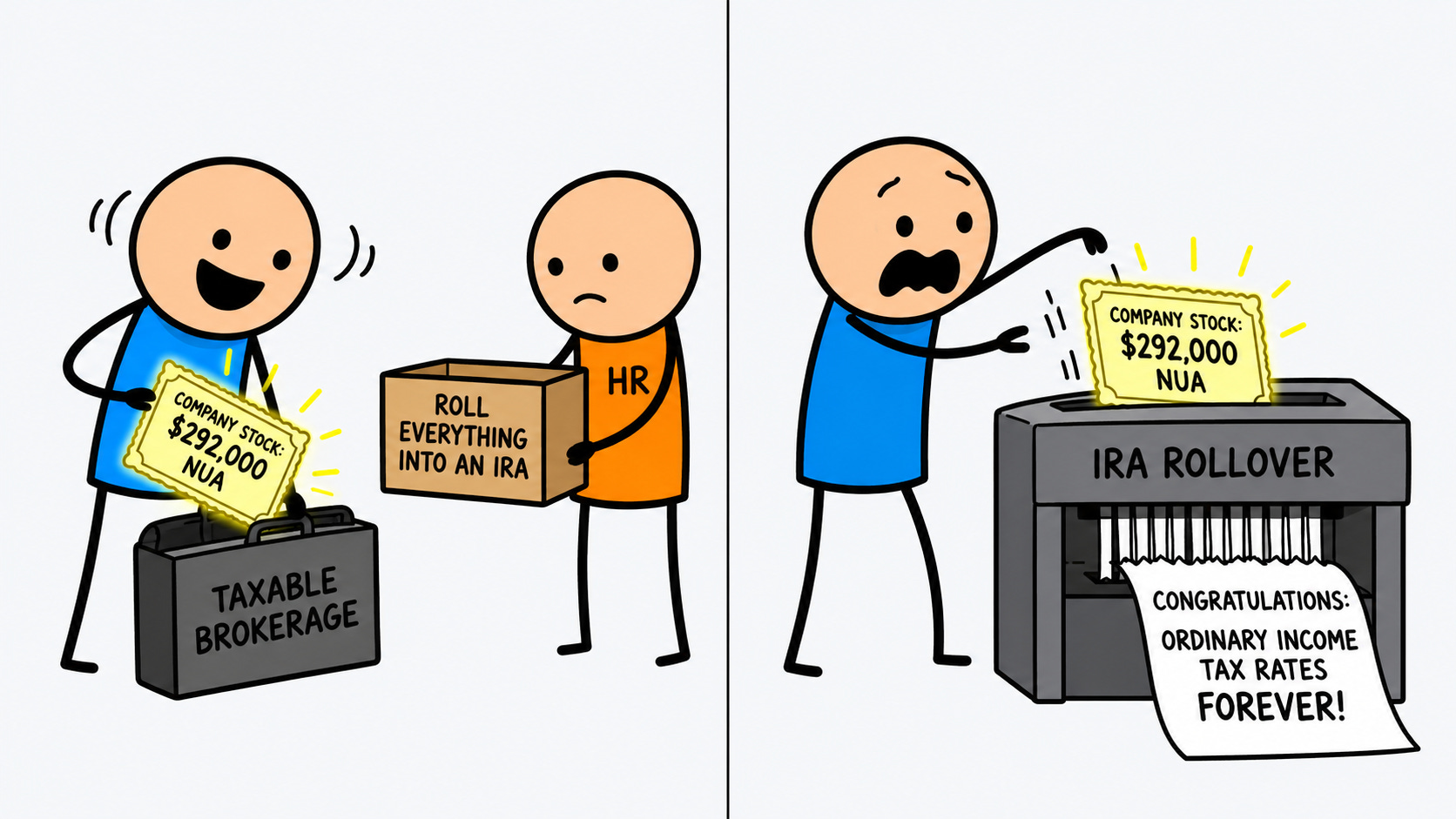
When you leave a job, the plan hands you a short list of boxes to check, and one of them rolls everything into an IRA. That box is the default, and for almost every asset in the account it is correct. For one specific holding it closes a door that does not reopen, and the form gives you no indication that is happening.
The holding is employer stock. If your plan account contains shares of the company you worked for, worth more than the plan paid for them, the gap between those two numbers has its own set of rules. Checking the ordinary box makes those rules unavailable permanently.
The gap has a name, net unrealized appreciation, and the publication defines it as the net increase in the securities’ value while they were in the trust. The treatment covers the employer corporation’s stocks, bonds, registered debentures, and debentures with interest coupons attached, so it reaches more than common shares, which is what nearly everyone holds.
The treatment splits one asset into two tax events. The taxable plan cost in the shares is ordinary income to you in the year they come out, while any nondeductible contributions of your own come back tax free. The appreciation on top of that cost is deferred until you sell, and the gain is then long term capital gain up to the amount of that deferred appreciation, regardless of how long you held the shares after they left the plan. Any further gain beyond the deferred amount is long or short term depending on how long you held them. The deferred figure shows up in its own box on the distribution form, so the number is not something you have to reconstruct.
Now the gate, which is the part worth memorizing. Full deferral of the appreciation requires that the shares come out as part of a lump sum distribution, and the term has a specific definition here: the payment of the participant’s entire balance, within a single tax year, from all of the employer’s qualified plans of one kind, meaning pension, profit sharing, or stock bonus plans. And the distribution has to be paid for one of four reasons: because the participant died, after the participant reaches 59.5, because the participant was an employee and separates from service, or after a self-employed participant becomes totally and permanently disabled.
Four doors. The one most people walk through is separation from service, which is also the moment the plan hands them the rollover form. That collision of timing is the whole problem.
Miss the lump sum requirement and you do not lose everything, but you can lose most of it. If the distribution is not a lump sum distribution, deferral reaches only the appreciation attributable to employee contributions, which can cut sharply into how much of the gap gets the treatment.
There is also an election running the other direction. You can choose to include the appreciation in income in the year of distribution, but only by electing out of the treatment altogether, in which case the full value of the securities is ordinary income that year and no part of it qualifies for capital gain treatment later.
One practical detail surprises people at the window. The usual 20% withholding on a rollover distribution paid to you does not apply to the appreciation that can be excluded from your income, and no withholding is required at all when the distribution consists solely of employer securities plus cash of $200 or less for fractional shares.
Then the part that costs the most. Roll the employer stock into an IRA and the treatment is gone for those shares. The rule needs a distribution of the securities out of the plan, and a rollover is not one. The shares become ordinary IRA assets, and later payments out of that IRA follow the IRA rules, where appreciation carries no capital gain character at all. There is no election to make afterward and no form to file. The appreciation that would have been capital gain becomes ordinary income on its way out, years later, a little at a time.
Harold is 61 and retires from a manufacturer on March 31. His plan account holds 4,000 shares of company stock plus $410,000 in ordinary funds. The shares were bought entirely with pretax plan money at an average cost of $22, so the plan’s cost in them is $88,000, and they trade at $95 on the day he takes the distribution, which puts the shares at $380,000 and the appreciation at $292,000.
He is past 59.5 and he has separated from service, so two of the four doors are open. He takes his entire balance out within the same tax year, directing the 4,000 shares in kind to a taxable brokerage account and the $410,000 of funds into an IRA. For that year he reports $88,000 of ordinary income, the plan’s cost in the shares. The $292,000 rides along untaxed, recorded in its own box on the form he receives in January. Whenever he sells, that $292,000 is long term capital gain even if he sells the week after the distribution, and anything the shares gain after that depends on how long he held them.
Now the other version. On April 9 he signs the form that moves the whole account, shares included, into a rollover IRA. His tax bill for the year is zero, which feels like the better outcome in April. The 4,000 shares sit in the IRA and the $292,000 of appreciation is now indistinguishable from any other dollar in it. When distributions start, that appreciation comes out as ordinary income, and so does everything it earns from here. In July his advisor explains what happened. There is nothing to undo for those shares. The event that could have triggered the treatment was the distribution he chose not to take, and the shares now answer to the IRA rules.
Which version costs less is a real calculation and not a foregone one. The first version means paying ordinary income tax on $88,000 now, in exchange for capital gain treatment on $292,000 later. The second defers everything and converts the appreciation to ordinary income. The answer turns on the spread between the two rates in the years that matter, how large the appreciation is relative to the plan’s cost, how soon the shares get sold, and what else is on the return in the year of distribution. A small appreciation sitting on a large cost basis is a weak candidate. A large appreciation on a small cost basis is the case the treatment was built for.
What is not a real calculation is doing it in July. The deferral needs the shares to leave the plan in a qualifying distribution, and the qualifying event is usually a separation from service that has already happened. So the useful move is to find out whether the account holds employer stock and what the plan’s cost in it is, before signing anything at separation. Plans will tell you both if you ask.
The number arrives on the distribution form in its own box, and the guide to Form 1099-R covers which box carries it and what the surrounding codes mean. If you are weighing how the rest of the account should move, the mechanics of getting it there sit in the rollover IRA guide.
I write one of these every day, one retirement rule, explained in plain language and verified against the source. The daily email is free: subscribe here.
Full archive, worksheets, and search live at RetirementNewsRundown.com.
Disclaimer
This article is for educational and informational purposes only. It is not tax, legal, or financial advice and does not create an advisor-client relationship. Always consult appropriate professionals regarding your specific situation.