A SIMPLE IRA plan is built around the calendar year. An employer that runs one generally cannot contribute to any other retirement plan for the same year, and the ordinary way out of a SIMPLE waits for the year to end. A small business that outgrows its SIMPLE in March would spend nine months admiring the 401(k) it wants.
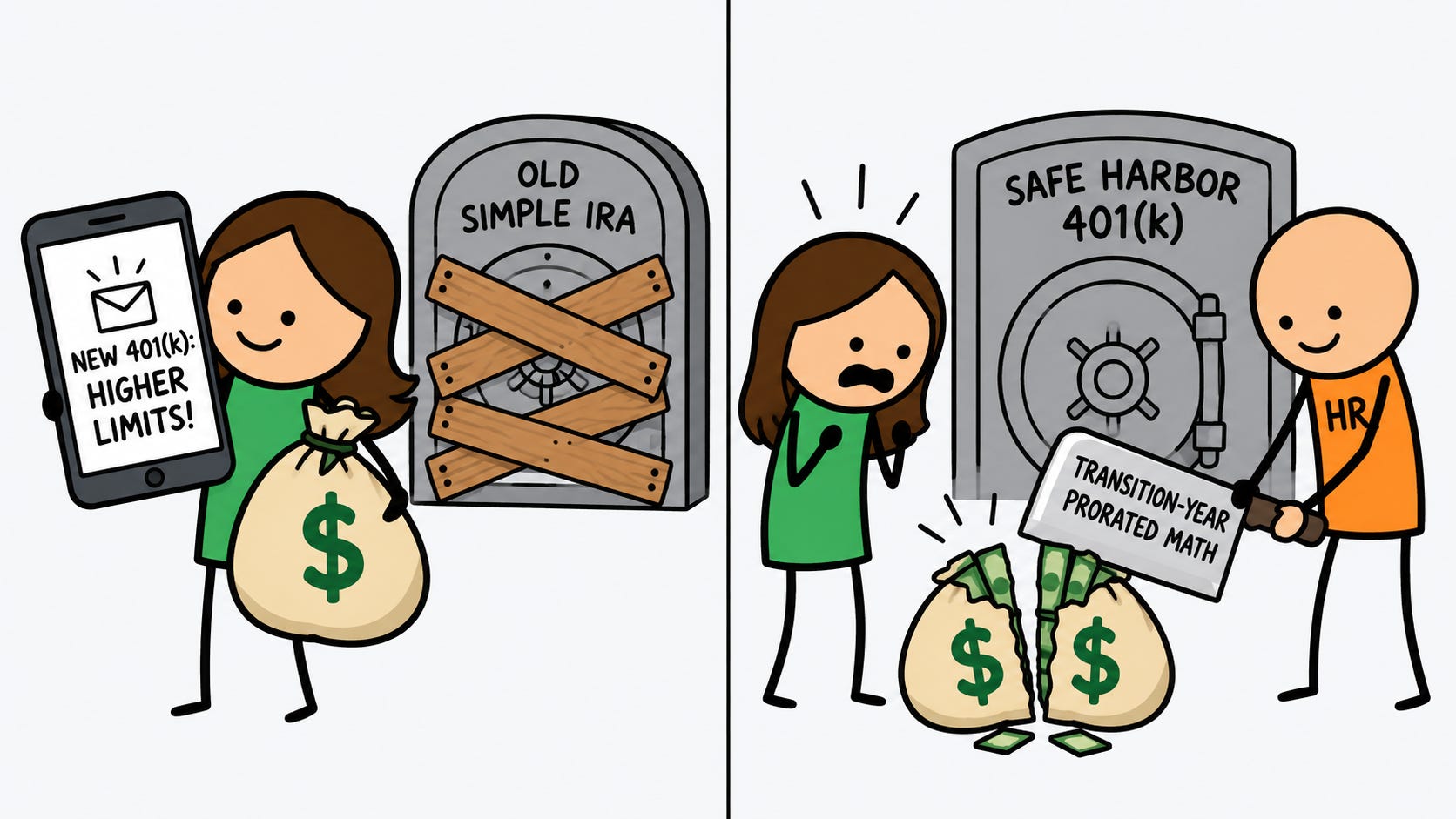
There is one exit in the middle of the calendar. An employer can end a SIMPLE partway through the year and start a 401(k) the next day, as long as the replacement is a safe harbor 401(k). Plenty of employees find out about this in a single all-staff email, read “better plan, higher limit,” and assume they can pick up deferring wherever the new plan’s limit allows. The transition year runs on a math problem that nobody puts in the subject line.
The switch starts with the employer taking formal written action that names a termination date for the SIMPLE. Employees have to be notified at least 30 days before that date. The notice has to say that no salary deferrals will go into the SIMPLE from pay after the termination date, and that the employer still owes its matching or nonelective contributions on pay earned through that date. A notice that goes out later simply pushes the earliest possible termination date later, because the 30 days run from the notice. The IRS does not need to be told.
Only a safe harbor 401(k) qualifies for this midyear exit. Any other 401(k) collides with the one-plan rule, which means waiting for the calendar year to turn over.
The employer contributions owed for the SIMPLE portion of the year follow the usual SIMPLE deadline, which is the due date of the employer’s tax return including extensions. Ending the plan early neither cancels them nor moves that deadline.
Then comes the transition-year limit. For the year of the switch, an employee’s combined deferrals to both plans are capped by a blend of the two plans’ limits, weighted by the days each plan was in effect. Take the SIMPLE deferral limit, including the catch-up for anyone old enough to use it, and multiply it by the number of days the SIMPLE ran divided by 365. Do the same with the 401(k) deferral limit and the days the 401(k) ran. Add those together and subtract whatever the employee already deferred into the SIMPLE. What remains is the room in the new 401(k) for the rest of the year. If the new plan is one that has to send a safe harbor notice, that notice has to describe this reduced limit, so affected employees are supposed to get the number in writing. Many plans built on the nonelective safe harbor contribution are exempt from that notice, and in those plans the number may never show up on paper.
The two-year rule gets a special exception during the switch. Normally, money in a SIMPLE IRA can move tax free only to another SIMPLE IRA until two years after the employee began participating in the plan, and a withdrawal inside that window can draw a 25% additional tax on the taxable portion instead of the usual 10%. When an employer terminates a SIMPLE and replaces it, an employee still inside the two-year window can roll the money into a 401(k), including the new one, or a 403(b), without that problem. The receiving plan has to hold the money under its own withdrawal restrictions. A regular IRA still has to wait until the two years are up.
So the deadlines sort out like this. The 30-day notice and the termination date run on the employer’s own schedule. The one-plan rule and the transition-year limit run on the calendar year. The employer’s contributions for the SIMPLE stretch run on the employer’s tax-filing deadline. The two-year window runs from when the employee began participating in the SIMPLE, whatever the calendar says.
A dental practice decides in the spring that its SIMPLE has to go. On May 20, the owner signs a written resolution ending the SIMPLE as of June 30 and adopting a safe harbor 401(k) effective July 1. Staff get written notice on May 25, which is 36 days ahead of the termination date.
The SIMPLE was in effect for 181 days of a 365-day year, and the 401(k) runs for the other 184. Each plan gets just about half of its own annual limit.
Maya, 44, front-loaded her SIMPLE with a large spring bonus and had deferred the full SIMPLE limit by the end of June. Her room in the new 401(k) is just under half the SIMPLE limit plus just over half the 401(k) limit, minus the full SIMPLE limit she already used. That works out to roughly half the gap between the two plans’ limits. She expected the 401(k) limit. She gets a fraction of the difference, and if the new plan is subject to the safe harbor notice requirement, that limit has to be spelled out in the notice.
The practice still owes the SIMPLE match on Maya’s pay through June 30. It has until the due date of its return, including extensions, to deposit it.
Leo, 31, joined the practice eight months before the switch, so he is well inside his two-year SIMPLE window. He can roll his SIMPLE balance into the new 401(k) without the 25% problem, and from then on it follows the 401(k)’s withdrawal rules. If he moves the money to his own IRA instead before his two years are up, it counts as a withdrawal. The taxable portion is income, and at his age, without an exception, it draws the 25% additional tax. If he leaves the SIMPLE IRA where it sits and waits until his two-year mark, an IRA rollover opens up on the normal schedule.
Most of what makes this feel risky is the timing, and the timing is mostly in the employer’s hands. The notice, the termination date and the employer’s remaining contributions are the employer’s checklist. An employee’s part is narrower: knowing that the transition year has its own cap, and knowing that the two-year SIMPLE restriction still applies to every destination except a 401(k) or 403(b) that takes the money under its own withdrawal rules.
The transition year happens once. Starting the following January, the 401(k) runs on its own normal limit with no blending and no SIMPLE math. For a business weighing whether a SIMPLE or a 401(k) fits its size and payroll in the first place, the Small Business Retirement Plan Selector lays out how the plan types compare before anyone has to switch midstream.
I write one of these every day, one retirement rule, explained in plain language and verified against the source. The daily email is free: subscribe here.
Full archive, worksheets, and search live at RetirementNewsRundown.com.
Disclaimer
This article is for educational and informational purposes only. It is not tax, legal, or financial advice and does not create an advisor-client relationship. Always consult appropriate professionals regarding your specific situation.