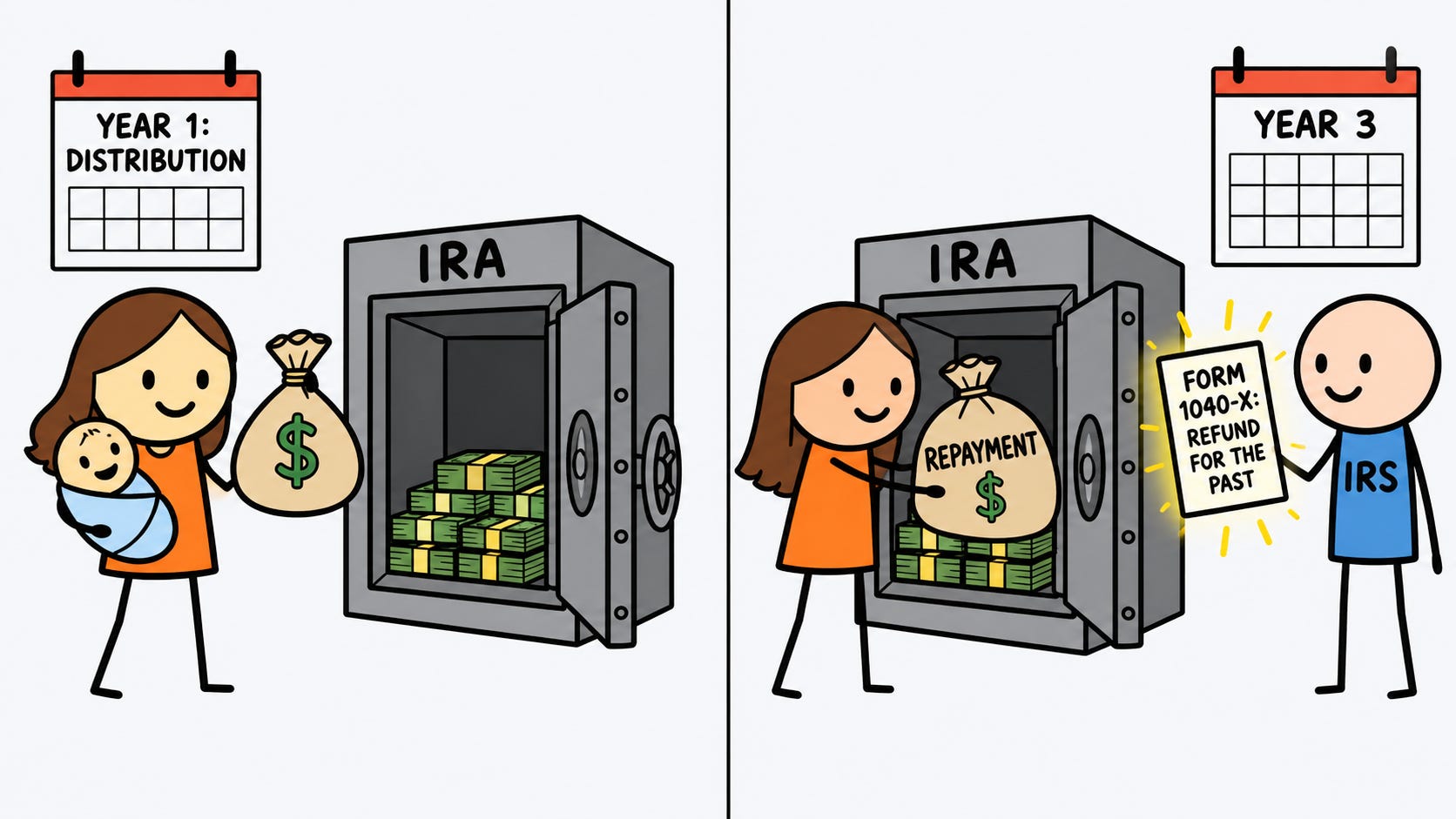
A handful of early IRA withdrawals now come with an undo button. Money taken for the birth or adoption of a child, a terminal illness, domestic abuse, or an emergency personal expense escapes the 10% additional tax, and it can also be put back. The IRS treats the repayment like a rollover, as if the money had never really left.
The undo button has an odd wiring diagram. People who repay tend to go looking for the payoff on the return for the year they wrote the check, as a deduction or an offset against whatever else that year brought. The repayment actually reaches back into the year the money came out, and when that year’s return is already filed, collecting on it means amending that return.
The repayment window is three years, beginning on the day after the distribution was received. The money can go back into an IRA or another eligible retirement plan of which the person is a beneficiary and that accepts rollovers, in one deposit or several, and the total repaid cannot exceed what was taken out. Inside that window, the repayment is treated as a rollover, so it sits outside the annual IRA contribution limit.
When the money comes out and goes back in the same tax year, everything happens on one return. The distribution and the repayment are both reported, and only the taxable part of whatever was never repaid ends up in income.
When the repayment lands in a later year, the return for the year of the distribution gets amended on Form 1040-X. Income for that earlier year goes down by the repaid amount that was taxable when it came out, which lowers that year’s tax and can produce a refund. The return for the year the check is written does not change.
The taxable part matters when the IRA holds basis from nondeductible contributions. Part of every distribution from that IRA came out tax free, and repaying the tax-free part reduces nothing. Pub 590-B uses a ratio of the IRA’s basis to its year-end value to sort the repayment into taxable and tax-free slices, and only the taxable slice comes off the amended return. An IRA holding only pretax money skips all of that, because every dollar of the distribution was taxable.
Form 8606 can enter the picture too. For a traditional IRA, it comes into play when the IRA holds basis, since that is the form where taxable and tax-free amounts get sorted. Roth IRA distributions generally run through it as well.
The emergency personal expense distribution carries one more string. Only one can be taken per calendar year, and after taking one, another cannot be taken for the following three calendar years unless the first is repaid or new contributions to the IRA since then at least equal the unrepaid amount. Repaying is one way to reopen the door early, and enough new contributions can do it too.
After the three-year window closes, the undo button is gone. The distribution stays income in the year it came out, and any money deposited later is just a contribution, subject to the usual limits.
Qualified disaster recovery distributions can be repaid too, but they run on their own form and their own reporting choices, which is a separate article.
So the timing sorts into three clocks. The distribution belongs to the tax year it was taken. The repayment window runs three years from the day after the money came out, regardless of the calendar. The amended return corrects the earlier tax year, whenever the repayment happens to arrive.
Priya, 34, finalizes an adoption on March 10. On May 1 of the same year she takes $4,000 from her traditional IRA as a qualified adoption distribution. The IRA holds nothing but pretax money rolled over from an old 401(k), with no nondeductible contributions, so the full $4,000 is taxable. Because it qualifies under the adoption exception, there is no 10% additional tax. She files that year’s return the following April with the $4,000 included in income.
Her repayment window runs from May 2 of the adoption year through May 1 three years later.
If Priya had repaid the $4,000 that December, both moves would have landed in the same tax year. Her original return would have shown the distribution and the repayment, nothing would have been taxed, and no amendment would ever be needed.
She repays it in August of the following year instead. Her return for that following year looks exactly as it would have without the repayment, with no deduction and no offset. She files Form 1040-X for the adoption year, lowering that year’s taxable IRA income by $4,000 and claiming the resulting reduction in tax. Because her IRA holds no basis, Form 8606 stays out of it.
If she misses the window and deposits the $4,000 on May 2 three years later, it is no longer a repayment. The adoption-year income stays put, no amended return can undo it, and the deposit is an ordinary contribution, subject to the usual limits.
Most of the anxiety here comes from expecting the repayment to show up somewhere it never will. The original exception already did its job. The 10% additional tax never applied, so nothing is riding on the repayment except the income tax already paid, and three years is a long runway to recover it.
What matters is lining up the years correctly: the distribution year carries the income, and the amended return for that same year carries the fix. When the IRA holds basis, the taxable slice of a repayment gets sorted on Form 8606, and our Form 8606 guide walks through what that form tracks and when it is required.
I write one of these every day, one retirement rule, explained in plain language and verified against the source. The daily email is free: subscribe here.
Full archive, worksheets, and search live at RetirementNewsRundown.com.
Disclaimer
This article is for educational and informational purposes only. It is not tax, legal, or financial advice and does not create an advisor-client relationship. Always consult appropriate professionals regarding your specific situation.