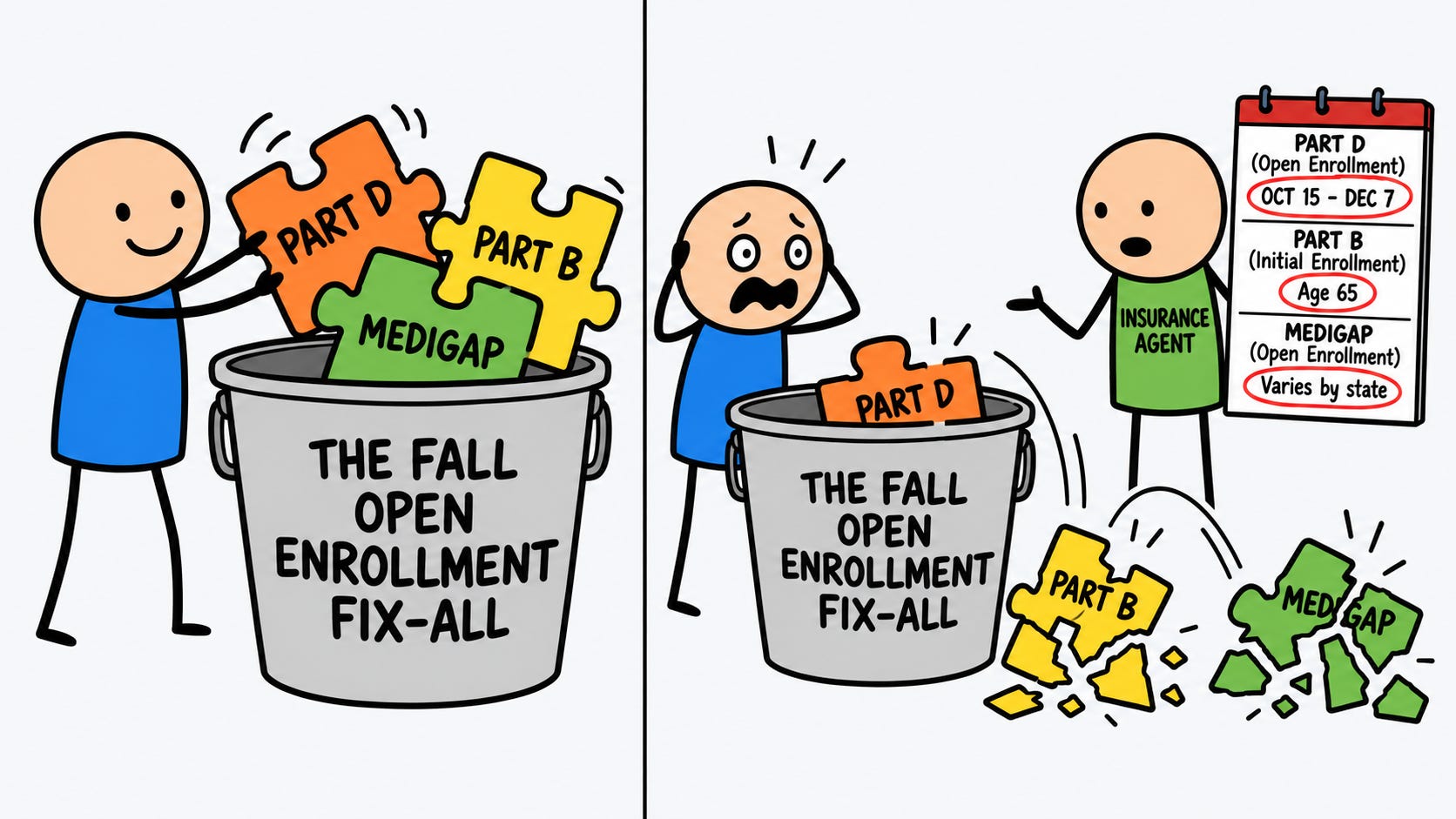
Every fall, Medicare holds a shopping season of a little under eight weeks, and your mailbox knows about it before you do. Plan brochures, postcards with smiling golfers, and the occasional phone call from someone very excited about dental benefits all arrive on schedule. The window runs from October 15 through December 7, and the name it goes by, (drum roll please) OPEN ENROLLMENT! It sounds like an invitation to rearrange every piece of Medicare you own.
It covers less than the name suggests. Open Enrollment is a window for Medicare Advantage plans and Medicare drug plans. Medigap policies, Part B sign-ups and a few other moves run on their own calendars, and a surprising number of people find that out in December, holding a form that was due somewhere else.
Here is what the window actually does. Between October 15 and December 7, people with Medicare can join, switch or drop a Medicare Advantage plan, with or without drug coverage. They can join, switch or drop a separate Medicare drug plan. And someone in a Medicare Advantage plan can leave it and go back to Original Medicare, picking up a separate drug plan along the way.
Switching drug coverage is simpler than people expect. Joining the new plan is the whole move. When the new drug coverage starts, the old drug coverage ends, and the new plan is supposed to send a letter saying when coverage begins, so there is no cancellation call to make first.
Every change made in this window takes effect on January 1, provided the plan gets the request by December 7. The new coverage also comes with a full calendar year attached. Outside the enrollment periods, Medicare generally expects people to stay in the plan they picked for the rest of that year.
Doing nothing is also a choice the window accepts. A current plan that is still offered carries into the new year, along with whatever cost and coverage changes it announced in the fall. That annual notice deserves its own article, and it gets one.
Now the parts the window leaves alone.
Medigap runs on its own clock. The best time to buy a Medigap policy is a six-month window that starts the first month someone has Part B and is 65 or older. After that, Medicare’s own handbook says a person “may not be able to buy a Medigap policy or it may cost more,” with certain guaranteed rights carved out. Open Enrollment gives no special federal right to switch Medigap policies. An application in November is still governed by the Medigap rules and any extra protections a state adds, some of which run on their own dates. Medigap also cannot pay costs inside a Medicare Advantage plan, and a person in Medicare Advantage generally cannot buy Medigap unless they are switching back to Original Medicare.
Part B has its own door too. Someone who skipped Part B when first eligible and has no special enrollment period signs up during the General Enrollment Period, January 1 through March 31, with coverage starting the month after signing up and possibly a higher premium for the late start. Open Enrollment has no Part B sign-up in it at all.
After December 7, the options narrow sharply. People already in a Medicare Advantage plan get a second, smaller window from January 1 through March 31 to switch Advantage plans once or return to Original Medicare. That window does nothing for someone in Original Medicare who wanted a different drug plan. Beyond that, changes mid-year generally need a special enrollment period, triggered by events like moving or losing other coverage, or the five-star special enrollment period for switching into a plan with Medicare’s top quality rating. People with Medicaid or Extra Help may be able to change drug coverage once a month.
So the deadlines sort into three calendars. Open Enrollment runs October 15 through December 7 and governs Advantage and drug plans, with changes taking effect January 1. The Medigap window is personal, tied to when Part B started. The Part B window runs January through March for anyone who missed it the first time and has no special enrollment period. None of these are tax deadlines, and none of them come with a correction window. A missed date usually means waiting for the next one.
Frank has Original Medicare, a Medigap policy and a separate drug plan. In October his drug plan announces a higher premium for the coming year, and his neighbor tells him the plan down the street covers his prescriptions for less.
He joins the new drug plan on December 3. The new plan sends him a letter, his old drug plan ends on December 31, and the new one starts January 1. He never calls the old plan.
While he is at it, Frank calls his Medigap insurer to switch to a policy with a lower premium, assuming Open Enrollment covers that too. Open Enrollment has no say in it. His Medigap open enrollment window closed years ago, so this application runs on the rules that apply to him outside that window, including anything his state adds, on the insurer’s timeline, and the November date earns him no special treatment.
Had Frank waited and submitted the drug plan enrollment on December 9, he would have missed the window. Because he is in Original Medicare, the January to March window offers him nothing, so he keeps the more expensive drug plan for the year unless a special enrollment period comes along.
His sister Joan skipped Part B when she first became eligible and has no special enrollment period. She assumes Open Enrollment is her chance and calls in November, only to learn that Part B has its own window. She signs up during the General Enrollment Period on February 10, her Part B starts March 1, and her premium may carry a surcharge for the late start.
Most of the panic around this window comes from treating it as the one shot at everything Medicare. Its real job is narrower and friendlier: an annual chance to change Advantage and drug plans that comes back every October. If the current plan remains available, it generally continues when someone does nothing, though its costs and coverage can change for the new year.
What matters is matching the move to the right calendar. Drug plans and Advantage plans belong to October 15 through December 7. Part B belongs to its own window. Medigap belongs to its own rules entirely, and our Medigap guide lays out when a policy can be bought or switched and how it fits around Medicare Advantage and drug coverage.
I write one of these every day, one retirement rule, explained in plain language and verified against the source. The daily email is free: subscribe here.
Full archive, worksheets, and search live at RetirementNewsRundown.com.
Disclaimer
This article is for educational and informational purposes only. It is not tax, legal, or financial advice and does not create an advisor-client relationship. Always consult appropriate professionals regarding your specific situation.