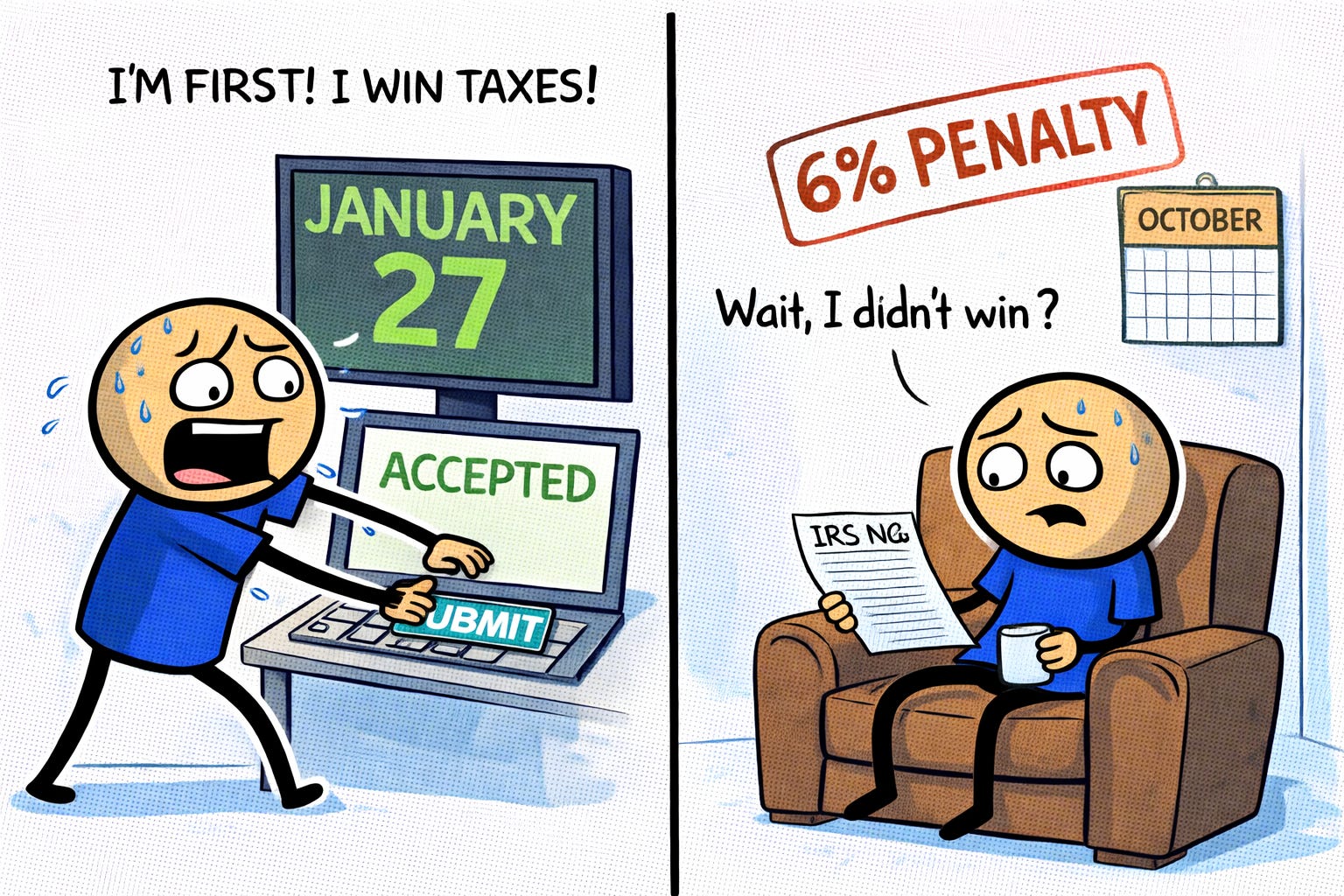
Tax season rewards speed. File early, get your refund, move on. The whole system is designed to make you feel like finishing is the goal.
It is not.
Filing your return and filing it correctly are two completely different accomplishments. The IRS will accept a return with mistakes on it. They will process a return that leaves money on the table. They will deposit your refund even if you forgot to claim a credit you qualified for. The system does not check your work for you. It checks whether the math adds up and whether your Social Security number matches. That is the bar.
The IRS distinguishes between a return that is “accepted” and one that is “processed.” Accepted means the submission went through electronically without format errors. It does not mean the IRS reviewed your entries, agreed with your deductions, or verified your retirement account contributions. Processing happens later. And even after processing, the IRS has three years from the filing date to audit the return, or six years if they suspect a substantial understatement of income.
Filing by April 15 (or October 15 with an extension) meets the legal deadline. But the deadline only governs when the return is due. It says nothing about whether the return is accurate.
Here is what that distinction actually costs people.
Say you contributed $7,000 to a Roth IRA in January 2025. Your income was $140,000 at the time, well within the limit for single filers. But you got a raise in September, and your final MAGI for 2025 lands at $157,000. That puts you squarely in the Roth IRA phase-out range for 2025, which runs from $150,000 to $165,000 for single filers. At $157,000, your allowable contribution drops to roughly $3,733. The remaining $3,267 is an excess contribution.
You file your return in February 2026. It gets accepted in minutes. Refund hits your account two weeks later. Done.
Except you now have a $3,267 excess Roth IRA contribution sitting in the account. That amount needed to be removed or recharacterized by the tax filing deadline, including extensions. If you filed in February without addressing it, you still have until October 15, 2026 (with an extension on file) to fix it. But if October passes and you have not corrected it, the IRS assesses a 6% penalty on the excess amount. Every year. Until you fix it.
Filing fast did not cause the problem. But filing fast without checking the details meant you missed the window to fix it painlessly.
The same pattern shows up with estimated tax payments. If you did a Roth conversion in 2025, that conversion amount gets added to your taxable income. If you did not adjust your withholding or make estimated payments, you may owe an underpayment penalty when you file. The penalty is not dramatic. It is essentially interest on what you should have paid quarterly. But it is avoidable if you catch it before April 15 and make the payment then.
Filing an extension does not help here. Extensions give you more time to file, not more time to pay. The tax is still due April 15 regardless of whether you file an extension. If you owe and you wait until October to file and pay, you are accumulating both the underpayment penalty and a failure-to-pay penalty of 0.5% per month on the outstanding balance.
Retirement account contributions add another layer. Traditional IRA contributions for 2025 can be made until April 15, 2026. Not until the extension deadline. April 15, period. If you rush to file in February and forget to make the contribution, you can still contribute before April 15 and amend the return. But amending is slower, messier, and entirely avoidable if you just waited to file until you had all the pieces in place.
SEP IRA contributions are different. Those can be made until the filing deadline, including extensions. So a self-employed person who files an extension has until October 15, 2026 to make their 2025 SEP contribution. Filing early without the extension means the SEP deadline becomes April 15. You may have just cost yourself months of contribution flexibility by filing too quickly.
None of this means you should delay filing indefinitely. If your return is straightforward and your retirement accounts are clean, file whenever you want. The point is that speed is only valuable when accuracy comes with it. The IRS does not reward you for filing first. They do not penalize you for filing on April 14 instead of January 27. The refund might arrive a few weeks later. That is the entire difference.
The people who get burned are not the ones who file late. They are the ones who file fast without double-checking whether their retirement contributions, conversions, and estimated payments are all accounted for.
Getting through tax season feels good. Getting it right saves money.
I write one of these every day, one retirement rule, explained in plain language and verified against the source. The daily email is free: subscribe here.
Full archive, worksheets, and search live at RetirementNewsRundown.com
Disclaimer This article is for educational and informational purposes only. It is not tax, legal, or financial advice and does not create an advisor-client relationship. Always consult appropriate professionals regarding your specific situation.