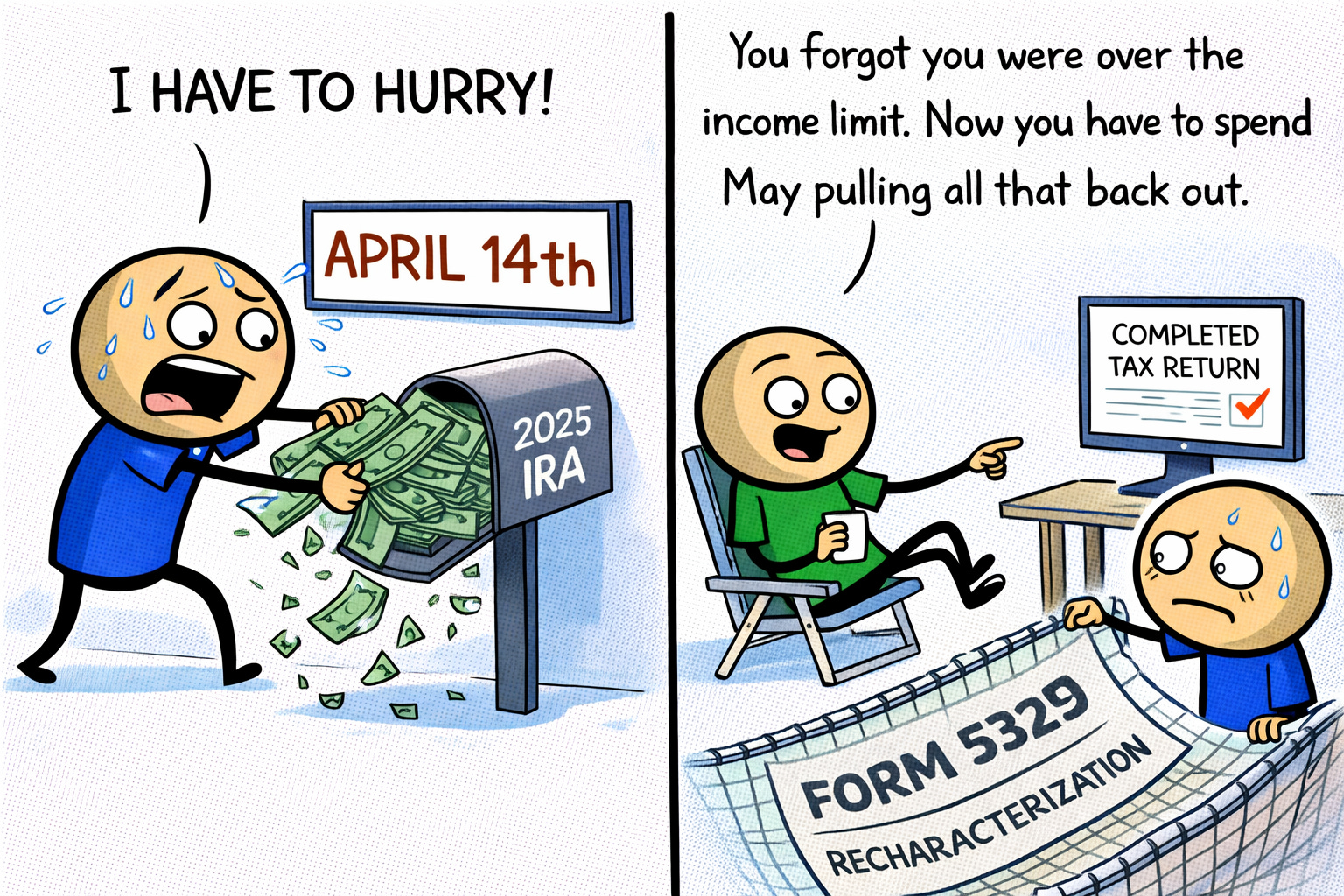
The retirement system has real deadlines. It also has deadlines that feel real but aren’t. The problem is that pressure makes them all feel the same, and people under pressure don’t stop to check which is which.
A financial advisor calls and says the market is about to shift, you need to move your 401(k) now. Your employer sends a separation package with a 30-day window to elect your pension distribution. Your tax preparer emails on April 10 and asks if you want to make a prior-year IRA contribution before the deadline. Your brother-in-law at Thanksgiving tells you Roth conversions won’t be available much longer because Congress is going to close the loophole.
One of those has a real, hard deadline. Two have flexible timelines disguised as urgent ones. And one is completely made up. Under pressure, all four feel like they need to happen this week.
The pension election is the one with real pressure and real permanence. When you leave an employer with a defined benefit pension, you’re typically given a limited window to choose between a monthly annuity for life or a lump-sum distribution. That window is defined by the plan document. It might be 30 days. It might be 90 days. Once it closes, your election is final.
Choose the annuity, and you receive a guaranteed monthly payment for life. The amount is fixed. It doesn’t fluctuate with the market. If the plan offers a joint-and-survivor option, your spouse can continue receiving a reduced payment after your death. The trade-off is that you give up control of the lump sum and any potential for the money to grow beyond the fixed payment.
Choose the lump sum, and you receive a one-time payment that you can roll into an IRA or another qualified plan. You gain control and investment flexibility. You lose the guarantee. If you live longer than the actuarial tables predicted, you might run out of money. If you die early, your heirs get whatever is left.
A 60-year-old with a $400,000 lump-sum offer and a $2,200 monthly annuity option has a real decision to make. The lump sum, invested at 6% and drawn down at $2,200 per month, lasts roughly 25 years. The annuity pays $2,200 per month for life, regardless of how long that is. At 85, both options have delivered approximately the same total. Past 85, the annuity wins. Before 85, the lump sum had more flexibility.
Neither option is wrong. But this decision, made in a 30-day window during the stress of a job transition, has a 30-year impact. The pressure to decide quickly is real. The complexity of the decision requires the opposite of speed.
The IRA contribution deadline creates pressure that feels urgent but has more room than people think. The deadline for a prior-year contribution is the tax filing deadline, typically April 15. Miss it and the contribution can’t be made for the prior year. That part is real.
What isn’t real is the pressure to decide on April 10 whether to contribute, how much to contribute, and which account type to use. If you’re not sure whether you’re eligible for a Roth contribution, whether your Traditional IRA contribution is deductible, or whether you have room in the budget, you don’t have to guess. You can file an extension for your tax return, take until October 15 to figure it out, and still make the contribution by April 15.
Wait. That doesn’t work. The IRA contribution deadline is April 15 regardless of extensions. Filing an extension gives you more time to file, not more time to contribute. So the deadline is real, but the solution isn’t rushing. The solution is doing the math before April instead of on April 10.
If you miss the April 15 deadline entirely, the contribution simply counts for the current year instead. You don’t lose the ability to contribute. You lose the ability to apply it to the prior year. That matters for the tax deduction timing, but it’s not a catastrophe.
Someone who panics on April 12 and contributes $7,000 to a Roth IRA without checking their income, then discovers in August that their MAGI was too high, now has an excess contribution. They have until October 15 (with an extension) to recharacterize or withdraw. If they’d waited two days, finished their return, and checked the number, the problem never would have existed.
The deadline created real time pressure. The pressure created a mistake that cost more time to fix than it would have taken to do it right.
The Roth conversion “loophole closing” narrative creates fake urgency that has persisted for over a decade. Every few years, a news cycle or a financial commentator warns that Congress is about to eliminate Roth conversions or Backdoor Roth contributions. Proposals get introduced. Headlines get written. People rush to convert massive amounts in a single year because they believe the window is closing.
As of 2026, Roth conversions remain fully available. The Backdoor Roth IRA strategy remains legal. Congress has discussed limitations multiple times and has not enacted them.
The cost of reacting to this pressure is real even when the threat isn’t. Someone who converts $300,000 in a single year because they’re afraid conversions will disappear next year pays tax on $300,000 of additional income. That might push them from the 24% bracket into the 35% bracket. The excess tax on the amount that crossed the bracket threshold is permanent. The conversion can’t be undone.
If they’d spread the same $300,000 over four years at $75,000 per year, each conversion might have stayed within the 24% bracket. Same total amount converted. Tens of thousands less in tax. The pressure to act now, based on a threat that hasn’t materialized in over a decade, created a tax bill that was entirely avoidable.
Roth conversions have no annual deadline other than December 31 of the year you want the conversion to count for. There is no filing deadline. There is no correction window because conversions can’t be undone. The only time pressure is self-imposed or manufactured by someone else’s prediction about what Congress might do.
The market-timing pressure to move a 401(k) during a job transition is the most common form of manufactured urgency. Someone leaves a job and a friend, advisor, or financial media personality tells them to move their 401(k) immediately because the market is about to drop, or because they’re missing out on gains while the money sits idle.
There is no deadline to roll over a 401(k) after leaving an employer. The money can sit in the old plan indefinitely (in most cases). The plan may charge higher fees to former participants, but the account doesn’t disappear. The IRS doesn’t impose a timeline for the rollover itself.
If you request a direct rollover, the money moves from one custodian to another without a deadline. If you take an indirect distribution (money paid to you personally), the 60-day rollover clock starts. That’s a real deadline. But it only applies if you take physical possession of the funds.
A person who rushes a rollover because someone told them the market is about to crash might move the funds during a volatile week, sell investments at a temporary low, and repurchase at a different price in the new account. The rollover didn’t cost them anything in taxes or penalties. The timing of the rollover, driven by pressure, may have cost them in market execution.
Leaving the 401(k) in place while you research your options, compare custodians, and verify whether a rollover makes sense for your specific situation (especially if you’re between 55 and 59½ and might need the Rule of 55) is almost always the better approach. There’s nothing to lose by taking a month. There’s potentially a lot to lose by moving in a weekend.
The through-line across all of these is that pressure compresses the decision window, and compressed decision windows produce worse outcomes. Not because the decisions themselves are harder, but because the time to evaluate them properly gets cut short.
Real deadlines exist. The pension election window is real. The April 15 IRA contribution deadline is real. The 60-day rollover window is real. But even within real deadlines, the quality of the decision depends on preparation that should have started before the deadline arrived.
The manufactured deadlines, the ones based on market predictions, congressional speculation, or someone else’s urgency, deserve the most skepticism. If someone is telling you to act now, the most useful question is: what specifically happens if I act next month instead? If the answer is “nothing,” the pressure isn’t real. If the answer involves a specific date and a specific consequence, it might be.
Most of the time, the answer is nothing.
I write one of these every day, one retirement rule, explained in plain language and verified against the source. The daily email is free: subscribe here.
Full archive, worksheets, and search live at RetirementNewsRundown.com
Disclaimer This article is for educational and informational purposes only. It is not tax, legal, or financial advice and does not create an advisor-client relationship. Always consult appropriate professionals regarding your specific situation.