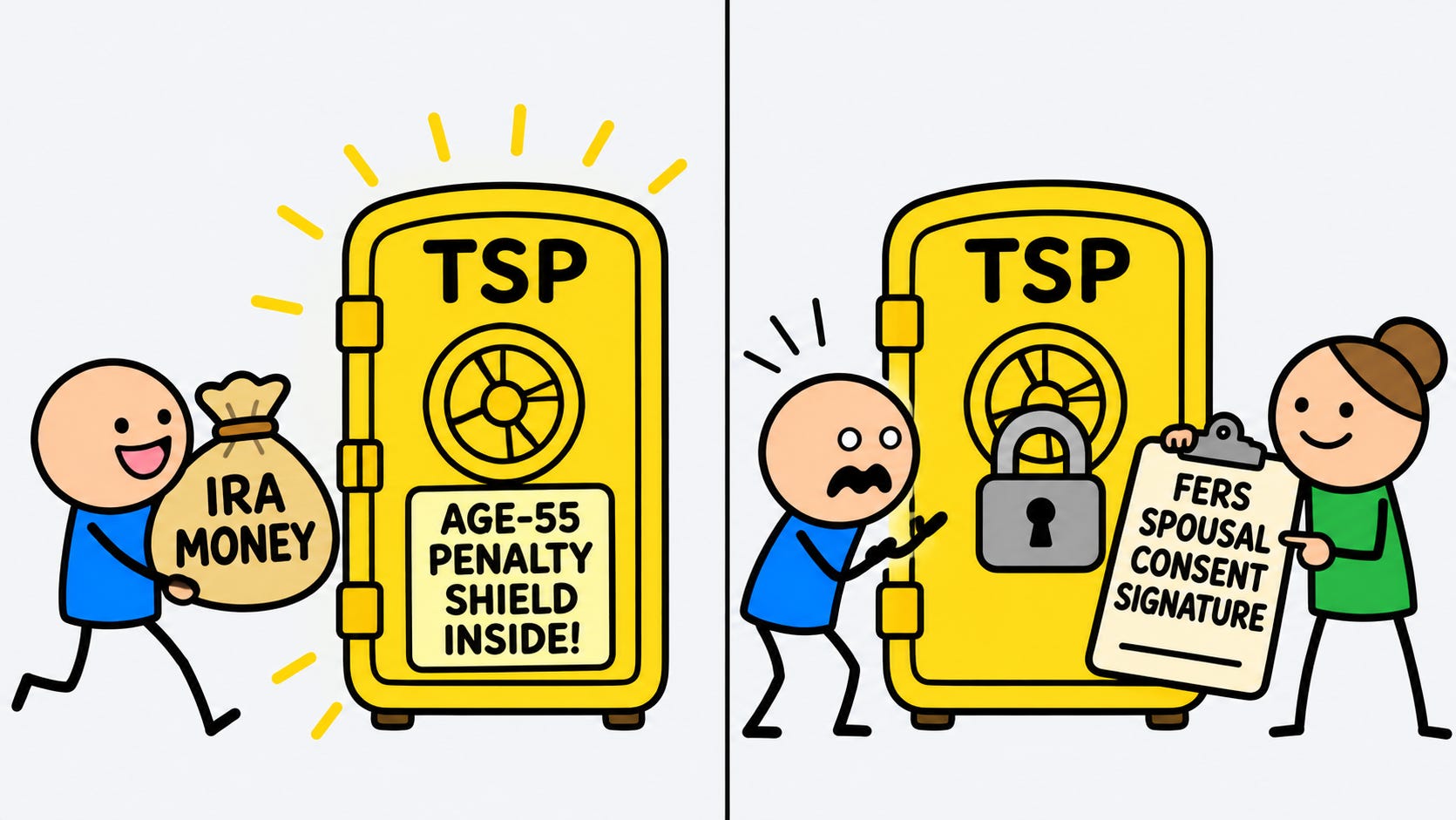
The TSP takes money in as well as paying it out. Current employees and separated participants can both move pretax money from traditional IRAs and other employer plans into their accounts, and Roth money from Roth 401(k), 403(b) and 457(b) plans. The rolled-in money joins the traditional or Roth balance, is invested under the participant’s current investment election, and does not count toward the yearly contribution limits.
The intake desk is picky, though, and once the money is inside, it follows TSP rules for good. Some of those rules are better than what the money had before. A couple are stricter. People tend to find out which is which after the rollover check has cleared.
On the traditional side, the TSP accepts eligible rollover distributions of pretax money from traditional IRAs, SIMPLE IRAs (after two years of participation in the SIMPLE), and eligible employer plans such as 401(k), 403(b) and governmental 457(b) plans. The money has to arrive in an existing TSP account that already has a balance, since a rollover cannot open one. Beneficiary participant accounts cannot accept rollovers at all.
From an IRA, only the dollars that would be taxable on the way out can go in. After-tax basis from nondeductible contributions stays behind. A special IRS rule makes this work in the participant’s favor: a rollover to an employer plan is treated as coming entirely from the taxable dollars, as long as the amount left in the IRAs is at least equal to the basis. That separates the after-tax money from the pretax money, which matters for anyone who has been fighting the pro-rata rule on Roth conversions.
On the Roth side, the TSP takes direct rollovers from Roth 401(k), 403(b) and 457(b) accounts, qualified or not, and the first one creates a Roth balance if there is none. It refuses Roth IRA money entirely, and it refuses Roth plan distributions that were already paid to the participant.
Pretax money can arrive two ways. A direct rollover goes custodian to TSP. An indirect rollover means the participant received a check and has 60 days to deposit it. A plan distribution paid to the participant generally has 20% withheld, and that withholding is mandatory. An IRA distribution generally has 10% withheld unless the owner elects otherwise. Getting the full amount into the TSP means making up whatever was withheld from other savings.
What happens if the 60 days run out? Anything not deposited in time is treated as a distribution: it is taxable that year and can face the 10% early withdrawal penalty if the participant is under 59.5. The IRS can waive the 60-day deadline in limited circumstances beyond the person’s control.
Required minimum distributions cannot be rolled anywhere. Someone already at RMD age has to take that year’s IRA requirement before moving the rest into the TSP.
Once the money is in, the TSP’s rules apply to it.
The age-55 separation exception covers TSP distributions. If a participant leaves federal service during or after the year they turn 55, the 10% penalty does not apply to TSP distributions taken that year or later, and that includes the dollars that used to be in an IRA. Left in the IRA, the same dollars would generally face the penalty until 59.5 unless another exception applied.
RMDs from the traditional TSP balance start only after separation and RMD age. An employee who keeps working past RMD age does not take TSP RMDs while still employed, and that includes the rolled-in money. The IRA’s own RMDs would have kept coming.
Spouses’ rights come along too. For a married FERS or uniformed services participant, the spouse is entitled to a survivor annuity, and any other distribution choice requires the spouse’s signed consent. The one exception is a total distribution of a balance of $3,500 or less. In an IRA, the owner withdraws without anyone’s signature. For CSRS participants, the TSP notifies the spouse.
One more: a separated participant receiving life expectancy installments who rolls money in before the end of the lock period changes the series and can bring back the 10% penalty on past installments with interest. The TSP recalculates the installment when new money arrives.
Denise is a FERS employee who turns 54 this year. She has a traditional IRA worth $150,000, of which $30,000 is basis from nondeductible contributions she tracked on Form 8606. In March she has the IRA custodian send $120,000 directly to her TSP account. Because she left $30,000 behind, equal to her basis, the rollover counts as all pretax money. Nothing is taxable, and the IRA that remains is all basis, apart from whatever it earns from here.
She retires in June of the year she turns 56. Because she separated during or after the year she turned 55, the TSP withdrawals she takes at 56, 57 and 58 carry no 10% penalty, including the $120,000 that came from the IRA, though they are taxable as income. Had that money stayed in the IRA, withdrawals before 59.5 would generally have faced the penalty.
Her husband now signs off on her TSP withdrawals, which he never had to do for the IRA. She decided that was an acceptable trade.
Rolling money into the TSP is a one-way change of rulebook. The money gets the TSP’s age-55 treatment, RMD timing tied to separation, and the separation of IRA basis, and it also picks up spousal consent and the installment rules. Whether that trade works depends on which of those rules a person is likely to use.
The parts that carry deadlines are the 60-day window on an indirect rollover, taking any RMD due before the move, and the lock period for anyone already on life expectancy installments. For tracking the basis that stays in the IRA after the pretax dollars leave, our Form 8606 guide walks through how that basis is recorded.
I write one of these every day, one retirement rule, explained in plain language and verified against the source. The daily email is free: subscribe here.
Full archive, worksheets, and search live at RetirementNewsRundown.com.
Disclaimer
This article is for educational and informational purposes only. It is not tax, legal, or financial advice and does not create an advisor-client relationship. Always consult appropriate professionals regarding your specific situation.