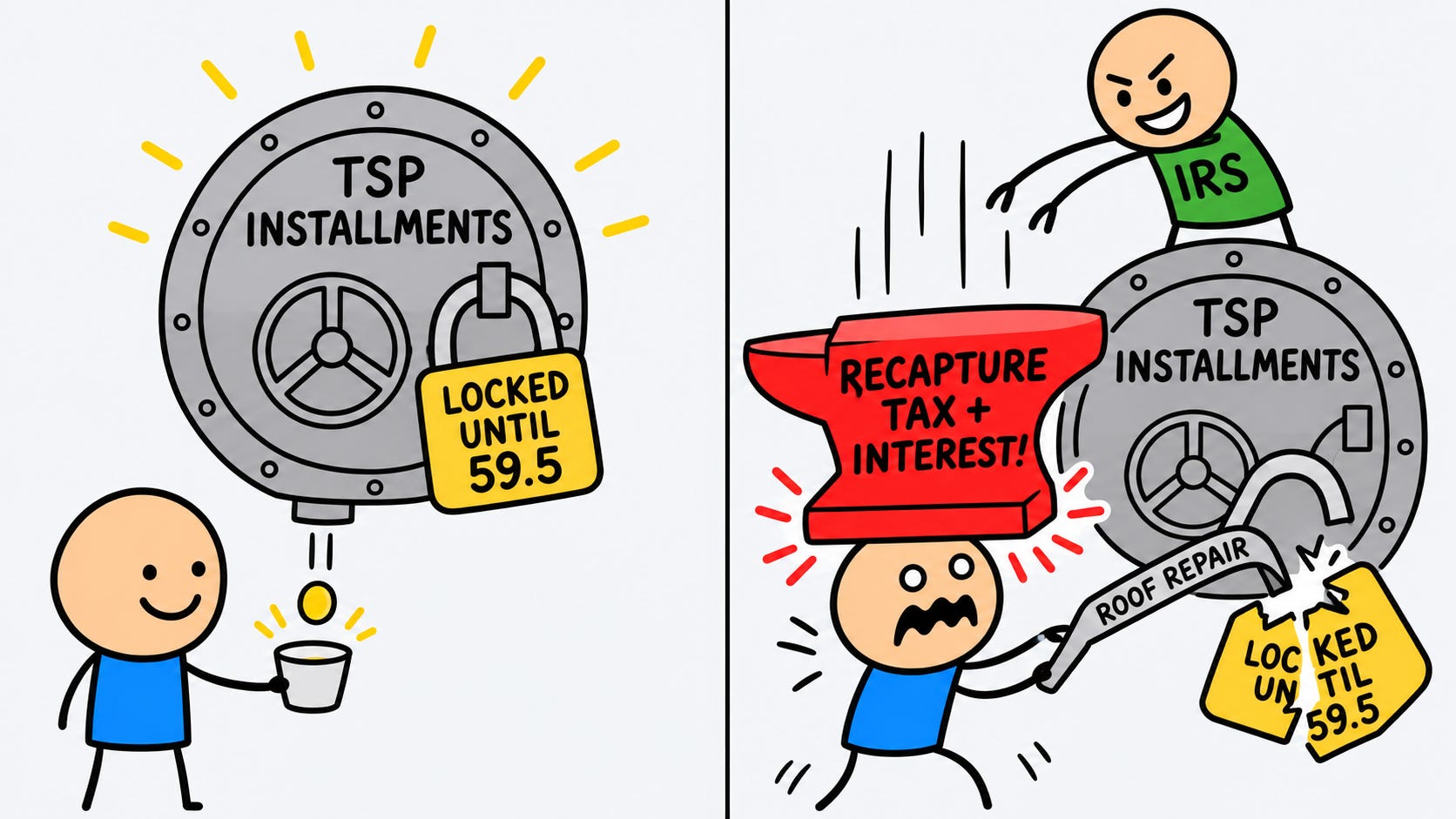
The TSP lets a separated participant take installments calculated from IRS life expectancy tables, and those installments carry an exception to the 10% early withdrawal penalty at any age. A participant who leaves federal service at 50 or 52, too early for the age-55 separation rule, can draw an income from the account without the extra 10% on top of the income tax.
The exception comes with a lock. The IRS treats these payments as a series it expects to keep going, and the series has to run long enough before anything about it changes. Change it too soon and the IRS goes back and collects the penalty on every payment it excused, with interest. The booklet mentions this in a few sentences, which is a modest amount of ink for a rule that can send a five-figure bill years after the fact.
The TSP calculates life expectancy installments from the participant’s age and the entire account balance, traditional and Roth together, and it recalculates the amount every January using the age and the balance at the end of the prior year. That yearly change is part of the method. A payment that shrinks after a bad market year is still part of the same series.
The lock runs until the later of two dates: five years after the first installment, or the day the participant reaches age 59.5. Someone who starts at 52 is locked until 59.5. Someone who starts at 57 is locked until 62, past 59.5, because the five years come later.
Inside that window, the TSP names three things that break the series: stopping the installments, switching them to a fixed dollar amount, and taking any other distribution from the account on top of the installments. The IRS adds more that the TSP booklet does not spell out: additions to the account other than investment growth, and certain transfers or rollovers out of it, also count as changes. Rolling an old 401(k) or IRA into the TSP partway through can break the series, and the TSP itself recalculates the installment amount when new money arrives. An additional partial distribution rolled into an IRA can break it too.
What happens if the change comes later, after the lock ends? Nothing. Once the later of the two dates has passed, the participant can stop the installments, switch to a fixed amount, take a lump sum, or roll the balance out, and the payments already received keep their exception.
What happens if the change comes early? The IRS imposes a recapture tax in the year of the change. It equals the 10% penalty that would have applied to installments from earlier years had the exception never existed, plus interest for the years it was deferred. It reaches only the taxable portion of those payments, and only payments made before age 59.5. If the change happens because of the participant’s death or disability, no recapture applies. Installments received earlier in the year of the change, the distribution that broke the series, and each installment paid before 59.5 after it is broken all face the regular 10% penalty on their taxable portion, unless some other exception covers them.
The recapture tax and the interest go on the participant’s federal return for the year of the change, reported on Form 5329. Calculating it falls to the participant.
Mark separated from federal service at 52 with $600,000, all traditional and all from pretax contributions, so every dollar he withdraws is taxable. The age-55 rule does not help him. He starts monthly life expectancy installments in May of the year he turns 52. His lock ends on the day he turns 59.5, since that comes after the fifth anniversary of his first payment.
His installments come to roughly $17,500 a year, adjusting each January. By the end of the year he turns 55, he has received about $65,000, all taxable and all excused from the penalty.
At 56 he needs a new roof and takes a $40,000 partial distribution. That breaks the series. On that year’s return he owes income tax on the $40,000, the 10% penalty on it ($4,000), and a recapture tax of roughly $6,500 on the installments from earlier years, plus interest. His installments from earlier that year, and the ones that continue after the roof until he reaches 59.5, face the regular 10% penalty too.
Linda, with her own all-pretax account, separated in the year she turned 54 and started life expectancy installments at 57. Her lock runs to 62. She stops the installments at 60. The recapture tax applies only to the payments she received before 59.5. The installments from 59.5 to 60 were never subject to the penalty in the first place, so nothing comes back on those.
Life expectancy installments are one of the few ways to get money out of the TSP before 55 without the extra 10%, and they work as advertised as long as the series stays untouched for its full run. The yearly recalculation is fine. Market swings are fine. What causes trouble is reaching into the account for anything extra, adding money to it, or ending the payments before the later of the two dates.
For people who separated in or after the year they turned 55, the age-55 exception may already cover TSP withdrawals without any lock at all, and the two rules are worth comparing before installments start. Anyone thinking about moving TSP money out during a series can check how the rollover mechanics fit in our guide to rollover IRAs, keeping in mind that inside the lock the move itself is the change.
I write one of these every day, one retirement rule, explained in plain language and verified against the source. The daily email is free: subscribe here.
Full archive, worksheets, and search live at RetirementNewsRundown.com.
Disclaimer
This article is for educational and informational purposes only. It is not tax, legal, or financial advice and does not create an advisor-client relationship. Always consult appropriate professionals regarding your specific situation.