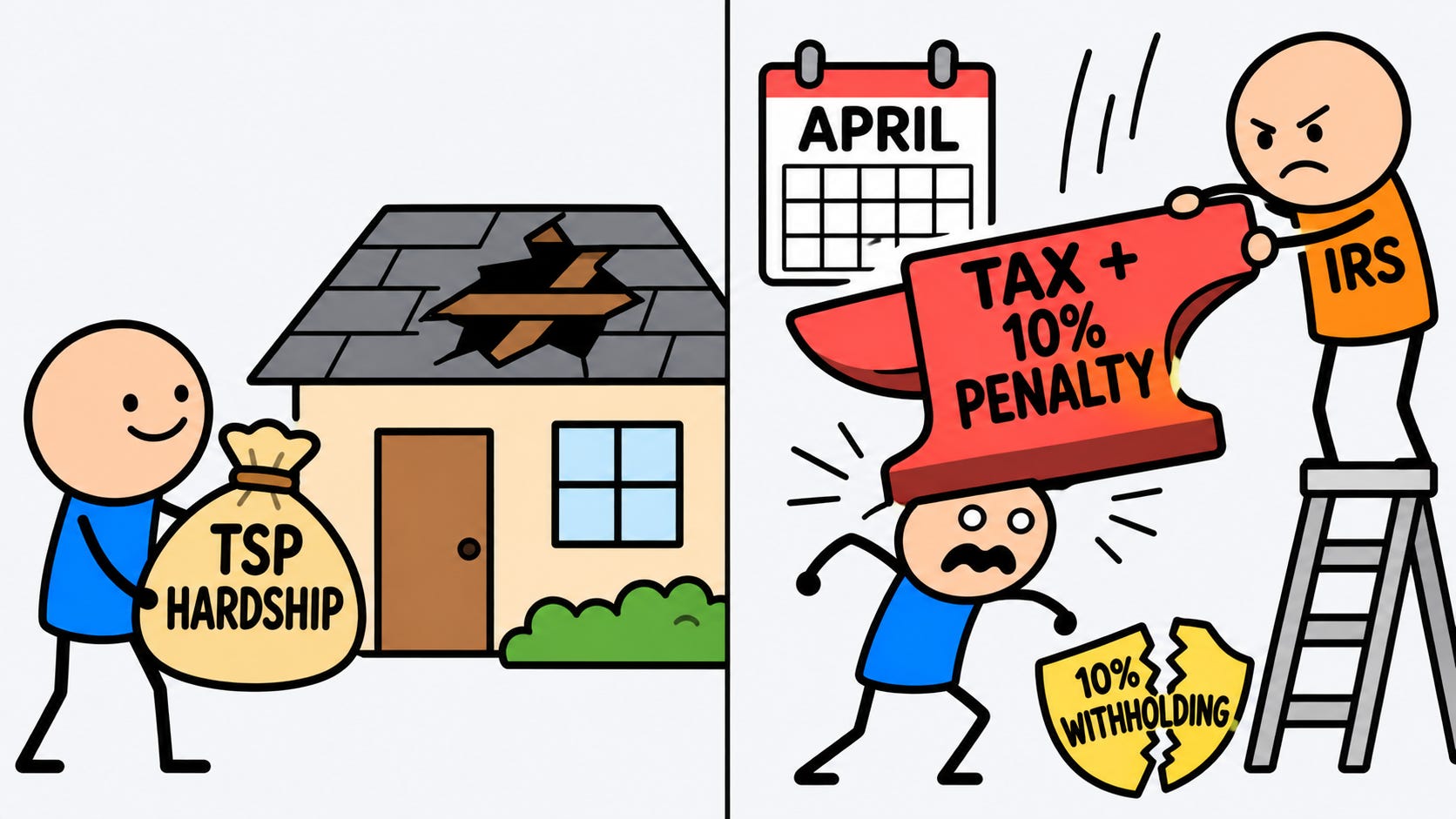
The TSP lets an employee who is still working take money out early for a genuine financial hardship. The participant certifies the need under penalty of perjury, the TSP sends the money, and nobody asks for receipts up front. That part is easy enough that people tend to stop reading there.
The fine print is where the cost goes up. The income tax is the part everyone expects. The rest arrives in pieces over the next several months, and some of it never goes away.
A financial hardship withdrawal is available only while the participant is still employed in federal civilian or uniformed service, and only for specific reasons: recurring negative cash flow, unpaid medical expenses that would be tax deductible, unpaid personal casualty losses, unpaid legal fees for a separation or divorce, and expenses or losses from a FEMA-declared disaster. Expenses already paid or reimbursable from insurance or elsewhere do not count. The withdrawal is limited to the amount of the need, with a minimum of $1,000, and it can come only from the participant’s own contributions and the earnings on them, including money rolled in from IRAs or other plans. Agency automatic and matching contributions stay put.
The taxable portion is income in the year of the withdrawal. That means all of it for traditional money from pretax contributions, and the earnings portion of any Roth money that is not yet qualified, since Roth withdrawals always carry a proportional share of earnings.
Under 59.5, the taxable portion can also face the 10% early withdrawal penalty. The age-55 separation exception does not help here, because the participant has not separated. Other exceptions still can, including medical expenses above 7.5% of adjusted gross income, up to $1,000 a year for emergency personal expenses, up to $5,000 after a birth or adoption, terminal illness, and certain disaster and domestic abuse distributions.
Withholding is where the second bill comes from. The TSP withholds 10% for federal tax by default, and the participant can raise, lower, or waive it. The participant can also gross the request up to 125% of the approved need so that the withholding does not eat into the money needed. For someone in the 22% bracket who also owes the 10% penalty, 10% withholding covers less than a third of what the withdrawal actually costs. The difference shows up at tax time.
Then come the parts that are permanent. A hardship withdrawal cannot be rolled over to an IRA or another plan. Once the TSP disburses it, the money cannot be returned to the account or converted into a loan. Whatever that money would have earned over the rest of a career is gone with it.
A married FERS or uniformed services participant needs the spouse’s signed consent before the withdrawal goes through. For CSRS participants, the TSP notifies the spouse first.
What happens if more money is needed later? A second hardship withdrawal has to wait six months after the first hardship payment goes out. If the participant chose traditional-only or Roth-only and that source fell short of the request, the TSP sends what is there and will not dip into the other source, so the shortfall waits the six months too. Payroll contributions keep going unless the participant stops them, so the agency match continues.
What happens if the money can wait? At 59.5, an employee can take up to four age-59.5 withdrawals a year with no hardship required, no 10% penalty, and the option to roll the money to an IRA. Taxable amounts paid directly to the participant generally carry mandatory 20% withholding, while a direct rollover avoids withholding. A TSP loan is the other route for someone in pay status. It is not taxable income as long as it is repaid, and the repayments go back into the account.
Carlos is a 57-year-old FERS employee. A spring storm damages his house, and after insurance he has $12,150 in unpaid repairs. His TSP is all traditional money from pretax contributions, so every dollar he withdraws is taxable. His wife signs the consent form.
He requests $13,500, which is within 125% of his need, and keeps the default 10% withholding. The TSP withholds $1,350 and sends him $12,150, which covers the repairs.
The following April, the $13,500 shows up as income. In the 22% bracket that is $2,970 of income tax. He is under 59.5 and the storm was not a declared disaster, so the 10% penalty applies to whatever no exception covers. If the repairs qualify for the emergency personal expense exception, $1,000 of the withdrawal escapes it and the penalty is $1,250. If no exception applies, the penalty is $1,350. The total lands between $4,220 and $4,320, and the $1,350 withheld leaves $2,870 to $2,970 to pay when he files.
In the fall, his car needs a $3,000 repair. He cannot take another hardship withdrawal until six months after the first payment went out, and he would need the expense to qualify as a hardship anyway. A TSP loan can still be available to him while he is in pay status.
The $13,500 that left his account, and whatever it would have grown into by the time he retires, does not come back.
A hardship withdrawal does the one thing it promises: it puts money in hand quickly when the need is real. The costs that follow are the ones worth seeing in advance. There is the 10% penalty that the age-55 rule cannot touch while still employed, and the gap between 10% withholding and the actual tax. The withdrawal cannot be repaid or rolled over, and it brings a six-month wait before the next one.
The dates that change the math are age 59.5, when in-service withdrawals stop needing a hardship and stop carrying the penalty, and separation in or after the year of turning 55. Readers comparing the TSP with a private-sector plan can find the employer-plan side in our 401(k) guide.
I write one of these every day, one retirement rule, explained in plain language and verified against the source. The daily email is free: subscribe here.
Full archive, worksheets, and search live at RetirementNewsRundown.com.
Disclaimer
This article is for educational and informational purposes only. It is not tax, legal, or financial advice and does not create an advisor-client relationship. Always consult appropriate professionals regarding your specific situation.