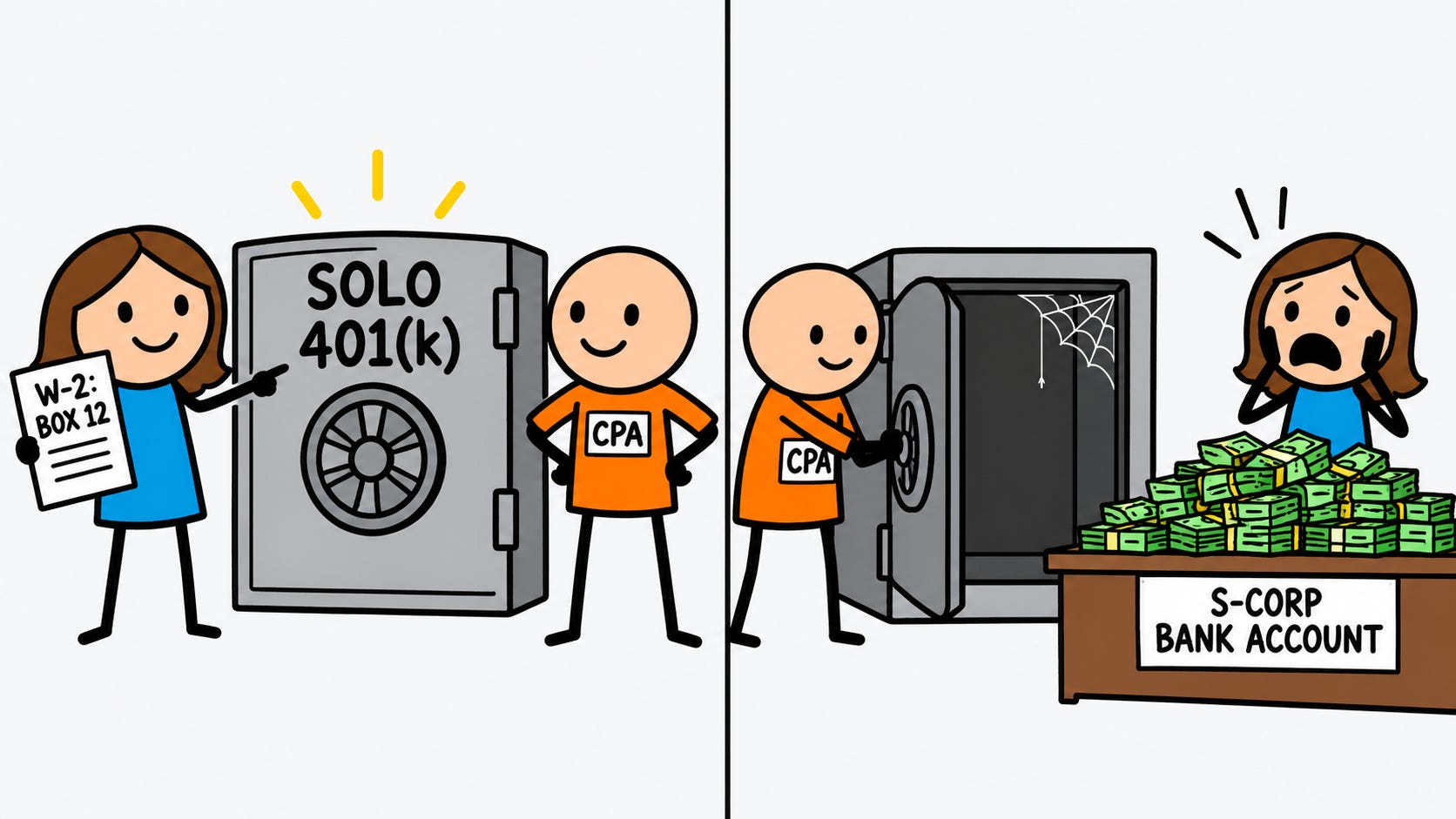
A solo 401(k) for an incorporated business owner runs through payroll like any other 401(k). The owner signs a deferral election, the payroll provider reduces each paycheck by the deferral, and the W-2 reports it. What payroll does not do, unless someone tells it to, is move the money into the plan. For a one-person company, the someone is usually the owner, and the step is easy to miss.
The discovery tends to happen months later, often when a CPA is finishing the business return on extension. Then four sources give four different answers about whether it is too late, mostly because each one is reading a different deadline.
Three separate clocks are involved, and the money in question only runs on one of them.
The first clock decides whether a deferral exists at all. A deferral has to be elected before the pay it comes from is available, and it has to come out of compensation for that year. For an owner paid on a W-2 through an S corporation, that means the paycheck itself had to be reduced during the calendar year. Pay that went out in full cannot be turned into a deferral after the fact. A sole proprietor works differently, because compensation is generally treated as available on the last day of the tax year, so the election generally has to be in place by then. A special first-year exception also lets certain sole proprietors with no employees who set up a new solo 401(k) make a prior-year deferral election by their unextended individual tax-return deadline.
The second clock is deposit timing. Once payroll withholds a deferral, the money is supposed to reach the plan’s trust, and the IRS emphasizes following the plan document’s own deposit terms. Missing a deposit schedule the document sets is an operational mistake under the plan. If the plan required prompt deposits, the failure may have begun shortly after each paycheck, long before the business tax-filing deadline. The exact timing and the correction requirements depend on the plan’s terms and the rules that govern owner-only plans.
The third clock is the business tax-filing deadline, including extensions. That is the deadline for the employer side of a solo 401(k), the profit-sharing contribution the company makes and deducts for the year. It has nothing to do with money that came out of the owner’s own paychecks.
So for withheld deferrals, the question is less about whether it is too late and more about the correction. The IRS fix for late deferral deposits is to figure out which deposits were late, deposit the missed deferrals plus the earnings they lost while sitting outside the plan, fix whatever process caused the miss, and keep a record of all of it. The IRS’s correction programs are the framework for documenting it.
Plans covered by federal employee-benefit law carry an extra layer. For them, the Department of Labor requires deposits as soon as the deferrals can reasonably be separated from company funds, no later than the 15th business day of the following month. Plans with fewer than 100 participants have a seven-business-day safe harbor. Late deposits can also create prohibited transactions subject to a 15% initial excise tax, with a separate correction process run by the Department of Labor. A plan that covers only the owner, or the owner and spouse, generally falls outside the Department of Labor’s employee-benefit rules, including its deposit-timing requirements, because those rules do not treat a business owner and spouse as employees of their own company. That exclusion does not automatically eliminate the tax code’s own prohibited-transaction rules, so a late deposit in an owner-only plan may still need separate review under them.
What happens if nothing was ever withheld? The original deferral opportunity has closed, because pay already received cannot be retroactively deferred. But if the owner made a valid election and payroll failed to carry it out, that is a separate operational mistake the IRS recognizes. Its standard correction is an employer-funded contribution equal to 50% of the missed deferral, adjusted for lost earnings. IRS correction rules also permit reduced contributions, sometimes as little as zero, when specific timing and correction requirements are met. The employer contribution is also still available until the business return’s due date, including extensions, and it closes for that year after that.
Dana owns an S corporation and pays herself through payroll. She sets up a solo 401(k) and elects to defer $1,500 a month. Her payroll provider withholds it from every paycheck all year, and her W-2 shows $18,000 of deferrals in box 12 with taxable wages reduced to match. Nobody ever sends a funding instruction, so the $18,000 sits in the company’s bank account.
The following August, her CPA is finishing the extended S corporation return and asks for the plan statement. The account is empty.
Because the money came out of her paychecks, the deferrals exist for the year they were withheld. They are just late. Dana deposits the $18,000 into the plan along with an amount for the investment earnings each monthly deposit would have earned if it had gone in on time, documents the calculation and the fix, and sets up a standing funding instruction with payroll. Her W-2 stays as filed, because it already reported the deferrals correctly.
In the other version, Dana signed the election, but payroll never reduced her checks, and her W-2 shows no deferrals. There is no money stuck anywhere, and her original deferral opportunity for that year ended with the year’s last paycheck. With the business return still on extension, the company can still make and deduct a permitted profit-sharing contribution for her until the extended due date. Separately, because she signed an election that payroll never carried out, the company may owe an employer-funded correction for the missed deferral under the IRS correction rules. That correction is a different thing from making the original salary deferral after the year has ended.
The panic around this problem mostly comes from asking the wrong deadline. Withheld deferrals that never got deposited and elections payroll never carried out are both correctable operational mistakes, with different fixes.
What matters is comparing the signed deferral election, the payroll records and the W-2. Together they show whether the problem is money withheld but never deposited, or an election payroll never implemented, and the rules differ for each. For owners still sorting out which plan fits their business, our Small Business Retirement Plan Selector compares the plan types side by side.
I write one of these every day, one retirement rule, explained in plain language and verified against the source. The daily email is free: subscribe here.
Full archive, worksheets, and search live at RetirementNewsRundown.com.
Disclaimer
This article is for educational and informational purposes only. It is not tax, legal, or financial advice and does not create an advisor-client relationship. Always consult appropriate professionals regarding your specific situation.