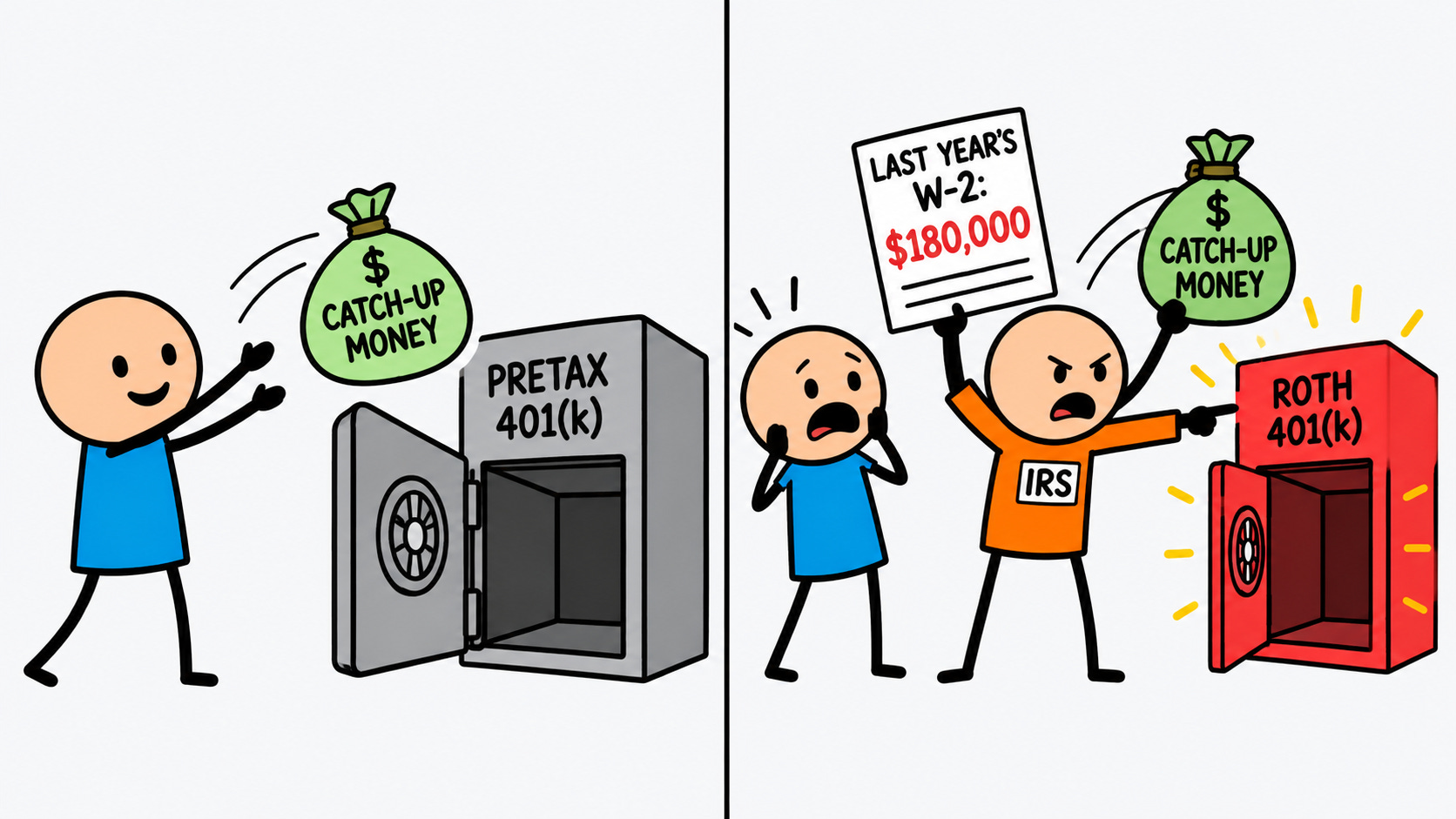
Turning 50 used to unlock a simple bonus in a 401(k): a catch-up contribution on top of the regular deferral limit, pretax if the employee wanted it that way. For higher earners, that choice now depends on last year’s paycheck. Payroll looks back at what the employee earned from that employer the year before, and above a certain line, every catch-up dollar has to go in as Roth.
The change tends to show up as a surprise on a pay stub. Take-home pay drops a little because the catch-up portion is now taxed going in, or a plan announces that some employees can no longer make catch-ups at all. Both are the same rule working as designed.
The rule applies to people old enough for catch-up contributions in a 401(k), 403(b) or governmental 457(b) plan. If their Social Security wages from the employer sponsoring the plan in the prior calendar year were above a threshold, their catch-up contributions for the current year must be designated Roth. The threshold started at $145,000 and is adjusted for inflation each year. Wages are measured using Social Security wages, generally the figure in Box 3 of the W-2 from the employer sponsoring the plan. Pay from an unrelated employer generally does not count, although special aggregation rules can apply to related employers.
Regular deferrals up to the standard limit are untouched. A higher earner can still make all of those pretax. Only the catch-up portion above the regular limit has to be Roth. The higher catch-up limit for people aged 60 through 63 follows the same rule.
Some people are outside it entirely. Someone with no Social Security wages from that employer in the prior year is not subject to it, which covers people in their first year at a new job and self-employed people whose income is self-employment earnings and not W-2 wages. SEP and SIMPLE IRA plans are excluded, and IRA catch-up contributions are a separate rule this one does not touch.
Plans are not required to offer Roth contributions. A plan with no Roth option can bar employees who are subject to the rule from making catch-up contributions at all, while still letting everyone else make them. Many plans that do offer Roth use a deemed election, automatically treating catch-ups from affected employees as Roth unless the employee chooses differently.
The timing runs on the calendar year. Last year’s W-2 decides this year’s status, and the answer can change every January. The final regulations take full effect after a transition period, and plans applying the rule before then are held to a reasonable good-faith standard, which is why plans differ in how smoothly they have rolled it out.
What happens if a catch-up goes in pretax when it was required to be Roth? The plan may be able to correct it by moving the contribution to the Roth account and reporting it correctly on the original W-2, which works only before that W-2 has gone out, or through a plan-directed in-plan Roth rollover reported on a Form 1099-R for the year of the rollover. These methods have specific eligibility requirements and deadlines, generally running through the end of the following year, and some failures require a corrective distribution instead. The tax reporting depends on the method and when the correction happens.
Mark is 55. Last year he earned $180,000 in W-2 wages at his employer, well above the threshold. His plan offers Roth contributions with a deemed Roth election for catch-ups. This year he defers the regular limit pretax, and his catch-up contributions go in as Roth automatically, so that portion stays in his taxable wages for the year. In exchange, the money grows under the usual Roth rules and can come out tax free later.
In March he changes jobs. His new employer paid him nothing last year, so at the new plan he is outside the rule for the rest of this year and can make catch-up contributions pretax there, within his overall catch-up limit across plans. Next January, his wages from the new employer decide his status for the following year.
His colleague Lisa is 58 and also earned above the threshold last year, but her employer’s plan has no Roth option. The plan bars her catch-up contributions for the year. She can still defer the full regular limit pretax. If her wages drop below the threshold in a later year, or the plan adds Roth, the catch-up door reopens.
The rule changes the tax treatment of a slice of savings without taking the savings away. Higher earners pay tax now on the catch-up portion, and in exchange that money can come out tax free later when the Roth distribution requirements are met, which is the trade every Roth contribution makes.
What matters is last year’s W-2 from the employer running the plan, and whether that plan offers Roth at all. For weighing what paying the tax now on that slice means against deferring it pretax, our Roth vs. Traditional calculator lays out the comparison.
I write one of these every day, one retirement rule, explained in plain language and verified against the source. The daily email is free: subscribe here.
Full archive, worksheets, and search live at RetirementNewsRundown.com.
Disclaimer
This article is for educational and informational purposes only. It is not tax, legal, or financial advice and does not create an advisor-client relationship. Always consult appropriate professionals regarding your specific situation.