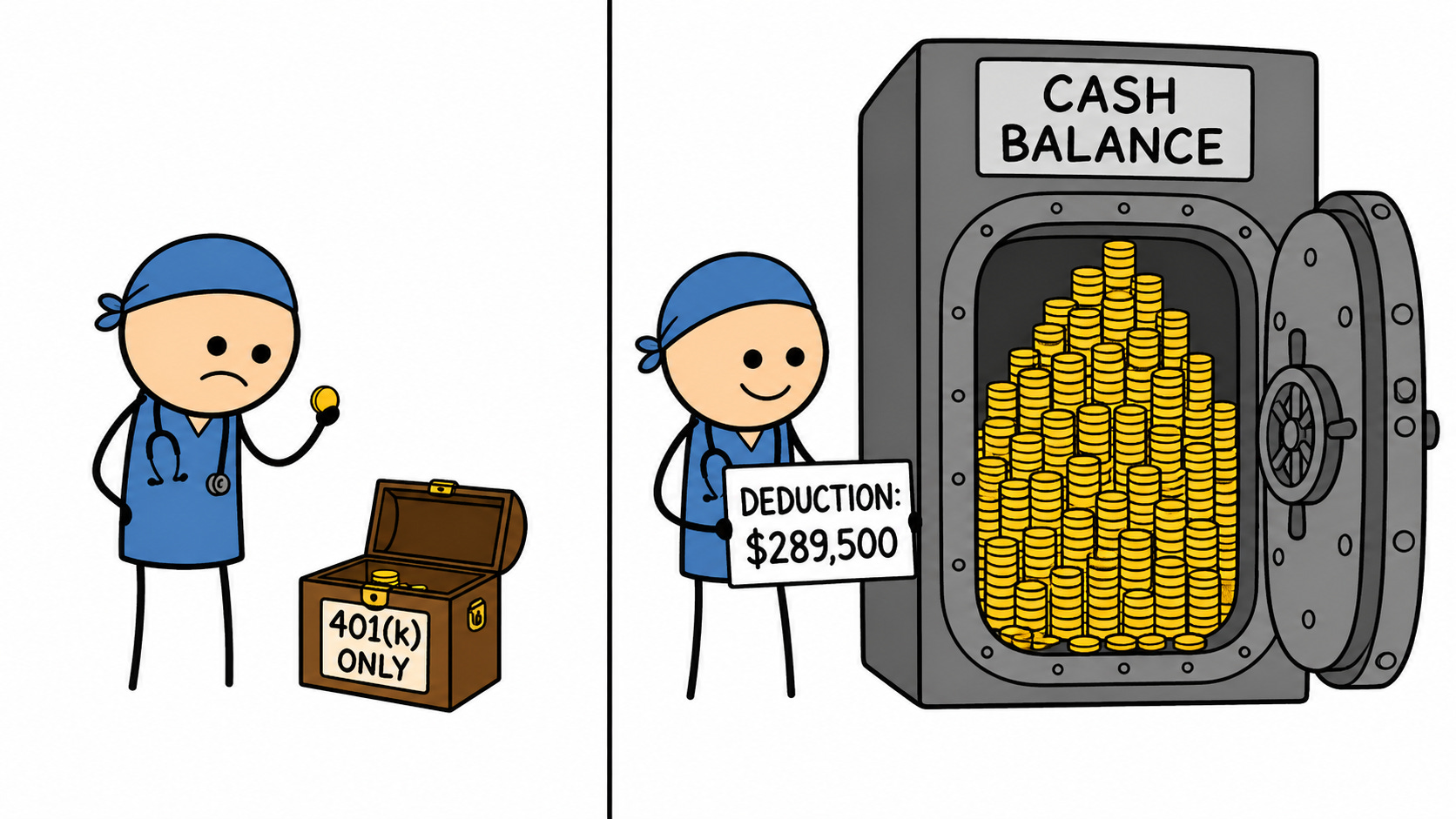
A 58-year-old surgeon walks into a CPA’s office in February holding her W-2. She made $710,000 last year. She maxed her 401(k), got the full profit sharing match, and assumes she’s done everything possible. Her CPA opens a calculator, types for thirty seconds, and tells her she could have deducted another $250,000 if she’d had a cash balance plan in place. She stares at the screen for a full minute. The deduction she missed is bigger than her son’s college tuition.
The reason cash balance plans command attention is the size of the deductible contribution. A 401(k) plus profit sharing combo caps each participant at the IRS annual additions limit per person under IRC Section 415(c). The limit indexes for inflation. Catch-up contributions are added on top for participants age 50 and older.
A cash balance plan doesn’t share that limit. The cash balance contribution is calculated separately by an actuary based on the participant’s age, compensation, and the plan’s stated benefit formula. The closer the participant is to retirement age, the larger the required annual contribution becomes, because there’s less time to fund the promised benefit. Pay credits for owners in their late fifties and early sixties routinely run between $150,000 and $300,000 per year. Owners over 60 can sometimes see pay credits north of $300,000 depending on the plan design and compensation level.
When an employer maintains both a defined benefit plan and a defined contribution plan covering the same employees, the combined deduction is limited under IRC Section 404(a)(7). If employer contributions to the defined contribution plan, other than elective deferrals, stay at or below 6% of aggregate participant compensation, the cash balance contribution can be fully deducted on top. Most CPAs running this strategy hold the profit sharing piece at 6% of pay precisely to keep the cash balance deduction clean. Going above 6% on the profit sharing side can push part of the contribution into a non-deductible status for the current year, with carryover treatment to future years. Compensation for plan purposes is also capped under IRC Section 401(a)(17), so the 6% calculation runs against the capped figure, not the full salary.
Catch-up contributions also have a wrinkle. Participants ages 60 through 63 qualify for an enhanced catch-up under SECURE 2.0 that sits above the standard amount. For participants whose wages exceeded the high earner threshold in the prior year, catch-up contributions, including the enhanced amount, must go in as Roth. That portion isn't deductible.
If the cash balance contribution lands after the tax filing deadline including extensions, it generally cannot be deducted for that prior tax year. The required minimum contribution is still owed, and underfunding triggers the IRC Section 4971 excise tax starting at 10% of the unpaid amount. If the funding gap isn’t corrected, the tax climbs to 100%. The IRS doesn’t forget.
A 60-year-old orthopedic surgeon owns her practice as an S-corporation with two associate physicians and four staff members. She pays herself $400,000 in W-2 wages, though only the 401(a)(17) capped amount counts for plan purposes. The two associates earn $300,000 each. Staff compensation averages $65,000.
She runs a 401(k) with full elective deferrals and the age-50 catch-up. Because her income clears the high earner threshold, the catch-up goes in as Roth. She holds the profit sharing contribution at 6% of eligible compensation across the plan to preserve the combined deduction. For her own account, that works out to $21,000 of profit sharing, with proportional contributions for the associates and staff.
She adds a cash balance plan effective for the calendar year that just ended, adopting it under the SECURE Act retroactive adoption rule before the tax filing deadline including extensions. The actuary calculates her pay credit at $245,000 based on her age and compensation. The associates, who are younger, receive smaller pay credits sized to pass nondiscrimination testing. Staff get a benefit accrual that satisfies coverage rules.
She funds the cash balance contribution by the extended S-corp deadline in September. Her personal stack for the year: $23,500 of pre-tax deferrals, $11,250 of Roth catch-up, $21,000 of profit sharing, and $245,000 of cash balance pay credit. Pre-tax deductible contributions for her alone reach about $289,500. Her total retirement contribution stack reaches about $300,750. The Roth catch-up sits outside the deduction, but the bulk of the stack reduces her taxable income.
If she'd skipped the cash balance plan, her deductible retirement contributions for the year would have topped out around $44,500, plus the separate Roth catch-up outside the deduction.
Year two arrives. Her enhanced catch-up of $11,250 still applies because she's between ages 60 and 63. The 401(a)(17) compensation cap rises, pushing her 6% profit sharing to $21,600. The actuary recalculates and the pay credit comes in at $260,000. She funds it on time. Form 5500 gets filed.
The contribution limits are what make cash balance plans worth setting up in the first place. The actuarial math drives a deduction that no other qualified plan structure can match for older, higher-earning business owners. The 6% rule on profit sharing, the Roth catch-up requirement for high earners, and the 415(c) limits on the defined contribution side all interact with the cash balance contribution in ways that determine how much of the total stack is actually deductible.
The plan stays running once started. The contribution is required every year until the plan is frozen or terminated. That’s the trade for the deduction size. Owners who run the math, fund on time, and stay inside the deduction rules end up with retirement balances that grow at a pace a 401(k) alone can’t touch.
I write one of these every day, one retirement rule, explained in plain language and verified against the source. The daily email is free: subscribe here.
Full archive, worksheets, and search live at RetirementNewsRundown.com.
Disclaimer This article is for educational and informational purposes only. It is not tax, legal, or financial advice and does not create an advisor–client relationship. Always consult appropriate professionals regarding your specific situation.