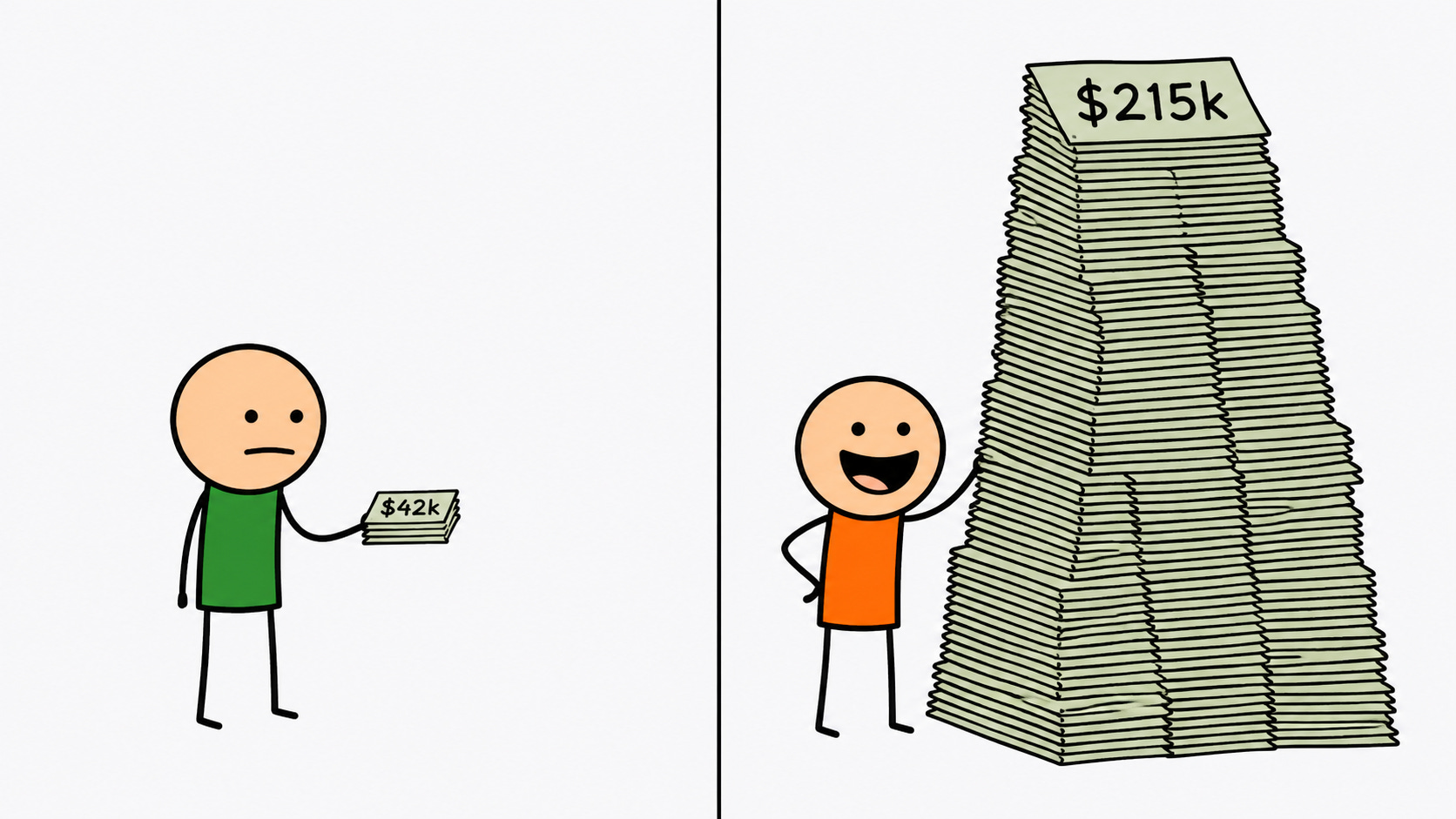
A 38-year-old software founder reads about cash balance plans on a finance blog, gets excited, and books a call with a TPA. The TPA pulls up the projection software, runs her numbers, and shows her a first-year pay credit of $42,000. She does the math. The administrative cost of running a cash balance plan plus actuary fees plus required staff contributions plus the lost flexibility of having to fund every year, all for a $42,000 deduction she could roughly match with a SEP IRA or solo 401(k). She thanks the TPA, ends the call, and never thinks about cash balance plans again. The plan wasn’t wrong for her. She was wrong for the plan.
Cash balance plans favor older participants, high earners, and stable cash flow. The actuarial math drives that outcome and it isn’t subtle. Pay credits are calculated to fund a future benefit by retirement age, so the closer the participant is to that target, the larger the annual contribution required to get there. A 60-year-old funding to age 62 needs a much bigger annual deposit than a 40-year-old funding to age 62, because the 60-year-old has two years to load the plan and the 40-year-old has 22.
The age sweet spot starts around 45 and gets dramatically better with each year after 50. Pay credits in the late 30s and early 40s typically run between $30,000 and $80,000. Late 40s push toward $100,000. Mid 50s commonly hit $150,000 to $200,000. Sixties can run $250,000 to over $300,000 depending on plan design and compensation. The older the owner, the more aggressive the math gets, until the Section 415(b) defined benefit limit caps the projected benefit, which can reduce the allowable contribution.
Income matters next. The cash balance contribution is calculated against compensation, and compensation is capped under IRC Section 401(a)(17). Owners drawing W-2 wages at or near the cap maximize the pay credit. Owners drawing $150,000 in wages will see meaningfully smaller pay credits than owners drawing wages at the compensation cap, even at the same age. The math pays attention to what the participant actually earns.
Stable cash flow is the third leg. Once the plan is in place, the owner has an annual funding obligation determined under the plan’s actuarial rules. Contributions are not as flexible as a SEP IRA or profit sharing plan, and reducing or pausing the plan generally requires formal plan action. Owners with lumpy income, founders pre-revenue, or businesses still in growth mode tend to regret cash balance plans within three years.
Employee count and demographics matter too. The plan must satisfy combined plan nondiscrimination testing. In many owner-heavy designs, staff contributions commonly land in the 5% to 7.5% of pay range when the owner is taking a large pay credit, though the exact number depends on demographics and plan design. A solo owner with no staff has the cleanest setup. A small practice with a few younger, lower-paid employees usually still works. A larger company with many non-owner employees can find the cost of staff contributions eats into the math.
If the math doesn’t pencil out, the plan still runs. The owner is still on the hook for funding it. The IRS doesn’t care that the deduction stopped feeling good in year four.
Two business owners walk into the same TPA office in the same week. These are simplified illustrative numbers. Actual contributions depend on plan design, compensation, interest crediting assumptions, testing, funding status, and actuarial calculations.
The first is a 42-year-old SaaS founder with $480,000 in W-2 wages, no employees, and revenue that swung between $300,000 and $1.2 million over the past five years. The actuary runs her numbers using the 401(a)(17) capped compensation. First-year pay credit comes in at $58,000. Combined with a full solo 401(k) contribution, her deductible stack reaches roughly $130,000. The TPA charges $2,500 in setup and $2,400 a year in administration. She’d save about $20,500 in federal taxes from the cash balance piece alone in a strong year, before state.
The TPA explains the funding obligation. She has to fund $58,000 the first year, and the actuary will recalculate every year. In a $300,000 revenue year, that funding obligation would be painful. The plan would not simply disappear because revenue had a bad year.
She walks away. A solo 401(k) gets her most of the deductible contribution she actually needs without the rigidity. Right call.
The second is a 58-year-old solo dentist with $345,000 in W-2 wages and stable revenue around $1.6 million per year for the last decade. She has a hygienist and a front desk staffer. The actuary runs her numbers. First-year pay credit comes in at $215,000. Combined with her 401(k) deferral and profit sharing contribution, her deductible stack reaches roughly $260,000. Required staff contributions to pass testing run roughly $9,800 across the two employees.
She’d save about $80,000 in federal taxes the first year. After staff contributions and admin costs, the net first-year benefit clears $65,000. The plan keeps running for seven years until she retires. Cumulative tax savings clear half a million dollars.
She signs the engagement letter. Right call.
Same TPA, same week. Two opposite answers driven entirely by age, income stability, and runway.
Cash balance plans aren’t bad for younger owners. They’re underwhelming for younger owners. The deduction is real, but the rigidity and overhead don’t pay for themselves at $50,000 pay credits.
The owners who get the most out of these plans are over 50, drawing wages near the compensation cap, with predictable revenue and a runway of at least five to ten years before retirement. That’s where the math breaks open and the deduction actually justifies the structure.
If you’re 40 and your income is climbing, the answer might be wait. If you’re 55 and you’ve been putting it off, the answer might be the plan you should have started three years ago.
I write one of these every day, one retirement rule, explained in plain language and verified against the source. The daily email is free: subscribe here.
Full archive, worksheets, and search live at RetirementNewsRundown.com.
Disclaimer This article is for educational and informational purposes only. It is not tax, legal, or financial advice and does not create an advisor–client relationship. Always consult appropriate professionals regarding your specific situation.