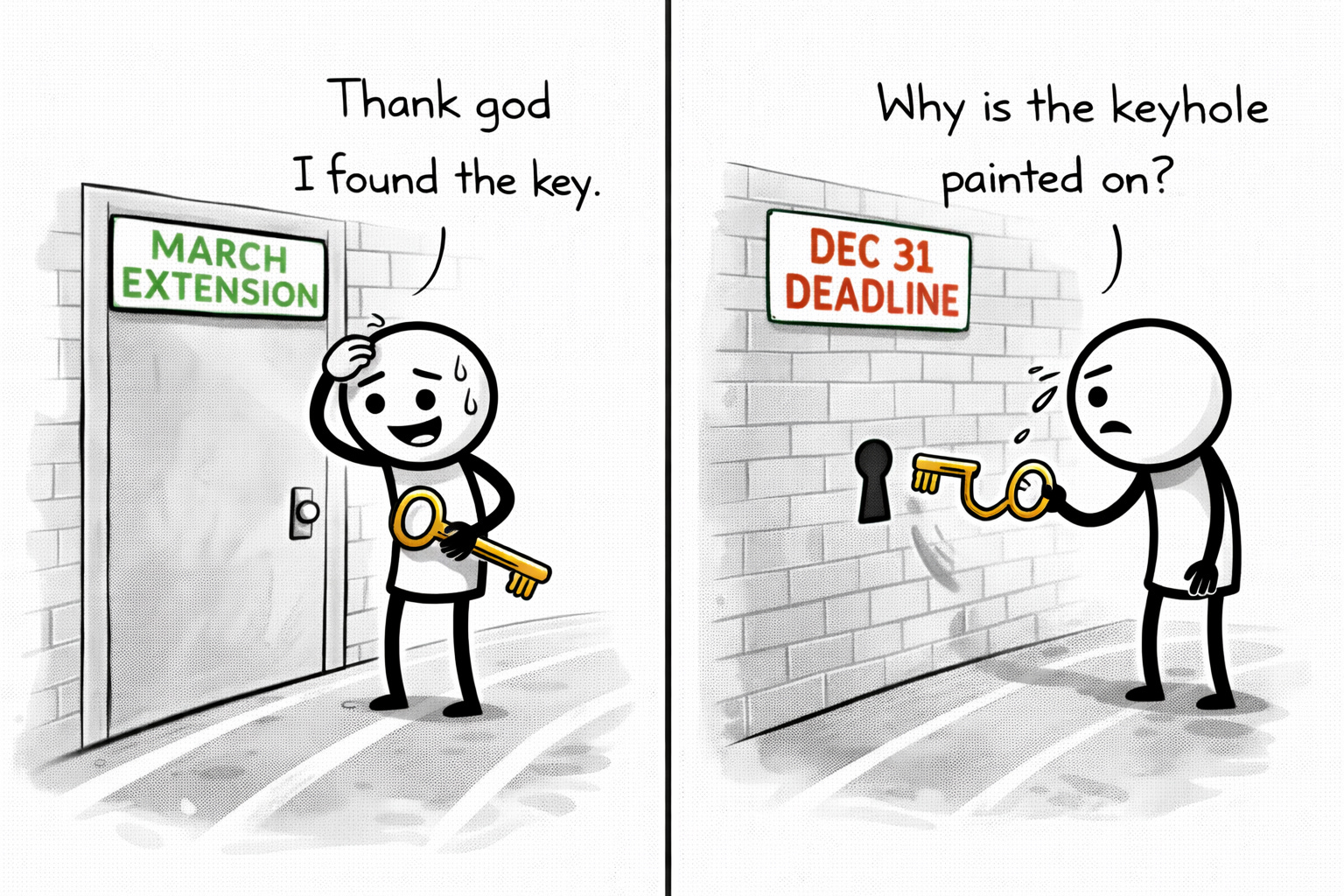
“Can I still do this?”
That question shows up every March and April, usually after someone finally opens a tax portal or sits down with a stack of envelopes they have been politely ignoring since January. The tone is hopeful. Reasonable. Almost optimistic. There is an assumption baked into it that if nothing bad has happened yet, then nothing bad has happened at all.
The system has not yelled. No penalties have appeared. No rejection notices have landed in the mailbox. So surely the door is still open.
Except very often, it is not.
Most retirement and tax mistakes are not dramatic. They do not explode on impact. They quietly finalize while everyone is focused on something else. By the time people ask whether something is “still open,” what they are really asking is whether the calendar has already made the decision for them.
Here is the rule that catches people off guard.
Not all deadlines mean the same thing. Some deadlines control when paperwork is filed. Others control when an action legally exists. And some only matter if something went wrong and needs to be fixed.
Calendar year deadlines decide whether an event belongs to one year or the next. Once December 31 passes, those decisions are done. Filing later does not reopen them. Extensions do not resurrect them. March does not negotiate.
Tax filing deadlines decide when reporting and certain contributions can still occur. Those deadlines often come with flexibility, especially if an extension is filed. This is where people get used to the idea that time stretches.
Correction windows exist only when something was done incorrectly. They do not exist for things that simply never happened. You cannot correct an action that was skipped entirely.
When people ask whether something is still open, the real question is which clock governed it in the first place.
What happens if it is done later instead depends entirely on that answer. Sometimes later is fine. Sometimes later means it is now a different year. Sometimes later means penalties. Sometimes later means the option no longer exists at all.
Roth conversions are a clean example.
A Roth conversion is a calendar year event. It either happens by December 31 or it does not. There is no filing deadline attached to the conversion itself. If it is done in March, it is a conversion for the current year. Full stop.
If someone planned to convert income during a lower earning year and waited until March to “see the tax numbers,” that opportunity is already closed. Doing it later does not fix anything. It simply changes the year, which can change tax brackets, Medicare premium calculations two years down the road, and how other income stacks.
Now compare that to an IRA contribution.
Traditional and Roth IRA contributions often follow the tax filing deadline. March is usually fine. Even April can be fine. Sometimes an extension buys more time. Doing it later still counts for the prior year as long as eligibility rules are met.
Two retirement moves. Two different clocks. One door closes quietly on December 31. The other stays open well into spring.
People assume consistency where none exists.
Required minimum distributions highlight the difference between “already closed” and “now in damage control.”
An RMD must be taken by December 31 for most people. If it is missed, the distribution is late. That fact does not change in March. The calendar year closed.
Taking the distribution later does not convert it into an on time distribution. It simply stops the penalty from growing. There may be relief available, but the miss still happened.
March is not a grace period. It is the point at which people realize they are no longer choosing between options. They are choosing between responses.
Employer plans add another layer of confusion.
Some plans allow contributions after year end, but only if the plan existed by December 31. That existence test is a calendar year rule. If the plan was not opened in time, no amount of filing extensions can fix that.
Other plans allow funding up to the filing deadline, but again only if the legal structure was already in place. Doing it later is fine. Creating it later is not.
People hear “you can contribute later” and miss the quiet condition attached to it.
Later works only if earlier already happened.
A real scenario shows how this plays out.
Someone is self employed and had a strong income year. In November, they meant to open a retirement plan. December was busy. January came and went. By March, they are finally ready to act and ask whether they can still open the plan and contribute for last year.
The answer depends on what they are asking without realizing it.
If the plan had been opened by December 31, funding might still be possible depending on the plan type and filing status. That door could still be open.
If the plan was never opened, whether the door closed depends on the type of plan and the type of business.
For 401(k) employee deferrals, the plan generally needs to exist by December 31 for those deferrals to belong to that year. Waiting until March usually means that specific opportunity is already closed.
But that rule is not universal. A sole proprietor can still establish a Solo 401(k) after year end and make both employer and employee contributions for the prior year if it is done by the original tax filing deadline. In that case, the door may still be open even though the calendar flipped.
SEP IRAs are even more flexible. A business owner can open a SEP for the first time in March or later and fund it for the prior year if they are within the filing deadline or extension window. The plan does not need to have existed on December 31.
S corporations are where the calendar is less forgiving. Employee deferrals generally require the plan to be established by year end. Waiting until March means that deferral opportunity is gone, even if other contributions may still be available later.
Nothing went wrong. Nothing was done incorrectly. The system is simply finished with that decision.
This is why March feels emotionally heavier than April.
April has deadlines. March has realizations.
March is when people discover that silence was not permission. It was finalization.
Once you understand which clock applied, most of the fear dissolves. You stop wondering whether you missed something and start understanding exactly what happened.
Some things are still open. Some things are already closed. Knowing which is which is the entire game.
The resolution most people need is not urgency. It is orientation.
If something was governed by a calendar year deadline, March is not the month to fix it. It is the month to acknowledge it and move forward cleanly.
If something is governed by a filing deadline, March is still part of the process, not the end of it.
If something requires a correction window, the only question is whether the mistake occurred at all.
Once those distinctions are clear, the system stops feeling hostile. It starts feeling mechanical. Predictable. Even fair in its own cold way.
The stress comes from assuming all doors behave the same. Relief comes from realizing they never did.
By the time you finish reading, you should not feel rushed. You should feel oriented.
You now know where you stand.
I write one of these every day, one retirement rule, explained in plain language and verified against the source. The daily email is free: subscribe here.
Disclaimer
This article is for educational and informational purposes only. It is not tax, legal, or financial advice and does not create an advisor–client relationship. Always consult appropriate professionals regarding your specific situation.