When a TSP participant dies and the spouse is a named beneficiary, the TSP sets up an account in the spouse’s own name, called a beneficiary participant account. The money stays invested the way it was, taxes stay deferred, and the spouse can manage it much like a regular TSP account. Other beneficiaries receive a death benefit payment, which an individual beneficiary can send by direct rollover to an inherited IRA. The spouse gets to stay in the plan.
That makes the account feel like a simple continuation, and in many ways it is. It also carries rules of its own about penalties, required distributions, and what happens when the surviving spouse dies, and the last of those surprises families more than anything else.
The TSP creates the account automatically when the spouse’s share is $200 or more. Investments carry over as they were, except any money in the mutual fund window, which is moved into TSP funds under the deceased participant’s investment election. The account can hold both traditional and Roth balances. It cannot take new contributions or rollovers in, and the spouses’ rights rules that apply to regular TSP accounts do not apply here.
From there, the spouse has three directions. The account can stay where it is, with the spouse choosing investments and taking money out through installments, partial or total distributions, or an annuity purchase. A spouse who has a TSP account from their own federal or uniformed service can combine the two by rolling the beneficiary account into it. Or the money can leave the TSP through a distribution, which can be rolled over to an IRA or an eligible employer plan.
The penalty rule is the reason the first option exists for some people. Payments from a beneficiary participant account are exempt from the 10% early withdrawal penalty, regardless of the spouse’s age. A widowed spouse of 45 can take money out and owe income tax on the taxable portion, with no penalty. Once the money is combined into the spouse’s own TSP account or rolled to the spouse’s own IRA, it is the spouse’s money for penalty purposes, and withdrawals before 59.5 face the 10% unless some other exception applies. Combining works only in one direction: a beneficiary account can roll into the spouse’s own TSP account, and the reverse is not allowed.
Required minimum distributions work differently too. For the spouse’s own TSP account, only the traditional balance counts. In a beneficiary participant account, the RMD covers the whole account, traditional and Roth together, and any distribution counts toward it. If the TSP sends an automatic payment to make up a shortfall, it comes proportionally from both balances.
When RMDs start depends on whether the participant died before the required beginning date. If the participant died before it and had not reached RMD age, the spouse’s RMDs begin by December 31 of the year the participant would have reached that age, and they are figured on the spouse’s age. If the participant had reached RMD age but died before the required beginning date, the first RMD is due by December 31 of the year after death. If the participant died on or after the required beginning date, the participant’s RMD for the year of death still has to come out by December 31 if it had not been taken, and later years use the longer of the spouse’s life expectancy or the participant’s remaining life expectancy.
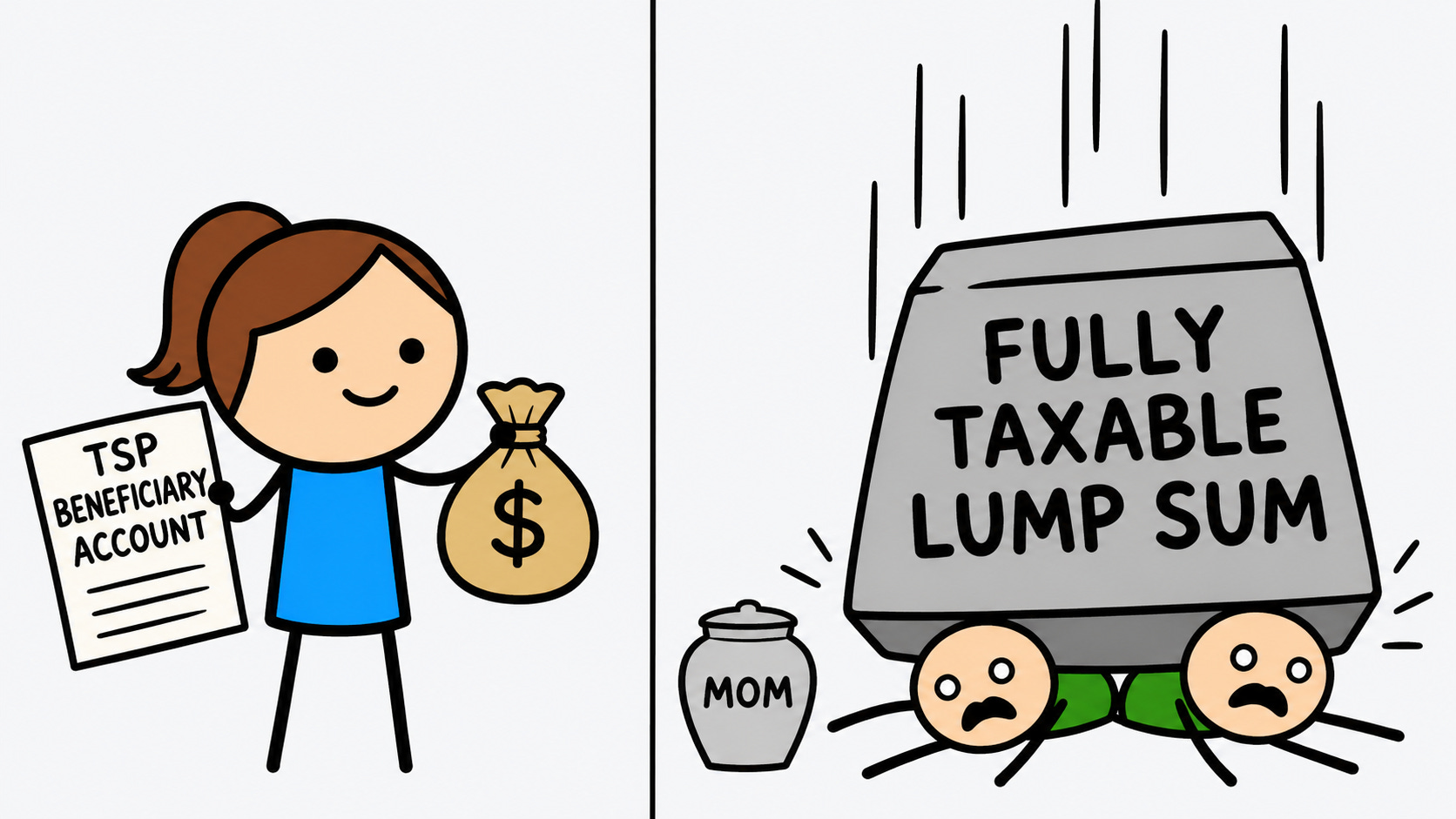
What happens if the spouse dies with money still in the beneficiary account? This is the part that catches families. Everyone who inherits from a beneficiary participant account, spouse or not, is treated the same way: the TSP pays a lump sum, the payment cannot be rolled over to an inherited IRA or anywhere else, and the taxable portion carries 10% federal withholding by default, which the beneficiary can raise, lower, or waive. The whole taxable balance lands as income for the next generation in a single year. Money the surviving spouse had already moved into their own TSP account or own IRA would be inherited under the rules for those accounts.
Maria is 52 when her husband, a FERS employee whose RMD age would have been 75, dies at 58. She is his beneficiary for the entire $400,000, all traditional money from pretax contributions. The TSP sets up a beneficiary participant account in her name.
At 53 she takes a $30,000 partial distribution for a new roof. The $30,000 is taxable income, and since it comes from a beneficiary participant account, there is no 10% penalty. Had she combined the account with her own TSP account first, the same withdrawal at 53 would have carried a $3,000 penalty unless an exception covered it.
Her husband died before reaching RMD age, so her required distributions from the beneficiary account start by December 31 of the year he would have turned 75, and they are based on her age.
She is now weighing the second-generation question. If she dies holding the beneficiary account, her two children each receive a lump sum, fully taxable that year, with no way to roll it to an inherited IRA. Money she moves out of the beneficiary account to her own IRA before then would pass under inherited IRA rules instead, though any of it taken before she turns 59.5 would be her own withdrawal again, penalty included.
The beneficiary participant account gives a surviving spouse continuity, low costs, and penalty-free access at any age, and none of that requires a decision on day one. The account can stay put as long as the RMD schedule is met.
What matters is the order of the choices. The any-age penalty exception exists only in the beneficiary account, so any move into the spouse’s own TSP account or IRA trades that away. The lump-sum treatment at the spouse’s death applies to whatever is still in the beneficiary account at that point. For how the rollover side compares once money leaves the TSP for an IRA, our rollover IRA guide covers the move.
I write one of these every day, one retirement rule, explained in plain language and verified against the source. The daily email is free: subscribe here.
Full archive, worksheets, and search live at RetirementNewsRundown.com.
Disclaimer
This article is for educational and informational purposes only. It is not tax, legal, or financial advice and does not create an advisor-client relationship. Always consult appropriate professionals regarding your specific situation.