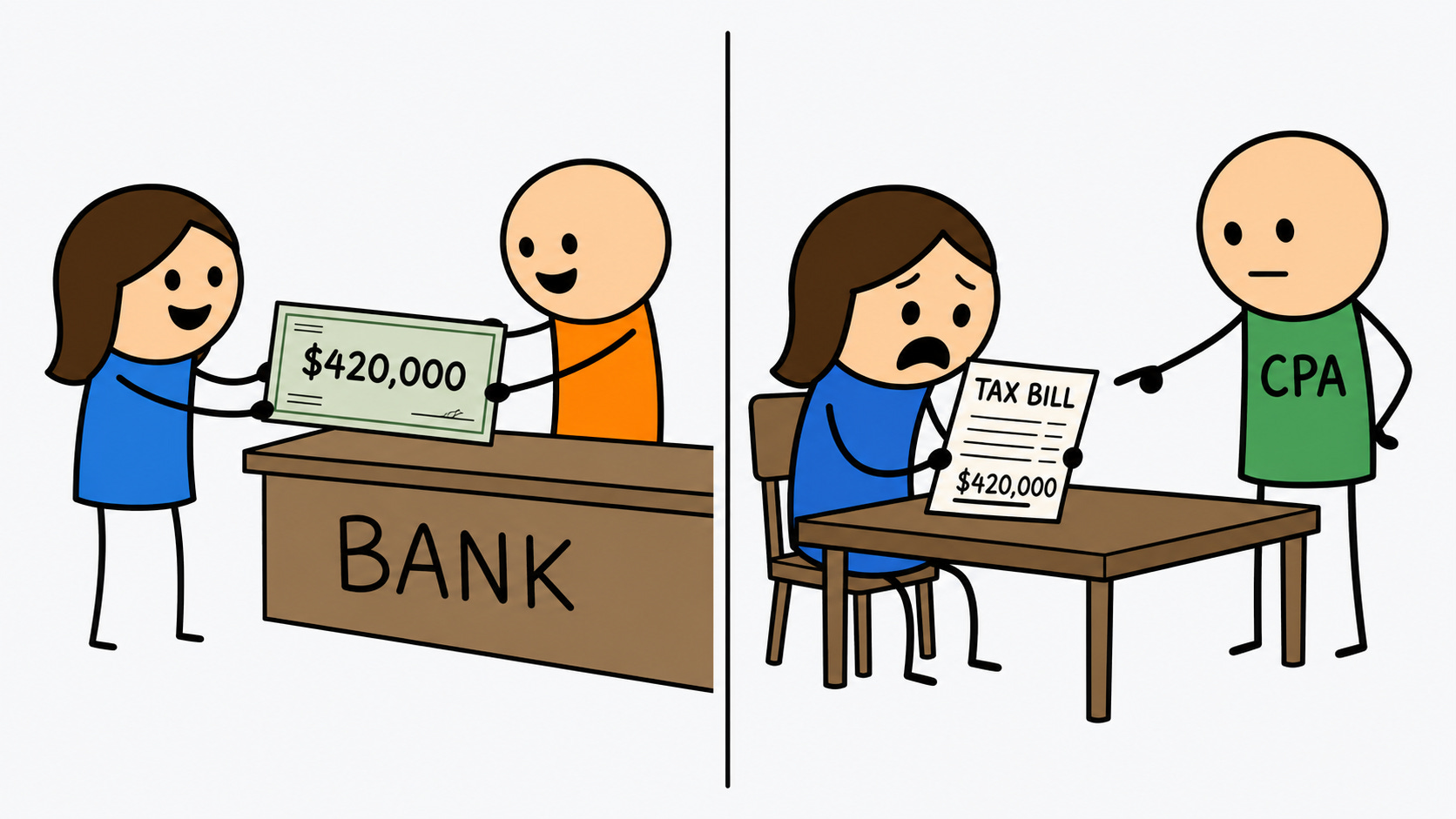
A widow walks into her late husband's bank in February to close out his accounts. She tells the teller she wants to transfer everything to her account so she can pay funeral expenses and start consolidating. The teller pulls up his $420,000 IRA, confirms her identity as primary beneficiary, and writes her a check for the full balance. She deposits it into her checking account a few days later. The 60-day rollover window started ticking the day the check was written. By April of the following year, when her CPA finally walked through the tax return, that window had been closed for months. The IRS counted the entire $420,000 as taxable income for the year. Her tax bill includes the 24% bracket she was already in, the 32% bracket she's now pushed into, and the surtax on her Medicare premiums for two years going forward. The teller didn't know there was a better way. She didn't either.
A surviving spouse has options that no other beneficiary has. A surviving spouse who inherits an IRA from the deceased spouse can roll the inherited assets into their own IRA, treating them as their own from that point forward. Children, siblings, parents, friends, trusts, and estates all have to take the inherited IRA route, with its more restrictive distribution rules.
The spousal rollover happens via a trustee-to-trustee transfer or a 60-day rollover. The trustee-to-trustee transfer is the safer path, since it never puts the funds in the surviving spouse’s name. A 60-day rollover requires the surviving spouse to deposit the full amount into their own IRA within 60 days of receiving the funds. Missing the 60-day window converts the entire distribution into taxable income.
Once the rollover is complete, the IRA belongs to the surviving spouse. Their age determines RMD timing. If the surviving spouse is younger than RMD age, no RMDs are required until they reach that age. If they’re already at or past RMD age, their own RMD rules apply going forward.
The alternative is treating the IRA as an inherited IRA (sometimes called a Beneficiary IRA). The surviving spouse leaves the IRA in the deceased spouse’s name with the surviving spouse listed as beneficiary. Distributions follow inherited IRA rules, which depend on whether the deceased spouse had started RMDs before death and the age of the surviving spouse. Under SECURE 2.0, surviving spouses gained the option to elect to be treated as the deceased spouse for RMD purposes, which can delay RMDs significantly if the deceased spouse was younger.
Disclaimer is the third path. A surviving spouse can disclaim some or all of the inheritance, allowing the assets to pass to contingent beneficiaries. The disclaimer must be made in writing within 9 months of the date of death and meet specific qualified disclaimer requirements. The disclaiming spouse cannot have received any benefit from the assets before the disclaimer.
Roth IRAs work similarly. A surviving spouse can roll an inherited Roth IRA into their own Roth IRA, treating it as their own with no RMD requirement during their lifetime.
Timing matters. The spousal rollover doesn’t have a hard deadline, but waiting too long can create complications. The IRA continues to be subject to inherited IRA RMD rules until the rollover is completed. If the deceased spouse had begun RMDs, the year-of-death RMD must still be distributed by December 31 of the year of death, even if the rollover happens after.
Tax-wise, the rollover itself isn’t a taxable event. Distributions from the rolled-over IRA are taxable when taken, just like any IRA distribution.
A 67-year-old widow inherits her late husband's $620,000 Traditional IRA. He was 74 at death and had been taking RMDs for one year. She has three options to consider.
If she rolls the IRA into her own Traditional IRA via trustee-to-trustee transfer, the IRA becomes hers. Since she's still below her own RMD age, she has years before RMDs begin on the rolled-over assets. The year-of-death RMD that her husband hadn't completed cannot be rolled over and has to come out first, before the remaining balance moves into her name.
If she keeps it as an inherited IRA in his name, her RMD calculation uses either her single life expectancy or her election to be treated as her husband under SECURE 2.0. Since he was older than her, the election option doesn’t help. She’d take inherited IRA RMDs based on her own life expectancy starting the year after his death.
Run the same scenario with a younger widow. She’s 45 when her 50-year-old husband dies. He hadn’t started RMDs. If she rolls into her own IRA, she can’t access the funds without the 10% early withdrawal penalty until she turns 59½. If she keeps it as an inherited IRA, distributions are penalty-free regardless of her age, although inherited IRA distribution rules then apply.
A common solution for younger surviving spouses: keep the IRA as an inherited IRA temporarily for penalty-free access if needed, then roll it over to her own IRA later when she no longer needs early access. The rollover can happen years after death.
The IRA doesn’t disappear when a spouse dies. The surviving spouse has more options than any other inheritor, and the right option depends on age, current RMD status, and short-term cash needs.
What matters in the days and weeks after a death is to avoid the worst path: a lump sum distribution to the surviving spouse’s checking account, which converts the entire balance into taxable income for one year and forces the surviving spouse into brackets they’ll never want to revisit.
Take the time to evaluate the options before taking any action. The IRA isn’t going anywhere. The IRS gives surviving spouses more flexibility on this than almost any other tax decision they’ll face.
I write one of these every day, one retirement rule, explained in plain language and verified against the source. The daily email is free: subscribe here.
Full archive, worksheets, and search live at RetirementNewsRundown.com.
Disclaimer This article is for educational and informational purposes only. It is not tax, legal, or financial advice and does not create an advisor–client relationship. Always consult appropriate professionals regarding your specific situation.